

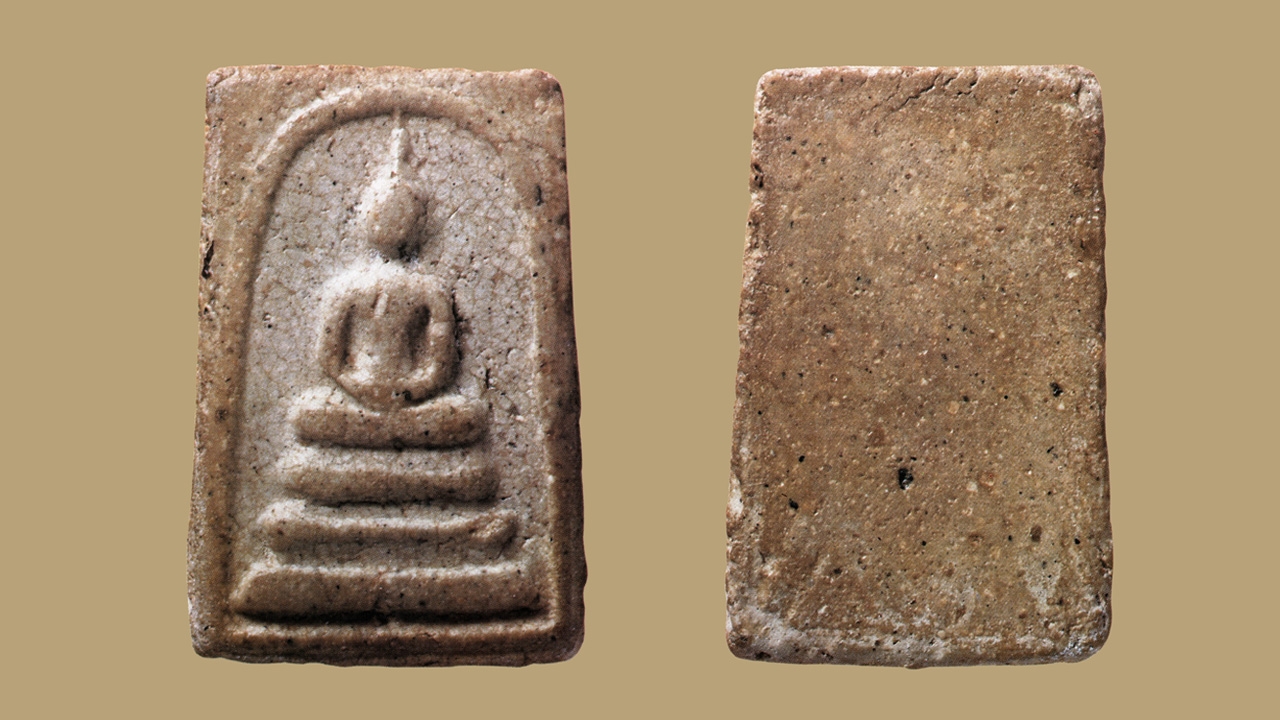
An important step in making Phra Somdej Wat Rakang is preserving the surface to prolong the wear resistance of the statue's texture for hundreds of years. After the Buddha image is molded and its edges trimmed into the classic rectangular shape, it is dried in the sun for about 3-4 days (according to the book “Oil Plaster and Various Oils” by Thiti Hatthakit, Fine Arts Department, published in 2021). Then, the surface is coated with materials that protect it from wear caused by use—contact with water, sweat, or even saliva when held in the mouth. Preservation methods include applying lacquer, which comes in several types such as black lacquer and clear lacquer (some sources mention using herbal water, betel juice, or certain tree saps). Some statues may also have gold leaf applied and red enamel filling.
Ajarn Prakit Limsakul, also known as Phlai Chumphon, of Thairath newspaper, explained that nearly all Phra Somdej Wat Rakang made by Somdej To have lacquer applied. Over time, this lacquer usually peels off almost entirely, making it difficult to observe. A way to identify genuine Phra Somdej that has undergone lacquer coating, known as the lacquer patina theory, is as follows: “An original, complete statue should be carefully preserved. For statues that have been used and stored for a long time, appearing somewhat faded, if uncertain, a simple test is to dip it in warm water. The warm water draws out the lacquer patina as red flakes. When the water dries, the red patina fades or partially remains, adding charm and color to an otherwise pale statue.”
In the first volume of "Prirotthabai Lang Phra Kherng" (Explanatory Notes on Amulets), Triyampawai discusses the lacquer and gold leaf finishing on Phra Somdej, citing a record by Mr. Kanok Satchukorn who interviewed Phra Thammathaworn, a close disciple of Somdej To: “While creating the Phra Somdej, villagers from Thong Ti Thong Road often invited Somdej To to preach and brought large amounts of gold leaf as offerings. Somdej To then applied clear lacquer and some gold leaf to the statues. The gold leaf was not selectively applied to special pieces but depended on the amount of gold leaf offered at the time. Most Phra Somdej were not gilded because the gold leaf supply was far less than the number of statues.”
Regarding the gold with red enamel filling technique, (applying red enamel between gold coatings, as defined by the Royal Institute Dictionary, synonymous with ‘roeng chad’ [red groove] ) Triyampawai states that a confirmed example is the ‘Bodhi Leaf’ mold, of which Somdej To applied gold with red enamel filling on some pieces and coated the back with lacquer to attach them to wooden boards. Historical evidence shows that people in the past used lacquer as an adhesive to fix Buddha images onto wooden frames by carving a groove slightly larger than the statue, pouring black lacquer into it, then placing the statue. When the lacquer dried, the statue was firmly attached.Details include: “Phra Somdej of this mold from Wat Rakang are often coated with clear lacquer or gold with red enamel filling, with lacquer traces on the back attaching them to wooden boards. Each board holds about 20 statues, intended for decorating a ubosot or another location, though it is unclear. Before any such use, Somdej To passed away. Later, a wealthy man named Suan Khun Ban Huai K.K. during King Rama V’s reign (different from another wealthy man named Hong) obtained one such board with Phra Somdej from Wat Rakang and affixed it to his house’s gable for good fortune, out of deep respect for Somdej To. After his death, the family dismantled the house and donated the board to Wat Chakrawat. Attempts to remove the statues from the board caused damage due to the strong lacquer adhesion. Eventually, a new method was devised: cutting the wooden board along the statue edges and sanding the back and sides to reduce thickness and bulk. Thus, these Phra Somdej, after thinning the board, reveal three layers from the side: the white or gold-coated statue, the black lacquer used to attach it to the board, and the wooden board itself.”

Triyampawai also explains how to recognize Phra Somdej Wat Rakang that have undergone lacquer coating, gold leaf finishing, and gold with red enamel filling:
“Early lacquer and gold leaf applications were thin layers that, once peeled from the statue’s surface, allowed the lacquer’s color to seep beneath the surface if the texture was soft, darkening the statue. Old lacquer and gold leaf fragments remaining in crevices enhance the statue’s appearance. On firm textures, lacquer penetrates crack patterns known as lacquer striations (soft textured statues rarely show these cracks). This creates a pattern of translucent white alternating with dark patches and reddish lacquer striations, known as ‘proroy’ patterns.”
“Gold with red enamel filling resembles old lacquer and gold leaf but the peeling of old red enamel is less frequent, and the enamel layer is usually thicker. Soft textured statues (like Bodhi Leaf mold) typically do not show crack patterns, but areas where the enamel flakes off absorb the red enamel color similarly.”
Ajarn Prajam U-Arun, a senior Phra Somdej expert, explained: “Most lacquer used to preserve statue surfaces is imported from China. Initially black, it was mixed with expensive red pigment also from China, producing a ruby color. Lacquer artists are familiar with this pigment. Good lacquer dries slowly. Before applying gold leaf, a thick black lacquer base is applied and allowed to dry, followed by a clear lacquer coat. Clear lacquer is often used as a primer before gold leaf. Black lacquer is thick and viscous; if gold leaf is applied on thick black lacquer, the gold sinks into the lacquer layer. Lacquer and gold leaf applications from Wat Bang Khun Phrom usually cover only the statue body up to the base, leaving the arch and base uncoated, and are applied before enshrining; these are rare. Wat Rakang’s statues are usually gilded afterward, applied to the gold leaf surface.”
“The Science of Phra Somdej” suggests a simple initial method to examine old lacquer, gold leaf, or red enamel layers is to compare them with other old statues whose lacquer ages are known, then study similarities with the Phra Somdej under consideration.
Most Phra Somdej Wat Rakang have lacquer applied to preserve the surface, making them durable against wear from use and enabling them to last for hundreds of years. Ajarn Prakit Limsakul’s “lacquer patina theory” is very helpful in examining authenticity. Some Phra Somdej also have gold leaf applied after lacquer or even gold with red enamel filling. The evaluation methods by various teachers, as described above, are very valuable in authenticating genuine Phra Somdej of Somdej To based on forensic principles.
Read more on the Facebook page “Phra Somdej Science” by Police Lieutenant Colonel Komsan Sanongphong. Thanks to Assistant Professor Rangsarn Torsuwan for kindly providing photos of an exemplary Phra Somdej Wat Rakang statue for educational purposes. Thanks also to the current owner of this statue, a beautiful and nearly pristine Phra Somdej Wat Rakang in the Chedi mold, which is a master piece. It has a slightly brownish-white tone, firm texture, surface crack patterns from lacquer application (soft textured statues usually do not crack), remaining lacquer in crack lines (showing authenticity per Triyampawai's text), visible relic granules, needle-like pores, distinctive wormholes typical of Wat Rakang texture, correct mold shape per the scriptures, large split arch typical of Wat Rakang (smaller at Wat Bang Khun Phrom), smooth flat walls—a hallmark of Phra Somdej—edges trimmed exactly to mold frames, flat back with wrinkles and fissures on top, slight chipping on all four edges indicating natural aging (common in Wat Rakang). This statue serves as a good reference for studying Phra Somdej Wat Rakang. More articles are available in the “Science of Phra Somdej” column.
Author Police Lieutenant Colonel Komsan Sanongphong, former forensic police officer
Facebook page –Phra Somdej Science