

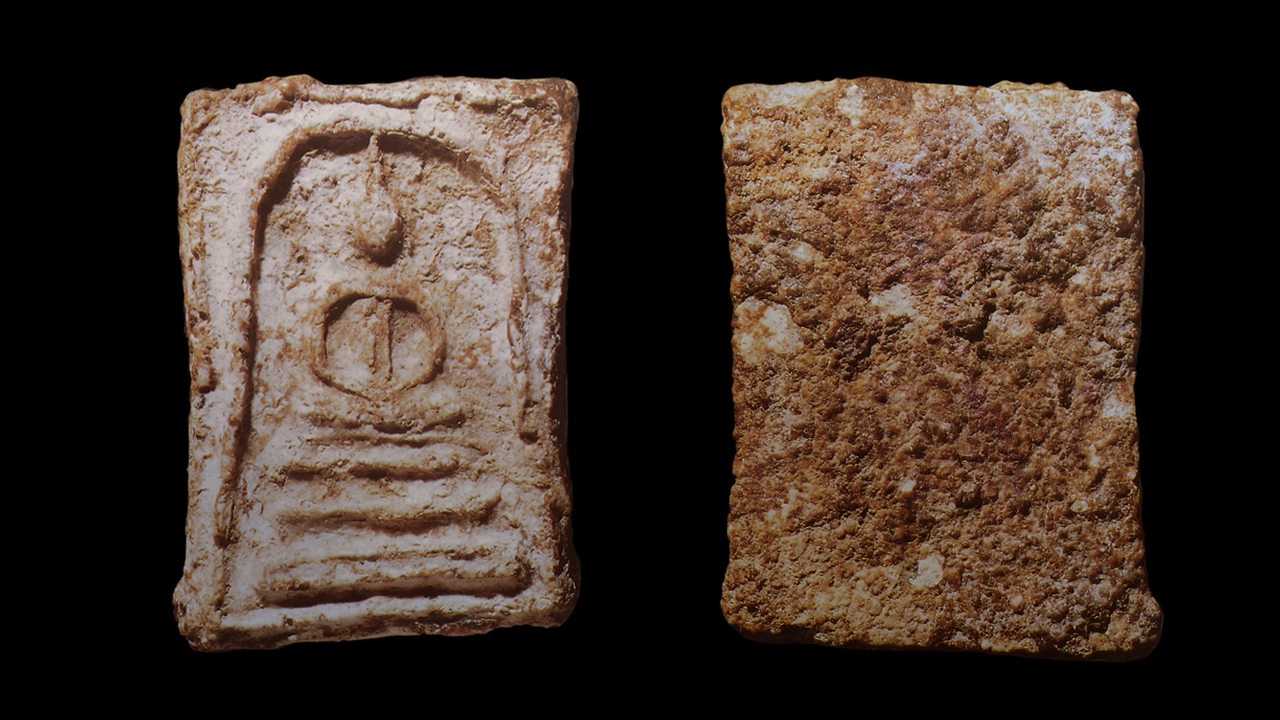
In studying the Phra Somdej amulets of Somdet Phra Phutthachan (Toh Prommarangsi), researchers often observe two significant surface marks. The cracked edge mark. . The flared edge mark. The cracked edge is usually found along the back edge of Phra Somdej Wat Rakang amulets and is rarely seen on Phra Somdej Wat Bang Khun Phrom amulets. In contrast, the flared edge, characterized by material lifting up, is commonly located on the front edge of Phra Somdej Wat Bang Khun Phrom amulets but is not present on Wat Rakang amulets.
It can be said that both cracked and flared edges are important distinguishing features of Somdet Phra Phutthachan's Phra Somdej amulets. However, their absence does not imply a fake amulet. Many Phra Somdej Wat Bang Khun Phrom amulets do not display flared edges, while numerous Wat Rakang amulets lack cracked edges.
An interesting question arises as to why these cracked and flared edges appear in those specific areas of the amulets. To clarify this, “The Science of Phra Somdej” will explain key steps in the creation of Phra Somdej amulets as follows.
In the creation of Phra Somdej Wat Rakang amulets, after pressing the amulet material onto the mold is complete (some say the mold is pressed onto the material, but considering the finely carved soapstone mold and the discovery of similar ancient molds in art, the mold likely holds multiple amulets on one stone slab, so it is inferred that the material is pressed onto the mold). Then the edges are trimmed with sharp tools like chisels or knives (citing the Triyampawai text). Senior expert Ajarn Prajam O-Arun stated that edge cutting can be done either from the front of the amulet toward the back or from the back toward the front. Cutting from the back to the front likely occurs while the amulet is still attached to the mold (the mold may have guide grooves for the blade). If the cutting tool is dull and the material is slightly moist, the back edge may show parallel cracked lines along the edge (sometimes appearing as cracked streaks extending outward), also called "crab tracks." (Some texts say "crab tracks" can refer to marks elsewhere on the amulet surface.) These marks may appear on some or all four edges. Ajarn Prakit Limsakul, also known as Phlai Chumphon from Thairath Newspaper, explained that these marks are considered by veteran collectors a key hallmark of authentic Wat Rakang amulets' backs. (Some suggest that cracked parallel marks along the back edges can also result from cutting from front to back, where sliding the blade sideways near the edge creates flared ridges and cracks. However, “The Science of Phra Somdej” doubts this because Wat Bang Khun Phrom amulets clearly cut from front to back do not show such cracked edges, especially when their material closely resembles Wat Rakang's.) Front-to-back cutting is done after removing the amulet from the mold, producing cleaner cuts since the mold's guide lines are visible.
Regarding Phra Somdej Wat Bang Khun Phrom amulets, their production mostly involves pressing newly carved wooden molds, cut to frame size, onto prepared amulet material sheets laid below for efficiency in mass production. When the wooden mold is lifted, the material touching the mold's sides pulls up, creating the characteristic flared edge seen on these amulets. Some Bang Khun Phrom amulets lack flared edges, possibly due to trimming the edges narrowly, removing the flare, or using Wat Rakang molds that press material onto the mold instead.
The direction of edge cutting can sometimes be deduced from side edge scratch marks. Especially in Wat Rakang amulets, which contain many coarse particles, the direction of particle scratches indicates cutting direction. Nirunam of Precious magazine, under Assistant Professor Rangsarn Tosuwan, explained that Wat Rakang amulets usually curve inward at the center front (face down, like an elephant's belly), while Wat Bang Khun Phrom amulets curve oppositely. “The Science of Phra Somdej” theorizes this difference arises from mold removal: Wat Rakang amulets are pulled upward from the mold's sides, sometimes leaving slight finger impressions, suggesting side prying. This likely corresponds to cutting edges while still on the mold from back to front. Conversely, Bang Khun Phrom amulets curve the other way, consistent with pressing wooden molds onto flat material sheets, which lifts side material more than the center, matching the flared edge phenomenon.
when authenticating Phra Somdej amulets with forensic principles, cracked edges (found on the back edges of Wat Rakang amulets) or flared edges (found on the front edges of Wat Bang Khun Phrom amulets) as explained are not exclusive features that must appear on every standard amulet of Somdet Phra Phutthachan. However, “The Science of Phra Somdej” regards these two characteristics as important identifiers, which, combined with other amulet features and related information, can aid in verifying authentic Somdej amulets. The case of Phra Somdej Wat Ket Chaiyo will be presented in due course.
For more information, follow the page Phra Somdej Science. By Police Lieutenant Colonel Komsan Sanongpong, with thanks to Assistant Professor Rangsarn Tosuwan for kindly providing images of a master-class Phra Somdej Wat Bang Khun Phrom amulet for educational purposes, and gratitude to the current owner. This amulet is a beautifully preserved Bang Khun Phrom Phim Sangkhati type without clear ears (or barely visible). The Sangkhati mold is among the most common Bang Khun Phrom types, alongside the Sen Dai mold. The amulet has thick temple dust covering front and back, pale yellowish-white color, mold shape matching references, sharp and full impressions, distinct flared edges on three sides except the bottom, which often shows flares on Bang Khun Phrom amulets. It is somewhat warped, likely from handling while still soft; some flares overlap the mold frame lines. The back is smooth, typical of most Bang Khun Phrom amulets, with brownish stains resembling soy sauce oil rising. Edges are neatly trimmed on three sides, except the bottom, where trimming extends beyond the mold frame and flared edge. This amulet serves as an excellent study model for Bang Khun Phrom amulet research.
Written by Police Lieutenant Colonel Komsan Sanongpong, former forensic officer.
Facebook page –Phra Somdej Science.