

The ancient Thai custom of creating Buddha amulets is said to have been intended to perpetuate the Buddhist religion permanently. Large quantities, such as 84,000 pieces matching the number of Buddhist scriptures, were produced and then buried or placed inside stupas. The belief was that even if the sacred stupas were to deteriorate in the future, anyone who uncovered these amulets would see the Buddha image and be reminded of Buddhism, ensuring its continuation. One reason Somdej Phra Buddhacharn (Toh Prommarangsi) initiated the creation of Phra Somdej amulets was his desire to follow the ancient practice of great monks who made amulets to be placed inside sacred sites to sustain Buddhism. He produced many Phra Somdej amulets, especially at three temples with well-documented histories: Wat Rakang, Wat Bang Khun Phrom (Wat Mai Amataros), and Wat Kesai Chaiyo.
It is intriguing to question whether the Phra Somdej amulets made at each of these temples were created specifically to be placed in stupa caches or solely for distribution without caching—or possibly both. At this time, “The Science of Phra Somdej” wishes to present information and perspectives that might differ somewhat from past discussions, aiming to benefit the academic study and forensic authentication of Phra Somdej amulets.
Regarding the case of Phra Somdej from Wat Rakang, Somdej Phra Thamtheeraratmahamuni (Thiang Akkathammo, Pali Scholar Level 9), former abbot of Wat Rakang, recounted the story of the Phra Somdej caches in his book "The Legend and Origins of Phra Somdej Amulets," first published in 1976 CE (B.E. 2519) when he held the monastic title Phra Sri Wisutthisophon. He stated:
"...Wat Rakang has six caches of Phra Somdej amulets... The first cache, is the prang built in the early Rattanakosin period. King Rama I had great devotion and contributed to its construction alongside the Senior Grand Princess Somdet Krom Phraya Thepsudawadi. Caches 2, 3, 4, and 5 are the four corner stupas to the northeast, east, south, and northwest of the ubosot. Cache 6 is located at the rear of the temple, about 20 wa (approximately 32 meters) west of the ubosot wall. Each prang and stupa is hollow inside, shaped following the outer structure, resembling an underground chamber or tunnel in a mountain without ventilation openings. The prang has a special chamber with a door and stairs on the east side, about 10 meters above ground level. The upper special chamber's floor once had a shaft about one foot square opening down to the lower cache, though it is unclear if this was original or added later. Later, Somdej Toh placed some Phra Somdej amulets into the prang cache through this shaft (Somdej Thiang also mentioned the ancient practice of "dropping amulets" through this shaft, a method apparently unique to Wat Rakang, which was later sealed with cement, and similarly practiced at Wat Mai Amataros or Wat Bang Khun Phrom)..."
The four corner stupas of the ubosot reportedly held Phra Somdej Pilant amulets made by Somdej Phra Buddhabat Pilant in all four locations. The northwest stupa also contained other types of amulets, such as a few of Luang Pho Pop. The rear stupa, constructed identically to the corner stupas, contained Phra Somdej made of sacred powder from pencil trees. All these caches belonged to Somdej Phra Buddhacharn, with a few pieces of jewelry and silver or gold mixed in, likely offerings from ceremony participants.
To place the Phra Somdej amulets inside the stupas, Somdej Phra Buddhacharn used crossed wooden slats arranged in a checkerboard pattern and nailed tightly. Then, he laid the amulets in rows stacked up nearly to the stupa's top. Some were stored inside ancient jars stacked together. Over the centuries, the powder coating on the outside of the amulets lost its binding moisture, causing it to flake off and accumulate on the cache floor, called “powder from the cache.” In old prangs or stupas, this is known as “powder from ancient caches.” Other ancient sites follow similar methods. This account uses Wat Rakang as an example due to close familiarity. Because of detailed knowledge about it, " (In Somdej Thiang's book, several individuals who had historical ties to Wat Rakang are named as informants, such as Phra Thep Sitthinanayok (Luang Pu Nak), former abbot of Wat Rakang; Luang Pho Khwan Wisithto, an elder of the temple; and Phra Kru Borihan Khunwat, abbot of Wat Mai Amataros at that time.)
Nevertheless, the mainstream view in the Phra Somdej community historically and currently is that the Phra Somdej amulets from Wat Rakang created by Somdej Toh were made on various occasions but were not placed in caches. “The Science of Phra Somdej” believes this consensus exists because the master amulet forms, also called the Luang Wijarn Janai style, show no signs of cache residue—except for the two Khlong amulets placed in Wat Bang Khun Phrom's cache. This might be because Somdej Toh made the amulets for immediate distribution. However, a question arises whether the Wat Rakang Phra Somdej amulets were once placed inside stupa caches as mentioned in Somdej Thiang's book, but were stolen shortly after, leaving no cache residue on the amulets. Somdej Thiang also stated that upon arriving at Wat Rakang, he found the stupa caches empty. Theft may have been driven by the high esteem for Wat Rakang Phra Somdej amulets during Somdej Toh's lifetime, as recorded in the biography of Somdej Phra Buddhacharn (Toh) by Phra Kru Kalyananukul (Phra Maha Heng Itthajaro), which mentions that Chao Khun Phra Ratchathamphani of Wat Rakang told acquaintances that the Phra Somdej molds had been placed in the first stupa cache at Wat Rakang, but a few days later the stupa was completely destroyed."
Regarding the case of Phra Somdej from Wat Bang Khun Phrom, the creator, the clerk Duang, invited Somdej Toh to perform consecration rituals around 1870 CE (some sources say production began in 1868 CE). The intention was to place 84,000 Phra Somdej amulets inside a large stupa. However, some Phra Somdej experts, such as Ajarn Prajam U Arun, suggest that some Wat Bang Khun Phrom amulets were produced but not cached. Triyamphawai described the caching of Wat Bang Khun Phrom Phra Somdej amulets in volume 1 of his "Explanatory Dictionary of Amulets," discussing the inside of the large stupa when it was opened in 1957 CE (B.E. 2500):
"...Inside the cache, brick partitions formed a cross-shaped wall rising vertically, creating a four-leaf clover shape. These walls not only supported and stabilized the stupa so it wouldn't tilt, but also divided the interior into four equal sections, each a cache containing vast numbers of Phra Somdej amulets. At the top of each leaf, Phra Somdej amulets were arranged continuously. Each cache section had ventilation holes (Triyamphawai noted these as openings used in the past to drop Phra Somdej amulets). The cache floor was sandy, with amulets piled directly on the sand without any container or support. There was much soil mixed in, originating from the dropping process where clay balls were molded and lowered. Around the lotus base niche inside the stupa, amulets were placed in areas unreachable by the dropping process. A corroded iron rod ran from the spire's tip down to about halfway in height; it is assumed that during the rainy season, rainwater and humidity caused rust droplets to fall onto some amulets. On the bell neck, believed to contain some Phra Somdej amulets, none were found when officials inspected."

Regarding Phra Somdej from Wat Kesai Chaiyo, the first edition of the book by Phra Kru Kalyananukul (Phra Maha Heng Itthajaro) in 1952 CE (B.E. 2495) states, "Initially, Somdej Phra Buddhacharn created 84,000 Phra Somdej amulets. The second time, he intended to make another 84,000, seven-layered type, intending to place them at Wat Chaiyo in Ang Thong province. However, he did not complete the full number (the exact amount made is unknown). One day, he told Mr. Thet from Ban Thanon Dinso, behind Ban Khamin market in Thonburi, that he would not be able to finish because he expected to pass away soon. So, he combined amulets made during the first batch with those from the second batch to reach 84,000 pieces. They were then placed inside the stupa at Wat Chaiyo. Soon after, he passed away. Because of this, most of the Wat Chaiyo cached Phra Somdej amulets are of the seven-layered type." (This account about placing Phra Somdej amulets at Wat Chaiyo aligns with Triyamphawai's references to credible sources, though some minor details differ.) Phra Kru Kalyananukul's book also mentions, "Chao Khun Phra Maha Phutthapimaban (Wor), abbot of Wat Chaiyo, said that years ago, when the stupa containing Phra Somdej amulets collapsed, he collected the amulets and placed them at the base of the large Buddha image inside Wat Chaiyo's viharn." Ajarn Prakit Limsakul, also known as Phlay Chumphon from Thairath newspaper, stated that the "Khaeng Mon" mold is a popular style among local villagers near Wat Chaiyo Worawihan since ancient times. However, several Phra Somdej experts claim that Wat Kesai Chaiyo amulets were not cached. Some say no cache openings have been found on the large Buddha image, while others report faint cache residue. “The Science of Phra Somdej” infers that non-cached Wat Kesai Chaiyo amulets often have their edges filed to reduce sharpness.
Closing Remarks
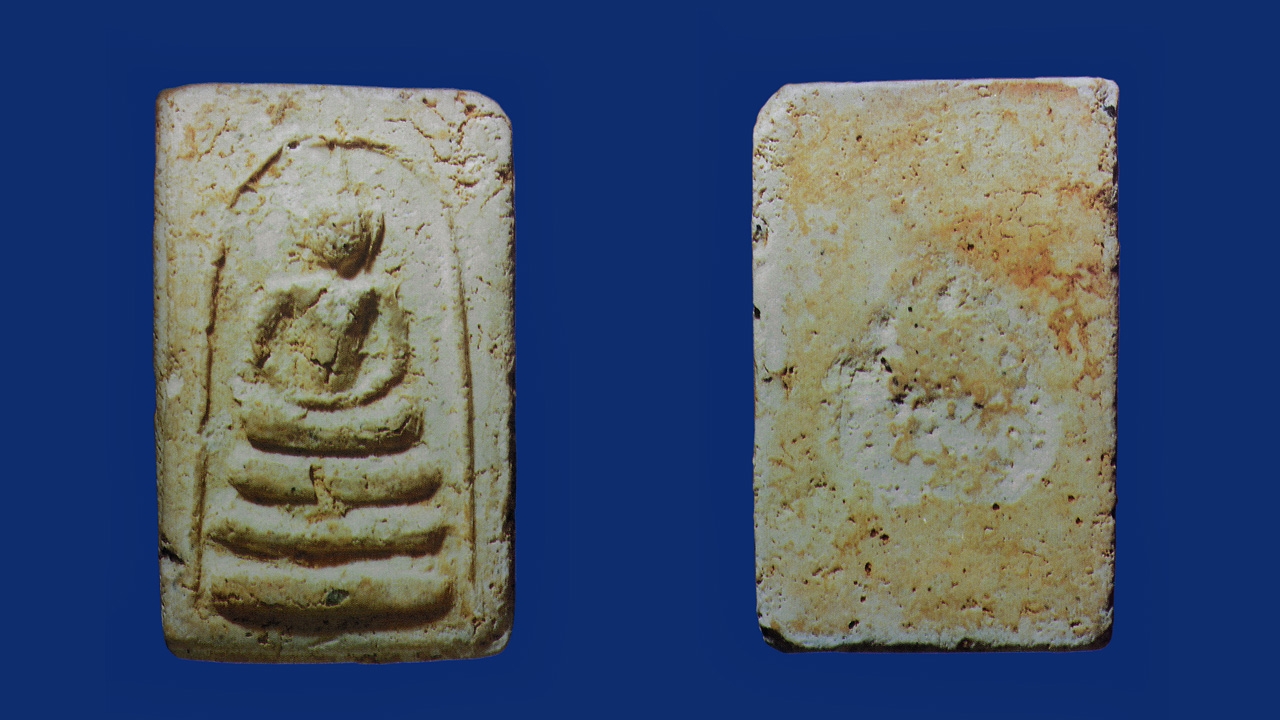
For further reading, visit the Facebook page “Phra Somdej Science” by Police Lieutenant Colonel Komsan Sanongphong. Thanks are extended to Assistant Professor Rangsarn Tosuwan for kindly providing images of a master example Phra Somdej from Wat Bang Khun Phrom to aid knowledge, and to the current owner of this particular amulet, which is a beautiful Wat Bang Khun Phrom Phim Sia Bat Ok Krut mold. The amulet shows signs of use with cache residue covering both front and back, a white-yellowish tone, correct mold shape per texts, and a distinctive feature of lacking a clear lower arch line. The edges are sharp but the flared edges typical in Wat Bang Khun Phrom amulets are not prominent. The back is smooth with an impression resembling a Bodhi leaf in the center, worn from use, with brown oil-like stains and wrinkles. This serves as a good prototype for studying Wat Bang Khun Phrom Phra Somdej amulets.
Author
Police Lieutenant Colonel Komsan Sanongphong, former forensic police officer Facebook page –
Phra Somdej ScienceRead the column