

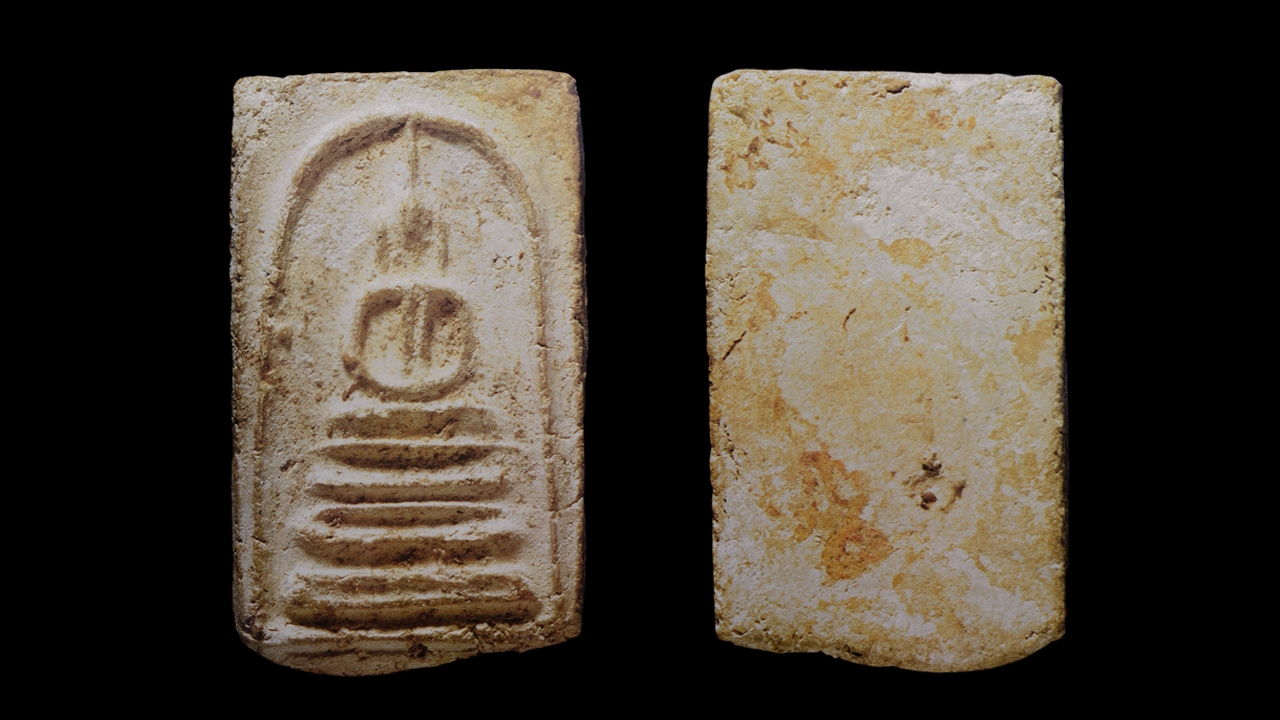
Phra Somdej amulets by Somdet Phra Phutthachan (Toh Prommarangsi) come in a variety of mold designs. It is intriguing to consider how the standard molds handed down to the present, especially the standard types, have evolved or unfolded over time. Understanding this can be useful for deeper studies of Phra Somdej amulets.
The “Science of Phra Somdej” once presented reliable information, especially from authoritative textbooks on Phra Somdej, such as those by Triyampawai and Phra Kru Kalyananukool (Phra Maha Heng Itthajaro). They suggest that early rectangular-frame Phra Somdej amulets (starting around 1866 CE), which before then were often modeled after ancient amulet molds, mostly had 5-, 6-, or 7-tier bases. These represented the Buddha performing all postures and are now called Phra Somdej Wat Kes Chaiyo. Later rectangular-frame Phra Somdej amulets mostly featured 3-tier bases, often showing a complete Buddha image symbolizing enlightenment. There is clear evidence that Somdet Toh created nine standard molds, which Triyampawai calls royal critique molds. These later groups usually refer to Phra Somdej Wat Rakhang and Wat Bang Khun Phrom.
There is little detailed discussion about the characteristics of the 5-, 6-, and 7-tier rectangular molds. However, Triyampawai mentioned in his 1964 book "Applied Amulets" that the rectangular mold signifies the "Four Noble Truths," and the 3-tier base symbolizes the "Triple Gem." The initial rectangular molds were said to have been carved and offered by “Nai Thet” (believed to be Somdet’s nephew) who lived on Dinso Road, marking the first phase, which is understood to be... the Thread Pattern mold, the Double Base mold, and the Sangkhati mold. Among others. Regarding the Garuda Head mold, it is believed that Somdet Toh himself created this design. Later, a royal from the Rear Palace, working in the royal crafts department, adapted and improved the design to be more beautiful than before. Ultimately, Luang Wicharn Chianai, a royal goldsmith under King Rama IV, carved the mold, producing a highly artistic design with fully integrated ancient art features.
In the same book, Triyampawai also discussed the creation of Phra Somdej at Wat Bang Khun Phrom in 1870 CE, noting that Somdet Toh performed the amulet-making ceremony at Wat Intharaviharn and then enshrined the amulets in the main stupa of Wat Mai Amataros. Due to the need for large quantities, molds from Wat Rakhang’s rectangular types were used, even some discontinued molds like... the Thread Pattern and the Double Base molds, were included.

It is interesting that the ancient molds with 5-, 6-, and 7-tier bases (possibly first carved by Nai Thet), as well as the 3-tier base molds from Wat Rakhang such as the Thread Pattern, Double Base, and Sangkhati—carved by Nai Thet (and likely a group of local craftsmen)—including the Garuda Head mold believed to be designed by Somdet Toh, all influenced the design or evolution of standard Phra Somdej molds. This evolution involved royal craftsmen and goldsmiths who later helped design standard molds for both Wat Rakhang and Wat Bang Khun Phrom.
Phra Somdej with the Thread Pattern mold and the Garuda Head mold are rectangular 3-tier bases showing the Buddha’s complete enlightened form, a concise Buddhist art style, and symmetry similar to the ancient 5-, 6-, and 7-tier base molds. However, some subtypes of the Thread Pattern mold found today show design influences with the Buddha figure tilted slightly right, as seen in the popular 7-tier mold from Wat Kes Chaiyo and the large standard mold from Wat Rakhang, likely designed by the same group of craftsmen late in the period, including royal goldsmiths. The Double Base mold (including the Sam Base mold) and the Sangkhati mold are rectangular 3-tier bases influenced heavily by the older 5-, 6-, and 7-tier molds depicting the Buddha’s various postures, such as the floating sitting posture and more artistic details like the Sam lines and ear decorations. Other 3-tier molds usually show the Buddha sitting with weight resting firmly on the base, which compresses to support the figure.
It is also possible that the Sam Base molds from both Wat Rakhang and Wat Bang Khun Phrom were adapted designs derived from Wat Bang Khun Phrom’s Double Base mold.
An anonymous writer for the Precious magazine, under Assistant Professor Rangsarn Tosuwan, discussed a key distinguishing flaw clearly separating Wat Bang Khun Phrom’s Sam Base mold from the Double Base mold as follows:
“The two robe lines running up and touching both sides of the chest curl inward toward the center (chest). This mold flaw clearly differs from Wat Bang Khun Phrom’s Sam Base mold, where the two robe lines spread outward toward the armpits on both sides when reaching the chest of the Buddha image. In contrast, the Double Base mold’s robe lines run straight up to meet the chest lines only. Moreover, in the clearly defined Wat Bang Khun Phrom Double Base mold, the chest lines running from both shoulders are higher than the robe lines that meet the chest.” The anonymous writer also noted that Wat Bang Khun Phrom’s Double Base mold has only one subtype and that no Double Base mold is found in Wat Rakhang amulets. Regarding the back of the amulet, there are two types: a smooth back, which accounts for over 90%, and a few with a textured back.
Ajarn Prakam U-Arun, a senior amulet expert, observed that Wat Bang Khun Phrom’s Double Base mold amulets have smaller heads, faces, and overall Buddha figures compared to the Sam Base mold. He also noted from his long experience collecting Phra Somdej amulets since before 1957 CE that he has seen all types of Wat Bang Khun Phrom amulets made from Wat Rakhang clay.
Regarding other standard molds such as the Chedi mold, Lotus Bud mold, and Bodhi Leaf mold, these too likely evolved or unfolded from earlier molds. Ajarn Prakit Limskul and Plai Chumphon of Thairath Newspaper have discussed these details interestingly in the “Miracles from the Amulet Shelf” column.
Studying the evolution or unfolding of Phra Somdej molds is useful for authenticating genuine amulets by Somdet Toh. It is intriguing that molds such as the Thread Pattern, Double Base, and Sangkhati from Wat Bang Khun Phrom encountered today might be molds originally from Wat Rakhang carved by Nai Thet (and local craftsmen) as Triyampawai mentioned in his book “Applied Amulets,” or newly carved molds used specifically for Wat Bang Khun Phrom amulets later (carved by the same craftsmen who made standard Wat Rakhang molds), or even produced by other groups. Ultimately, the key indicator of authenticity is the amulet’s clay, which should be similar across all groups, isn't it?
For more information, visit the "Phra Somdej Science" Facebook page by Police Lieutenant Colonel Komsan Sanongpong. Thanks to Assistant Professor Rangsarn Tosuwan for generously providing photos of an exemplary Wat Bang Khun Phrom master amulet for educational purposes. This particular amulet is a beautiful Wat Bang Khun Phrom Double Base mold, well-covered with residue, clean pale yellow color, accurate to textbooks, complete, featuring the distinctive three-tier double base lines that give the mold its name. The two robe lines run straight up to the chest line (unlike the Sam Base mold where the robe lines flare toward the armpits). The head and body are smaller than the Sam Base mold. The edges show a slight raised rim, often found in Wat Bang Khun Phrom amulets. The back is smooth with clean edges except for the bottom edge. This is an excellent model for studying Wat Bang Khun Phrom amulets.
Author Police Lieutenant Colonel Komsan Sanongpong, former forensic police officer
Facebook page –Phra Somdej Science