

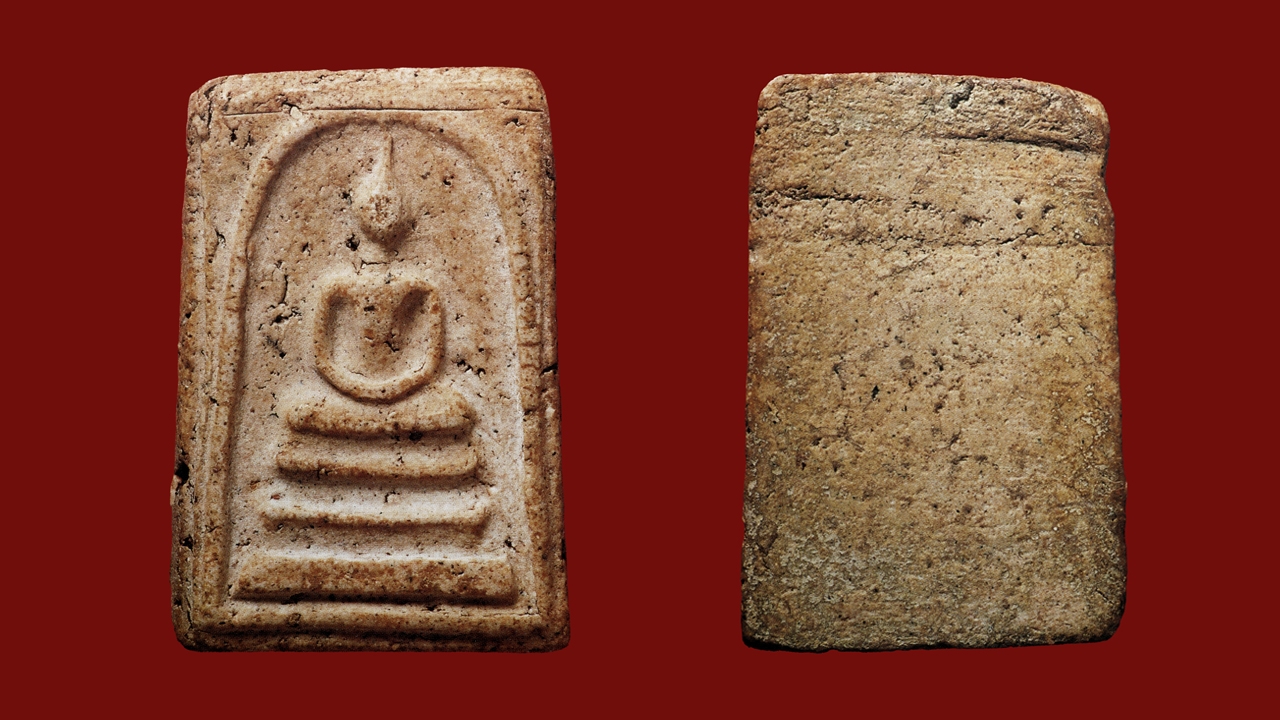
The most valuable plaster material in the world today is the sacred substance of the Somdej amulet made by Somdej Phra Phutthachan (Toh Prommarangsi). It is interesting to consider when these Somdej amulets first began to gain value and why. Currently, “The Science of Somdej” presents an in-depth look at the historical and present valuation of Somdej amulets.
The first volume of “The Explanatory Book of Amulets” by Triyamvaya states, “The Somdej amulet is the fastest gaining renown, becoming famous within just one year after the passing of its creator. It has remained highly sought after by many up to this day, showing no signs of decline in popularity. This is truly a remarkable and extraordinary case.”
Triyamvaya’s book also discusses the past prices of Somdej amulets from Wat Rakang, noting that shortly after the passing of the venerable Somdej, a Khmer monk who was his disciple took some Somdej amulets and stored them on the ceiling of a small chapel, intending to later mount and decorate them on wooden panels in Wat Rakang’s ordination hall as the Somdej had wished. However, before this could be done, villagers took all the amulets away. Early takers took two handfuls each. As the supply dwindled, people began to rent and worship the amulets at Wat Rakang. Their value was one tamlueng (a traditional Thai weight unit) per amulet. .
A key reason for the rising rental and purchase price of Somdej amulets in the past likely originated from the first excavation of Somdej amulets at Wat Bang Khun Phrom in 1882 (B.E. 2425). This was fueled by the reputation that Somdej amulets could cure illnesses during a major epidemic. In 1873 (B.E. 2416), one year after the passing of Somdej Phra Phutthachan, a severe cholera epidemic, known as the “Year of Great Disease,” caused many deaths. People reportedly soaked Somdej amulets in water to make holy water for drinking to cure the disease, and many recovered miraculously. This led to strong demand for Somdej amulets, including those from Wat Rakang and Wat Bang Khun Phrom, causing their market prices to soar. Consequently, there was also a rise in counterfeit Somdej amulets from that time onward.
Triyamvaya’s book also mentions the prices of Somdej amulets from Wat Bang Khun Phrom during the second excavation in 1893 (R.S. 116), when France invaded Thailand. People prepared to defend the nation and sought Somdej amulets for protection. At that time, the rental price reached as high as 20 baht per amulet. (Prices for renting or purchasing Somdej amulets fluctuated with demand over time. The 20 baht price was very high then, likely reflecting great demand.)

The third excavation occurred in 1907 (B.E. 2450) and was a large, prolonged dig lasting several months. Initially, only bricks were found, but later water was poured in large amounts to loosen the amulets attached to the clay at the base of the main chedi. Eventually, many amulets were recovered.
Thieves attempted to illegally excavate Somdej amulets from Wat Bang Khun Phrom continuously but usually failed because the chedi structure was very sturdy. Triyamvaya recorded two major successful illicit digs only 10 days apart in October 1957 (B.E. 2500), yielding over 1,000 amulets. He also noted in his first volume of “The Explanatory Book” that he once rented a Somdej amulet recovered from these illicit excavations from a dealer for 700 baht. The amulet was a double base mold.
Rangsan Tosuwan, assistant professor and editor of the Precious magazine, once said, “Around 1927 (B.E. 2470), Wat Bang Khun Phrom, now called Wat Mai Amataros, allowed the public to fish for Somdej amulets by purchasing a rope from the temple for one baht each — a considerable sum then, as civil servants earned only three baht a month. People tied clay to the end of the rope, lowered it into the chedi, struck it, then pulled it up to find amulets.”
The practice of searching for Somdej amulets around 1947–1952 (B.E. 2490–2495) was described by Chantichai (Chantich Kraesin) in the 1966 (B.E. 2509) fourth edition of the biography of Somdej Phra Phutthachan (Toh), originally published in the “Police” magazine in 1951 (B.E. 2494). He explained that although Somdej created 73 different mold types, people widely revered only four main types from four temples at that time: Wat Rakang, Wat Mai Amataros (known as Somdej Bang Khun Phrom), Wat Chaiyo, and Wat Intrawiharn. Specifically, Wat Rakang produced four popular molds: 1. Large base with three tiers, 2. Chedi base with three tiers, 3. Ear-flared mold with a stepped base (both grooved and smooth chest types – likely including the stepped base and lotus bud molds), and 4. Bodhi leaf canopy mold with three tiers. These four molds were very popular and had market prices ranging from 1,000 to 4,000 baht per amulet.
The book “Good Things from the Temple,” published in 1967 (B.E. 2510) by Thepchu Thapthong, a prominent Rattanakosin historian and former columnist for Thairath, described the rental prices of Somdej amulets from Wat Bang Khun Phrom during the major excavation of 1957 (B.E. 2500) as follows:
“After excavating the Somdej amulets from the chedi, the temple allowed the public to rent them for donations, with prices ranging from a high of 3,500 baht per amulet to a low of 400 baht, depending on the amount of encrustation from the chedi. There were four tiers, from special down to the third tier, raising a total of 1,400,000 baht...”
Large base mold Similar in shape to Wat Rakang’s but with a shallower mold. The special tier rented for 3,500 baht each; first tier 3,000 baht; second tier 2,500 baht; third tier 1,500 baht.
Chedi base mold Also similar to Wat Rakang’s but shallower and more elongated, with smaller Buddha body, base, and arch. The special tier rented for 2,200 baht; first tier 2,000 baht; second tier 1,500 baht; third tier 800 baht. Triyamvaya noted some unique molds with deep relief and elegant form, with sharp axe-shaped lion bases resembling Wat Rakang’s style, sometimes more robust. The arch lines were thick and prominent.
Lotus bud mold Had a value close to the large base mold. The special tier rented for 3,500 baht; first tier 3,000 baht. Similar to Wat Rakang’s but some molds were shallower. Triyamvaya mentioned some molds with large, thick heads and pointed tops, robust like beautiful U-Thong period Buddha statues.
Stepped base mold Similar to Wat Rakang’s but more elongated, with deeper grooves on the sanghati (monk’s robe) and two types: grooved chest and smooth chest. The special tier rented for 2,200 baht; first tier 2,000 baht; second tier 1,500 baht; third tier 800 baht.
Thread line mold Shallow mold with shallow Buddha body, base, and arch, usually with thick chedi encrustation. The special tier rented for 2,200 baht; first tier 2,000 baht; second tier 1,500 baht; third tier 800 baht.
Double base mold, with elongated Buddha body similar to stepped base mold but with delicate thin lines. The special tier rented for 2,000 baht; first tier 1,900 baht; second tier 1,600 baht; third tier 500 baht.
Bodhi leaf canopy mold Similar in shape and form to the chedi base and grooved ear-flared stepped base molds but smaller, with narrower face. The Buddha head appeared in both rounded and elongated forms. The base types included lion base and a medium size shorter than the lower and upper bases. The special tier rented for 3,500 baht; first tier 3,000 baht; second tier 2,500 baht; third tier 1,500 baht. Triyamvaya noted only 17 known examples.
Sanghati mold Resembled the Bodhi leaf canopy mold but with very prominent sanghati. The special tier rented for 2,000 baht; first tier 1,800 baht; second tier 1,200 baht; third tier 500 baht.
Garuda chest with alms bowl head mold (Kaiser) Had a large, broad Buddha head and chest resembling Garuda’s chest. The base lacked sharp axe and lion head features. The arch lines were small and only extended down to the lowest base tier. The chedi encrustation was thinner than other molds. The special tier rented for 1,400 baht; first tier 1,200 baht; second tier 800 baht; third tier 400 baht.
Reclining Buddha mold Only 2-3 pieces exist, with a rental price of 5,000 baht each.
Takua Tham Cha (Lead from Tea Cave) Somdej Also about 2-3 pieces exist, with a rental price of 5,000 baht each.
The data from Thepchu Thapthong’s book also states that these rental prices were set by the committee of Wat Mai Amataros during the large excavation. Compared to prices 30–40 years prior (circa 1917–1927, B.E. 2460–2470) the difference was significant. According to Phra Kru Borihan Khunwat, assistant abbot of Wat Mai Amataros, he once rented Somdej amulets from diggers at a rate of 3 pieces for 10 baht or 4 baht each if rented individually. He also said that diggers would discard any damaged or broken amulets.
After 1957 (B.E. 2500) the market prices for Somdej amulets from Somdej Phra Phutthachan gradually increased. Senior Somdej expert Ajarn Pram U-Arun shared that around 1962 (B.E. 2505), the legendary Somdej Wat Rakang chedi base mold amulet known as “Je Jaew” entered the market, purchased by a top amulet collector for 5,000 baht and then resold to a second collector for 80,000 baht. It was then passed on through others before reaching “Je Jaew” as the fourth owner. This particular amulet is now housed in a major collection. Ajarn Pram also noted that general market prices for Somdej Wat Bang Khun Phrom amulets at that time were about 2,000 baht for large and chedi molds, and 500–600 baht for others. The Bodhi leaf canopy mold was rare. As for Somdej Wat Kae Chaiyo, it was initially less popular until some were found in the large chedi excavation deposit at Wat Bang Khun Phrom in 1957, after which it gained popularity, believed to have been created by Somdej Phra Phutthachan as well.
Around 1977 (B.E. 2520) the price of Somdej amulets surged dramatically, reaching tens of thousands to hundreds of thousands of baht. In the following decades, prices climbed into millions and even tens of millions as seen today.
One key figure who significantly elevated the status of Somdej amulets internationally, turning them into highly valuable blue-chip collectibles, was Assistant Professor Rangsan Tosuwan, former administrator and faculty member of the Faculty of Architecture at Chulalongkorn University. Whether organizing national amulet contests or promoting Somdej amulet stories through major media such as television, magazines, and newspapers, he helped broaden their appeal to the public.
“The Science of Somdej” We conclude this segment by sharing an article by “Si Ka Ang,” senior columnist of the “Sanam Phra Vibhavadi” amulet column in Thairath Newspaper, who is well known alongside the “Miracles from the Shrine” column by Ajarn Prakit Limsakul or Phlai Chumphon, which states:
“...Although Ajarn Rangsan has distanced himself from the amulet scene in recent years, his reputation remains well known as a legend who elevated the amulet world to today’s standard. He shared his passion by publishing knowledge through Precious magazine, the first monthly amulet magazine printed with high standards and quality paper. The amulet images were so sharp they looked like the actual pieces, which had never been done before or even attempted due to high printing costs and difficulties in obtaining top amulets to photograph, as owners were protective. Precious succeeded thanks to Ajarn Rangsan’s connections, enabling him to photograph famous amulets from national collectors, creating a huge sensation when the first issue launched 20 years ago, with me as the initial editor after moving from Thairath...”
For further reading, visit the Facebook page “The Science of Somdej” by Pol. Lt. Col. Komsan Sanongphong. We thank Assistant Professor Rangsan Tosuwan for kindly providing images of a Somdej Wat Rakang master amulet for educational purposes, and the current owner. This beautiful large mold Somdej Wat Rakang amulet shows signs of use but remains smooth with a yellowish-white tone and a glossy lacquer-like coating on front and back. It has distinctive features, including a long blade-like mark across the arch, which some say was an accidental blade impression. It contains all three genuine Somdej characteristics: sacred grain, worm tracks, and porous needle holes. The mold matches standard references with a smooth back and faint ridge marks, wrinkles, and crack patterns. It is an excellent study example. More articles are available in the “Science of Somdej” column.
Author Pol. Lt. Col. Komsan Sanongphong, former forensic police officer
Facebook page –The Science of Somdej
.
.
.
.
.
.
.
.
.
.
.
.
.
.
.
.
.
.
.
.
.
.
.
.
.
.
.
.
.
.
.
.
.
.
.
.
.
.
.
.
.
.
.
.
.
.
.
.
.
.
.
.
.
.
.
.
.
.
.
.
.
.
.
.
.
.
.
.
.
.
.
.
.
.
.
.
.
.
.
.
.
.
.
.
.
.
.
.
.
.
.
.
.
.
.
.
.
.
.
.
.
.
.
.
.
.
.
.
.
.
.
.
.
.
.
.
.
.
.
.
.
.
.
.
.
.
.
.
.
.
.
.
.
.
.
.
.
.
.
.
.
.
.
.
.
.
.
.
.
.
.
.
.
.
.
.
.
.
.
.
.
.
.
.
.
.
.
.
.
.
.
.
.
.
.
.
.
.
.
.
.
.
.
.
.
.
.
.
.
.
.
.
.
.
.
.
.
.
.
.
.
.
.
.
.
.
.
.
.
.
.
.
.
.
.
.
.
.
.
.
.
.
.
.
.
.
.
.
.
.
.
.
.
.
.
.