

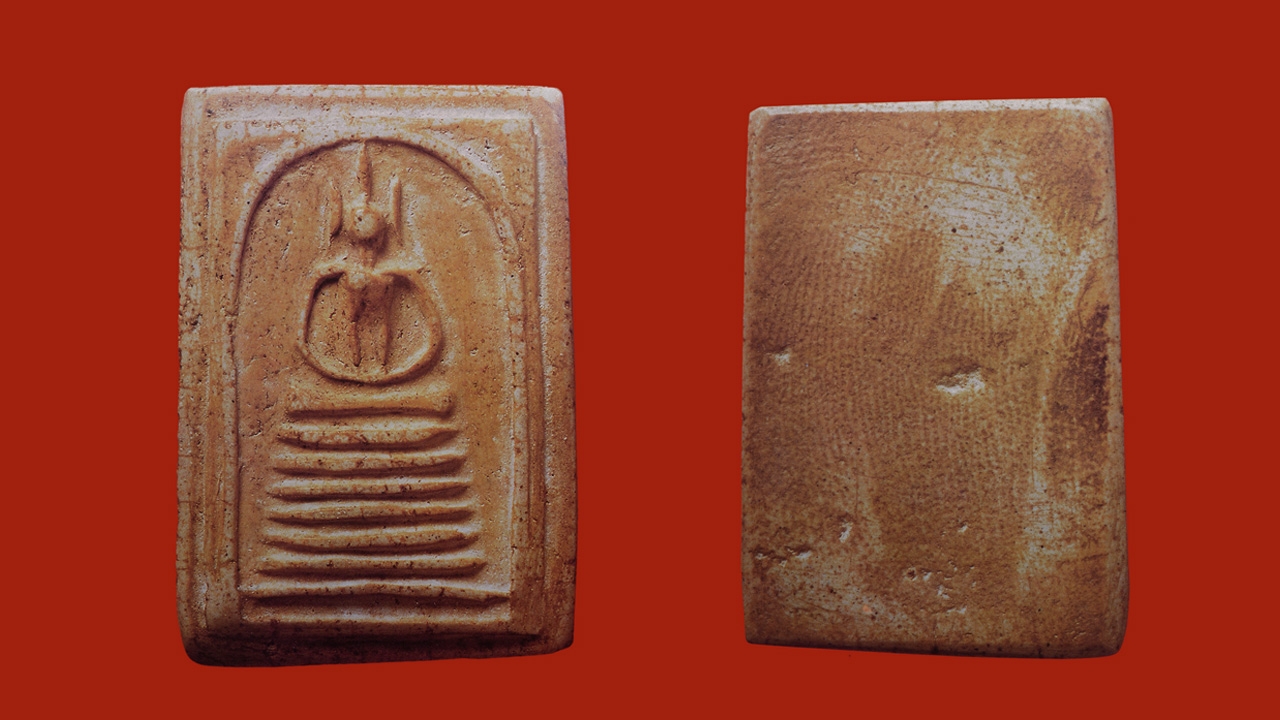
The "100th Anniversary Memorial Book of Somdej Phra Phutthachan To Phromrangsi," published in 1972 to commemorate the centenary of Somdej To's passing, was chaired by Professor Commander Somphop Pirom, RN. The book features images of two popular 7-layer molds of Somdej Wat Ket Chaiyo—one with patina and one without. The patinated piece was described by expert Wichai Uthaisutthivichit (Lim Krungthai) as "Somdej Wat Ket Chaiyo, intensely yellow material, grooved chest, Bai Sri ears, rounded arm region, brownish burnt patina with clear depth, smooth surface throughout." This piece was found in the Bang Khun Phrom cache. The piece without patina was described as "Somdej Wat Ket Chaiyo, white-yellowish, translucent, free of patina, grooved chest, Bai Sri ears, well-defined base and arch, smooth surface throughout."
Wichai also stated in this book: "The 7-layer mold Somdej Wat Ket Chaiyo found is genuinely old, mostly made of a finer, softer yellow material than Wat Rakang's. The powder composition is similar to Wat Rakang but appears much finer. Most have their backs neatly trimmed on all four sides. The 7-layer mold features a grooved chest, Bai Sri ears, and a double-layered glass frame... The popular 6-layer mold later produced is of less dense material and not as old as the 7-layer mold."
The book “Somdej Wat Ket Chaiyo and Amnat Thong Amulets,” published in 1985 by Mayor Kheng Ang Thong and Professor A Suphan, included images of Somdej Wat Ket Chaiyo, large 7-layer mold, and Somdej Wat Ket Chaiyo, continuous chest 6-layer mold, both showing patina. It stated, "These two pieces were found in the Wat Mai Amatarot cache at Bang Khun Phrom when the cache was opened in 1957. It is evident that Somdej Wat Rakang, Somdej Wat Bang Khun Phrom, and Somdej Wat Ket Chaiyo are related, serving as proof that their creator was the same individual: Somdej Phutthachan To Phromrangsi, the greatest genius monk of the Rattanakosin era."
The book summarized Somdej Wat Ket Chaiyo's characteristics: "They tend to show rather unusual and distinct molds, quite different from Somdej Wat Rakang and Wat Mai Amatarot Bang Khun Phrom. Most molds feature distinctive traits: a grooved chest, Bai Sri ears, and a glass frame. It also presented images of 19 molds: 12 types of 7-layer base molds, 7 types of 6-layer molds, and 1 type of 5-layer mold. Regarding the 'mobile cache' Somdej Wat Ket Chaiyo from Wat Pho Kriap, the book stated it is also genuine, citing Professor Prachum Kanchanawat's 1980 book "Three Somdejs," which confirmed, "The Wat Pho Kriap Somdej is actually a mobile cache from Wat Chaiyo Worawihan, made by Somdej To himself." This view aligns with that of expert Prajam U-Arun, another senior Somdej specialist.
"The Science of Somdej" once presented that Somdej To's 5-, 6-, and 7-layer base Somdej Wat Ket Chaiyo, based on reliable sources, were likely created before the 3-layer base type typical of Somdej Wat Rakang and Wat Bang Khun Phrom. The "grooved chest" often seen in 5-, 6-, and 7-layer bases represents the Buddha's ascetic practices before enlightenment. The 3-layer base usually depicts the Buddha after enlightenment, with a complete body. Some 3-layer molds, like double base or sangkhati base with grooves, resemble these earlier ascetic traits, possibly influenced by earlier designs or as a developmental transition. The glass frame probably originated from the mold design, with speculation that Wat Ket Chaiyo molds were made using methods similar to Wat Rakang molds.
Senior expert Prajam U-Arun noted that the 7-layer mold with shoulder ears of Somdej Wat Ket Chaiyo contains Wat Rakang material (he also mentioned finding other unusual molds with Wat Rakang material, such as triangle and Chulamani molds). However, standard Wat Rakang and Wat Bang Khun Phrom molds rarely share the same material as Somdej Wat Ket Chaiyo. This supports the hypothesis that Somdej Wat Ket Chaiyo was made before Wat Rakang and Wat Bang Khun Phrom. Reliable sources say the square frame mold started around 1866 CE or shortly before, aligning with the multiple creations and collapses of Somdej To's works at Wat Chaiyo, explaining the legend of the cache break. Eventually, King Rama V ordered the creation of the current Great Buddha image, as previously covered by "The Science of Somdej." ."

When creating Somdej amulets to enshrine in the main stupa of Wat Bang Khun Phrom in 1870 CE, both new molds and existing Wat Rakang molds were used. However, no molds of Somdej Wat Ket Chaiyo were reportedly used. The few Somdej Wat Ket Chaiyo pieces found in the stupa cache appear to have been deposited rather than produced there. If the old 5-, 6-, and 7-layer molds of Wat Ket Chaiyo had been used to make amulets, many such amulets of Wat Bang Khun Phrom material should be found in the cache likewise. It is intriguing why the large quantity of molds used to create Somdej Wat Ket Chaiyo amulets were not employed to make Somdej Wat Bang Khun Phrom amulets, despite the close timeframes of production at these two temples.
Trusted sources suggest that the 5-, 6-, and 7-layer base molds (and possibly other ancient wheel molds) were produced in large numbers, following the Buddhist canon of 84,000 teachings, similar to Wat Bang Khun Phrom. This was Somdej To's first major creation, intended for distribution and enshrinement in sacred places he established. Later in life, he planned a second major production to dedicate to his mother, originally intending to make 7-layer base amulets with Bai Sri ears (likely the popular 7-layer mold). These were probably created by the same craftsmen who made standard molds for Wat Rakang and Wat Bang Khun Phrom. Seeing the production might not meet the target, he appointed his nephew, Mr. Thet, to gather the previously made 5-, 6-, and 7-layer base amulets (including coin amulets and other molds) from the first big batch. Some say the first 7-layer batch included shoulder ear molds too. Because of this, most Wat Chaiyo cache amulets are 7-layer base types (mostly without patina). The 1952 book by Phra Kru Kalyananukoon (Phra Maha Heng) cites the former abbot of Wat Chaiyo, Phra Maha Phutthapimabal (Wor), who said, "Years ago, when the stupa containing Somdej amulets collapsed, he collected the amulets and enshrined them at the base of the Buddha image in Wat Chaiyo's vihara." The 7-layer base amulets (including 5- and 6-layer molds and possibly other ancient wheel molds) were intended by Somdej To as dedication amulets for his mother. This may explain why, when the clerk Duang made Somdej Wat Bang Khun Phrom amulets for the main stupa in 1870 CE, the 5-, 6-, and 7-layer molds were not used, and only a few Wat Ket Chaiyo amulets were deposited in the cache, as seen in the limited numbers found.
Before 1957, Somdej Wat Ket Chaiyo amulets were not widely traded. Some older experts' books, such as Triyamphawai's, even claimed that those found before then were not made by Somdej To. However, after the discovery of Wat Ket Chaiyo amulets in the 1957 opening of the Wat Bang Khun Phrom stupa cache, their popularity grew, believed to be Somdej To's creations as well. Later, the 1964 book "Applied Amulets" by Triyamphawai included images of Somdej Wat Ket Chaiyo. Prachit Limsakul (alias Phlai Chumphon of Thairath Newspaper) noted that the 5-layer base amulets in that book resemble those of Wat Intrawihan.
From a forensic academic perspective, finding these deposited Somdej amulets is valuable evidence. They can be analyzed further to understand their manufacturing process, material composition, and changes over time. This data helps define the identity of Somdej amulets and supports scientific authentication of genuine Somdej To amulets.
For more information, visit the Facebook page "Somdej Science" by Police Lieutenant Colonel Komsan Sanongpong. Special thanks to Assistant Professor Rangsarn Tosuwan for kindly providing images of an exemplary Somdej Wat Ket Chaiyo 7-layer mold amulet for educational purposes, and to its current owner. This amulet is beautifully preserved with moderate use, fine powder texture, smooth surface, white-yellowish color, no patina but some oily residue on the surface. The mold matches textbook descriptions with grooved chest, Bai Sri ears, clearly defined base and arch, rounded arms, and the characteristic glass frame of all Wat Ket Chaiyo molds. The edges are smoothed on all four sides, likely to remove sharpness for distribution to devotees. The back is smooth. This piece serves as an excellent study model for Somdej Wat Ket Chaiyo. More articles are available in the "Science of Somdej" column.
Author Police Lieutenant Colonel Komsan Sanongpong, former forensic police officer
Facebook page –Somdej Science