

The 1965 book "Amulets and Statues from the Nine Caches," authored by Thepchu Thapthong, a former senior journalist at Thairath, presents an engaging narrative about the opening of the great pagoda cache at Wat Mai Amataros (Wat Bang Khun Phrom). The story is recorded from the account of Phra Kru Borihan Khunwat (Chum), who was the deputy abbot of Wat Mai Amataros at that time, containing the following details:
"...The opening ceremony took place on 24 November 1957, chaired by General Praphas Charusathien, Deputy Prime Minister and Minister of the Interior. The Director-General of the Department of Religious Affairs, provincial and district ecclesiastical chiefs, police, and military also participated in the ceremony. The military police formed the innermost ring around the pagoda and ubosot, with the regular police controlling the outer ring, creating a dense and strong perimeter..."
Excavation began at 9:00 a.m., with General Praphas Charusathien ceremonially digging a few times before lay officials continued the excavation until reaching the cache. Subsequently, the excavation responsibility was handed over to the monks of Wat Mai Amataros, with Phra Kru Borihan Khunwat directing the monastic excavation team exclusively, strictly prohibiting any layperson from involvement.
Inside the pagoda, conditions were dark, stuffy, and suffocating. The temple had to install 100-watt electric bulbs for lighting and bring in fans to circulate air.
The area containing the Phra Somdej amulets consisted of four pits, each covered by crossbeams. The pagoda itself rested atop these crossbeams.
To excavate each pit, one had to crawl under the beams. The amulets were piled in pits that were consistently wet and muddy, causing heavy deposits and considerable damage to the amulets.
After removing amulets from each pit, they were immediately packed into sandalwood boxes, sealed, labeled, and transported from the cache to the ubosot, totaling 31 boxes. Of these, 27 contained only earth from the cache; only 4 boxes contained amulets mixed with soil, confirming that many amulets had disintegrated due to soil content.
The excavation was completed successfully on the same day at 10:00 p.m. without incident. The committee, monks, and novices remained on duty throughout the night, all exhausted by the effort.
The next day, 25 November, the committee counted the recovered amulets, finding a total of 2,950 Phra Somdej. Additionally, there was one lead Phra Somdej Takua Tham Cha, three reclining Phra Somdej, and some takrut (amulet scrolls) believed to have been placed at the time. Many Phra Somdej were damaged or broken.
The main types recovered included nine standard molds: five originally from Wat Rakang, and four newly added molds. Also found were Wat Rakang and Wat Ket Chaiyo Phra Somdej deposited for safekeeping. According to Professor Prakit Limskul (also known as Phlai Chumphon) of Thairath, more than three reclining Phra Somdej were found, including those removed from the cache before 1957.
The 1957 major cache opening was considered highly significant by Wat Mai Amataros. Previously, Phra Kru Amornkanachan (Seng), the abbot at that time, had firmly vowed not to open the cache. Even Pol. Gen. Phao Sriyanond, former Minister of Interior and former Director-General of Police, who chaired the temple's celebration committee in 1946, requested the opening multiple times but was refused. However, repeated illicit excavations and thefts of amulets, especially during storms, overwhelmed the temple's ability to protect the cache, leading to eventual permission to open it officially.
The amulets obtained from the opening were priced for lease as detailed in "The Science of Phra Somdej" has previously presented. There was debate about the exact number of amulets obtained, particularly the intact ones, possibly exceeding 2,950 (excluding damaged amulets and those embedded deeply in hardened soil), as officially announced by the temple. However, considering the firm vow of the abbot to preserve the amulets within the pagoda without opening it initially, and the later strict controls during the opening and leasing process accepted by the public — some even pre-booked — the account by Phra Kru Borihan Khunwat (Chum) names notable figures who leased amulets, including Field Marshal Sarit Thanarat, former Prime Minister; Field Marshal Thanom Kittikachorn, Prime Minister at the time of writing; and Admiral Luang Chamnan Attayut, former Commander-in-Chief of the Navy. Public sales were carefully managed: after payment, customers received receipts and collected amulets at designated windows in the ubosot, where monks distributed amulets without allowing customers to choose themselves. For these reasons, "The Science of Phra Somdej" believes that the 1957 leasing of Phra Somdej from the so-called "new cache" was conducted openly and transparently, in contrast to the "old cache" referring to amulets previously released by the temple.

(Thepchu Thapthong's book on the date of the pagoda cache opening and leasing details aligns closely with other reputable sources such as Triamvapai and the works of Nop Thaprajan, previously presented by "The Science of Phra Somdej," with only minor differences in details.)
Thepchu Thapthong's book also mentions Mr. Chaem Buapliansi, a committee member involved in the excavation, who was the sole expert at that time in repairing Phra Somdej amulets. Mr. Chaem stated: "I believe the material of the Phra Somdej from this cache is uniformly white. Most people examine only the surface; to see the interior, one must break the amulet. Newly made Phra Somdej may be slightly yellowish due to the yellowish soy oil used in production, but after burial in the cache, the material turns completely white. However, it's not ordinary chalk-white; if observed carefully, it has a certain density and firmness."
"The Science of Phra Somdej" Concluding this section, here is an explanation of the seven types of surface textures (material characteristics) of the Phra Somdej from Wat Mai Amataros, as selected from the book "Opening the Phra Somdej Cache at Wat Mai Amataros" published by the temple, for educational purposes:
1. White material: dense, strong, surface covered with a general patina called "cache rust" or "cache crust." This crust is white or nearly white, tightly attached to the amulet's surface and difficult to remove by washing or rubbing. Some amulets have thin crusts, others thick. Prolonged use or exposure to sweat can develop a shiny luster on the surface.
2. Creamy white material: dense, strong, with a white patina similar to the white material but slightly darker in shade.
3. White with light green tint: a faint greenish layer on the surface, which may appear white at first glance but differs subtly in hue from light ash-colored material.
4. Dull white material: slightly darker than creamy white, with a muted tone.
5. White-yellow material: similar to the white with light green tint, resembling light ash or young bamboo skin in color and texture. Careful observation reveals a shimmering mixture of white, green, and light gray hues.
6. Yellow material: distinctly yellow, different from dull white or creamy white, often with a porous texture, mostly in monk's cassock shape, but some in pagoda or bud-shaped molds.
7. White with light gray tint: white mixed with light gray resembling light ash, commonly called "light ash color."
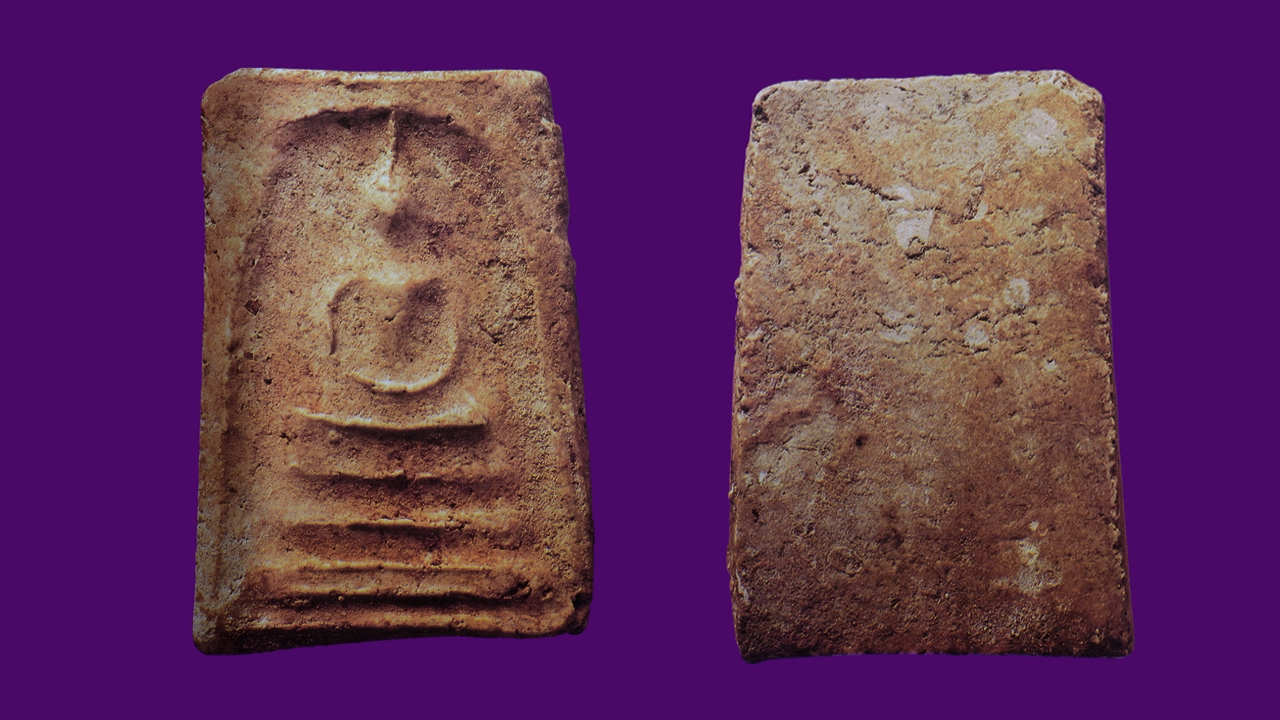
For more information, visit the page Phra Somdej Science by Police Lieutenant Colonel Komsan Sanongpong. Special thanks to Assistant Professor Rangsarn Tosuwan for kindly providing images of the master-piece Phra Somdej Wat Bang Khun Phrom amulet for educational purposes, and to the current owner. This amulet is a beautifully crafted Phim Sen Dai (Thread Mold) type of Wat Bang Khun Phrom, one of the most commonly found types alongside the Sangkhati Mold. Its mold is textbook accurate, with delicate arch and amulet body lines resembling threads, hence the name. It has a creamy yellowish hue with visible cache crust on the front and back (the lower back has a thick crust mixed with red soy oil stains). The edges are well-trimmed with slight raised ridges on the top and left side; no clear edge flares, which are often found on some Wat Bang Khun Phrom amulets. The back is smooth with some sagging and cracking. This exemplar serves as an excellent study model for Phra Somdej Wat Bang Khun Phrom. More articles can be found in the "Science of Phra Somdej" column.
Author Police Lieutenant Colonel Komsan Sanongpong, former forensic police officer
Facebook page –Phra Somdej Science