

The story of Somdej Phra Buddhacharn (To Phrommarangsi) says that whenever he undertook a project, he usually created something large and grand, such as buildinga Buddha image.He made a large Reclining Buddha at Wat Satoo in Phra Nakhon Si Ayutthaya Province as a memorial of his birthplace, created a large standing Buddha known asPhra Buddha Sri Ariya Mettraiyat Wat Intrawihan in Bangkok to commemorate the place where he taught standing and walking meditation, and built a large seated Buddha (the original Luang Pho To) at Wat Chaiyo Worawihan in Ang Thong Province as a reminder of the place where he taught seated meditation. This Wat Chaiyo Worawihan is also the origin of the “Somdej Wat Ket Chaiyo” amulet, one of the famous "Three Somdej" amulets, which include Somdej Wat Rakang, Wat Bang Khun Phrom, and Wat Ket Chaiyo.
Regarding Wat Chaiyo Worawihan’s history, it was established during the Ayutthaya period as a secondary royal temple of the worawihan class. It is located in Chaiyo Subdistrict, Chaiyo District, Ang Thong Province, on the west bank of the Chao Phraya River at the northern boundary of Ang Thong Province. The temple’s original name was Wat Chaiyo, but its founder is unknown. However,it was a common people's temple.It gained fame when Somdej Phra Buddhacharn (To), the abbot of Wat Rakang Kositaram, built a large seated Buddha here during the reign of King Rama IV.
The building of the Luang Pho To statue by Somdej To at Wat Chaiyo Worawihan was recorded by Ajarn Prachum Kanchanawat in the book "Three Somdej," published in 1980 CE, as being done in three phases (some sources say two). The first phase was between 1857 and 1862 CE. During this first phase, Ajarn Prachum noted no amulets were placed inside. Shortly after, the first statue collapsed, prompting the construction of a second statue around 1863–1864 CE. In this second phase, amulets created by Somdej To were placed inside, following ancient tradition of embedding smaller amulets within large Buddha statues. “The Science of Somdej Amulets” suggests the amulets placed then were those made before Somdej To began producing the square-shaped Somdej, such as the revered ancient wheel-shaped amulets. Ajarn Prachum opined that the Somdej Wat Ket Chaiyo amulets were made in 1861 CE. He stated they were made in advance to be placed inside the Luang Pho To statue built during the second phase. However, “The Science of Somdej Amulets” respectfully offers the view that the square-framed Somdej amulets according to Triyampawai’s research were made around 1866 CE. (Ajarn Prakit Limsakul, also known as Plai Chumphon from Thairath Newspaper, suggested it’s possible production began slightly before 1866.) The amulets made before 1864 CE were produced before Somdej To was officially appointed as Somdej Phra Ratchakhana, so they are not considered true Somdej amulets. The Somdej Wat Ket Chaiyo amulets seen today (with 5, 6, and 7-layer designs) likely began production in 1866 CE or as early as 1864 CE. (If made as early as 1864, it is possible that these 5, 6, and 7-layer square-framed Somdej amulets were also placed inside the second Luang Pho To statue.) Ajarn Prachum suggested the first statue collapsed because its base was too weak (larger than the current one) and it was made only from clay mixed with rice husks.
The third construction of the Luang Pho To statue (some sources say Somdej To built only two statues) according toAjarn Prachum’s bookwas done in 1867 CE to replace the second statue, which collapsed 3-4 years after completion. During this third building, Ajarn Prachum noted that many of the amulets originally placed inside were missing. It is said Somdej To had to plead with locals to return some amulets to be re-placed inside the statue. (It is also highly likely, considering the timing, that the 5, 6, and 7-layer square Somdej amulets by Somdej To were among those placed in this third statue, possibly along with other types.)

(This third Luang Pho To statue collapsed during King Rama V’s reign when he visited to worship and ordered restoration of Wat Chaiyo in 1887 CE. During foundation work of the viharn, the statue fell. The king then commanded a new Luang Pho To to be built following the style of Luang Pho To at Wat Kanlayanamit, naming it “Phra Maha Phutthapim.” They built a viharn as the Buddha’s house, 1 sen plus high, with an ubosot projecting forward and four surrounding pavilions. This restoration took eight years, completed in 1895 CE. King Chulalongkorn graciously elevated Wat Chaiyo to royal temple status.)
Triyampawai’s book cites a statement from Phra Ajarn Khwan Wisithoto, who heard from Phra Thammathaworn (Chuang Chantachot), a close disciple of Somdej To, saying, “The Somdej amulets were made in a complete set of 84,000 pieces, but the later production did not reach that number. Somdej To told Nai Ted that he might not finish making all 84,000, so he gathered earlier Somdej amulets, selecting mainly the 5, 6, and 7-layer styles, combining them with the newly made amulets to reach 84,000 pieces. These were placed inside the Wat Chaiyo crypt in Ang Thong to dedicate merit to his mother.”
This claim supports the likelihood that the 5, 6, and 7-layer style Somdej amulets were indeed placed at Wat Chaiyo Worawihan. Exactly where and how they were placed remains uncertain; they may have been placed inside the Luang Pho To statue as rumored, inside stupas following ancient customs, or distributed without being stored in a crypt, as various Somdej amulet experts have suggested.
." “The Science of Somdej Amulets" has previously presented that Somdej To’s large-scale Somdej amulet production occurred twice: the first mainly producing 5, 6, and 7-layer square-framed Somdej amulets, about 84,000 pieces, around 1866 CE or shortly before; the second near the end of his life (he died in 1872 CE), intending to make 84,000 7-layer (with decorative ears) Somdej amulets dedicated to his mother to be placed at Wat Chaiyo. Fearing he would not complete the full amount, he combined earlier 5, 6, and 7-layer amulets from the first batch. It remains unclear how many were made or whether they were placed in a crypt. The timeline of these two production periods aligns with the three phases of Luang Pho To statue construction, supporting the plausibility that amulets from the first large production were placed inside the statues.
Ajarn Prachum noted in "Three Somdej" that the former abbot of Wat Chaiyo Worawihan, Phra Khun Maha Phutthapim Pha Phiban (Wor), said: “Years ago, the stupa containing Somdej amulets collapsed. The amulets were then gathered and placed beneath the base of the Luang Pho To statue in the viharn at Wat Chaiyo.” These Somdej amulets are said to be mostly 7-layer prints. However, it remains unclear whether this stupa was built simultaneously with the third Luang Pho To statue (while Somdej To was still alive) or was constructed later during the restoration period under Chaophraya Rattanabodin.
The tradition of building large Buddha images passed down in Thai society today holds that when a large Buddha or even the principal Buddha image in a ubosot is created, smaller amulets are ceremonially placed inside. For example, many amulets in a deteriorated state were found inside the Luang Pho To statue at Wat Intrawihan, built by Somdej To. It is thus highly likely that every time Somdej Phra Buddhacharn (To Phrommarangsi) built a large Buddha image, he placed the amulets he had made inside, including when creating the Luang Pho To at Wat Chaiyo Worawihan. Is it possible that amulets stored inside the crypt for only a short time might not show typical signs of burial when removed?
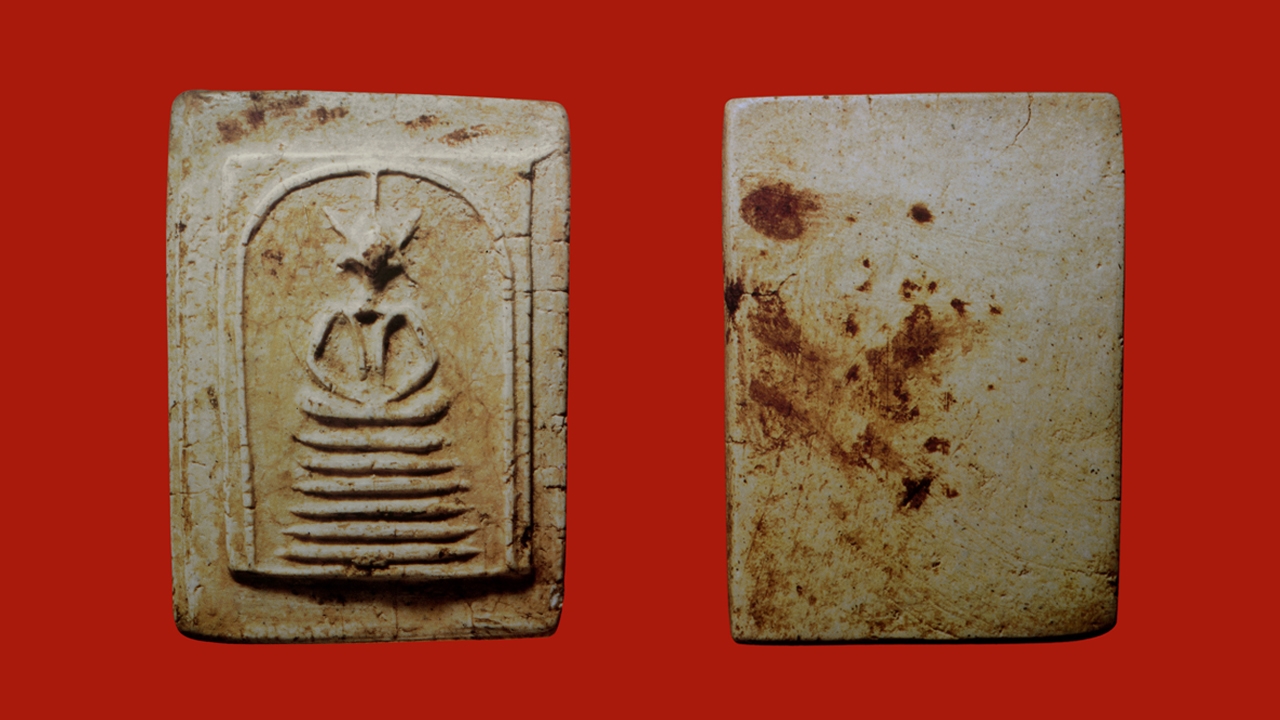
Further reading is available on the Facebook page “Science of Somdej Amulets” by Police Lieutenant Colonel Komsan Sanongpong. Thanks are extended to Assistant Professor Rangsarn Tosuwan for kindly providing images of an exemplary Somdej Wat Ket Chaiyo amulet as a study reference, as well as to the current owner of this amulet. This is a Somdej Wat Ket Chaiyo, 6-layer print, continuous chest pattern, well-preserved with moderate wear, fine powder texture, smooth surface, white-yellowish tone, translucent, free of burial stains, with slight oil-like marks on the surface. Its print matches reference books, featuring chest grooves and decorative ears.The base has six layers,with clear base and arch details, showing a glass frame characteristic of all Wat Ket Chaiyo prints. The edges are lightly worn on all four sides, likely smoothed for distribution to devotees. The back is smooth with slight erosion and faint fingerprint marks, making it a good original model for study of Somdej Wat Ket Chaiyo amulets. More articles can be found in the Science of Somdej Amulets
column, written by Police Lieutenant Colonel Komsan Sanongpong, a former forensic police officer.
Facebook page –Science of Somdej Amulets