

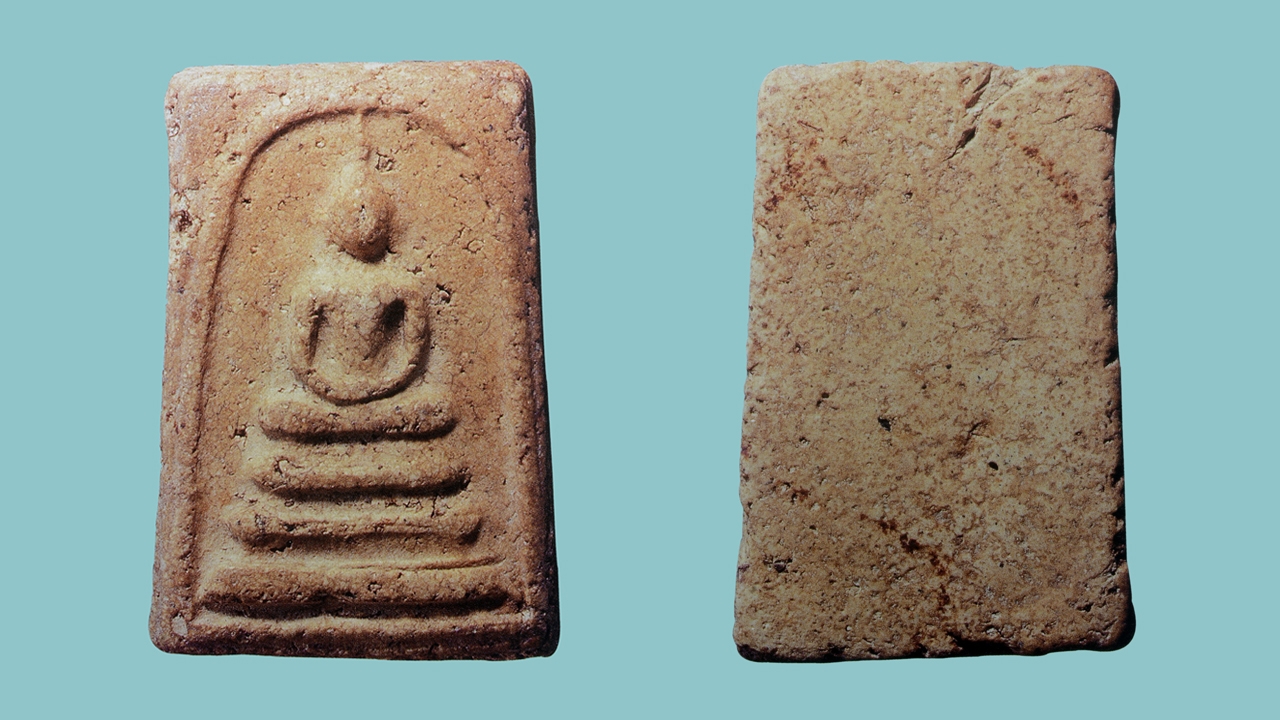
Phra Somdej amulets associated with Somdet To, especially Phra Somdej Wat Rakang, are often found in areas historically connected to him, particularly around the Bangkok Noi canal neighborhood. This is likely because residents there, who in the past mainly traveled by boat and frequently visited Wat Rakang for merit-making, had more opportunities to receive Phra Somdej Wat Rakang amulets directly from the temple during Somdet To's lifetime. Additionally, when Somdet To went on alms rounds or traveled elsewhere, he often carried and distributed Phra Somdej amulets to laypeople. Some texts mention that when he oversaw the construction of a large standing Buddha image, known as Phra Sri Ariya...Mettraiat Wat Intharavihan on the Phra Nakhon side (Bangkok), near the end of his life (he passed away in 1872 CE), he carried Phra Somdej amulets in his bag to distribute to people passing by there, warning that his amulets would become scarce in the future.
A knowledgeable anonymous expert on Phra Somdej from the magazine “Precious,” associated with Assistant Professor Rangsarn Tosuwan, provided valuable information around 1996 CE, stating that “...it is quite credible thatSomdet PhutthachanTo continuously produced his Phra Somdej Wat Rakang amulets. He might have chosen auspicious dates to make them, setting a specific number to create each time. However, he certainly did not produce large quantities at once to distribute over a long period... On days he decided to make amulets, he would mix the plaster and other ingredients into a lump, then shape it into a rectangular block, cutting it into pieces called ‘chunks’ in those days...”
The anonymous expert likely inferred this because, at that time, known Phra Somdej Wat Rakang amulets were not very numerous. Some specialists estimated the total number to be only in the low hundreds to low thousands. However, over the decades to the present, the standard models of Phra Somdej Wat Rakang—referred to in the Triyamphawai text as the Luang Wijarn Jiranai models—have been increasingly found, both entering the market and kept by owners for personal veneration. Starting from a few thousand, their number has grown steadily, leading some experts to reassess and estimate that the combined total of the three Somdet amulets (Wat Rakang, Wat Bang Khun Phrom, and Wat Ket Chaiyo) might actually be near ten thousand, including those yet to appear.
Based on data from various sources and trustworthy texts, the “Science of Phra Somdej” respectfully concurs with past teachers’ views that, specifically for Phra Somdej Wat Rakang, although the production quantity might not have matched that of Phra Somdej Wat Bang Khun Phrom (estimated around 84,000 pieces, equal to the number of Buddhist scriptures),it still was producedin a considerable quantity as well. An interesting question is how many of the standard models of Phra Somdej Wat Rakang, according to the five types in the Triyamphawai text—namely the Large, Chedi, Base Sam, Lotus Bud, and Bodhi Leaf models—were actually produced in total.
Reliable Phra Somdej texts, such as those by Triyamphawai or Phra Kru Kalyananukool (Phra Maha Heng Itthajaro), state that Somdet To’s large-scale production of Phra Somdej amulets occurred twice (excluding the Wat Bang Khun Phrom amulet production led mainly by Samian Trad Wong). The first major production by Somdet To comprised about 84,000 amulets—matching the number of Buddhist scriptures—mostly in five, six, or seven-layered styles, which are today known as Phra Somdej Wat Ket Chaiyo. There may have been other types, such as ancient replica prints popular at the time like Phra Khun Paen, Luang Pho To from Wat Bang Krathing, or Phra Rod Lamphun. This first large production likely occurred around 1866 CE or slightly earlier (at least after his appointment as Somdet Phra Rajakhana in 1864 CE). The main purpose was to distribute to villagers and to enshrine in sacred sites he had built during his monastic life. Records show he created large Buddha images from the reign of Rama III through Rama IV and into Rama V’s era. The five-, six-, and seven-layered Phra Somdej from this first large production were likely enshrined and distributed in two main locations: first, at Wat Chaiyo Worawihan in Ang Thong Province, placed inside a large seated Buddha image Somdet To had built (especially the third one built around 1867 CE), which later collapsed, giving rise to the legend of the cracked amulet; and second, placed and distributed inside the large standing Buddha image called Phra Sri Ariya...Mettraiat Wat Intharavihan, Phra Nakhon Province (Bangkok). According to the Triyamphawai text, the Phra Somdej Wat Ket Chaiyo placed inside this standing Buddha image has completely disintegrated. A notable issue is whether three-layered amulets were made during this first large production. The “Science of Phra Somdej” believes that during this initial large production, standard three-layered Phra Somdej Wat Rakang models were probably not included, but it is possible that three-layered amulets featuring folk art styles and materials akin to Phra Somdej Wat Ket Chaiyo were produced. The second large production (with no exact date known) is said in trustworthy texts to have been initiated by Somdet To late in his life as a dedication to his mother, intending to create seven-layered (Hoo Bai Sri) models. However, realizing he might not have enough time due to his old age, he combined the five-, six-, and seven-layered amulets from the first production. It is probable that for the seven-layered (Hoo Bai Sri) amulets dedicated to his mother, he sought the finest craftsmanship, involving the royal craftsmen (Chao Sip Mu) or royal goldsmiths to create new molds. The first large production’s amulets had a folk-art style, with basic print artistry (as noted by Ajarn Prakit Limsakul or Plai Chumphon from Thairath newspaper), resembling early development stages like the Garuda Chest Print. For example, the six-layered print from Wat Ket Chaiyo shows this folk style, distinct from the more sophisticated royal craftsmanship evident in the seven-layered (Hoo Bai Sri) Wat Ket Chaiyo amulets. The second large production, with high-level royal craftsmanship, is notably similar in style to that of Phra Somdej Wat Rakang and Wat Bang Khun Phrom. An interesting question is whether the standard-model Phra Somdej Wat Rakang made by royal goldsmiths was also produced during this period.

Considering the evidence and the timeframe between the productions of Phra Somdej Wat Ket Chaiyo and Wat Bang Khun Phrom, the “Science of Phra Somdej” deems this likely. Some texts also mention that in the second large production, beyond combining the five-, six-, and seven-layered amulets to complete the 84,000 pieces, Somdet To also included three-layered amulets. However, it is unclear whether the total truly reached 84,000 and which types were included. (The book “Sam Somdet” by Ajarn Prachum Kanchanawat cites evidence of discovering some three-layered base Phra Somdej Wat Rakang amulets in the Wat Chaiyo Worawihan repository, referencing interviews with local Ang Thong residents and elders such as Khun Suraphol Plengwat, who said, “Somdet To made large amulets at Wat Chaiyo and stored Phra Somdej amulets there, including three-layered types (meaning the Large, Chedi, and Base Sam prints) that are Wat Rakang amulets, though very few...” Ajarn Prachum also examined these Phra Somdej Wat Rakang amulets, including the Chedi print owned by Surin Sripradapkiat, a former police officer from Ang Thong, who reported it as a family heirloom from Wat Chaiyo and found it genuine.) /**No translation provided for this part.**/
In conclusion, based on available information, Phra Somdej Wat Ket Chaiyo were likely produced around 1866 CE or shortly before. For Phra Somdej Wat Bang Khun Phrom, existing data suggest production around 1868–1870 CE, with enshrinement in 1870 CE. Reliable texts do not specify the exact years of standard-model Phra Somdej Wat Rakang production, but evidence suggests it was made after Wat Ket Chaiyo and before Wat Bang Khun Phrom.
It is noteworthy that the distinctive “dense texture” of Phra Somdej Wat Rakang, as described by Triyamphawai, raises the question of how the preparation method created such consistent texture across many pieces, especially given the amulets were produced in multiple batches over time. The final question remains: for what special purpose was this considerable number of standard-model Phra Somdej Wat Rakang amulets created? Further reading is available on the Facebook page “Phra Somdej Science”
by Police Lieutenant Colonel Komsan Sanongpong, with thanks to Assistant Professor Rangsarn Tosuwan for kindly providing images of another master-piece Phra Somdej Wat Rakang for educational purposes, and thanks to the current owner of this exceptionally beautiful Phra Somdej Wat Rakang Chedi print master-piece. The amulet is well preserved with a soft, dense, white-brownish tone, showing minimal cracked surface typical of soft-textured amulets. It has visible sacred relic granules, needle-like pores, and characteristic worm-trail marks on the surface, matching the Wat Rakang style. The print is deep and distinct, with a slight separation at the upper edge of the base’s lower layer (an important authenticity feature). The arch-shaped frame is large, typical of Wat Rakang amulets (compared to smaller ones of Wat Bang Khun Phrom). The smooth flat back shows scattered reddish oil-like residue, with general wrinkles and fine cracks on the top, plus slight flaking on all four sides indicating natural aging, commonly found in Wat Rakang amulets. This piece serves as an excellent study model for Phra Somdej Wat Rakang research. Additional articles can be found in the “Science of Phra Somdej” column. Author Police Lieutenant Colonel Komsan Sanongpong, former forensic police officer
Facebook page – Phra Somdej Science
Read the columnScience of Phra Somdej