

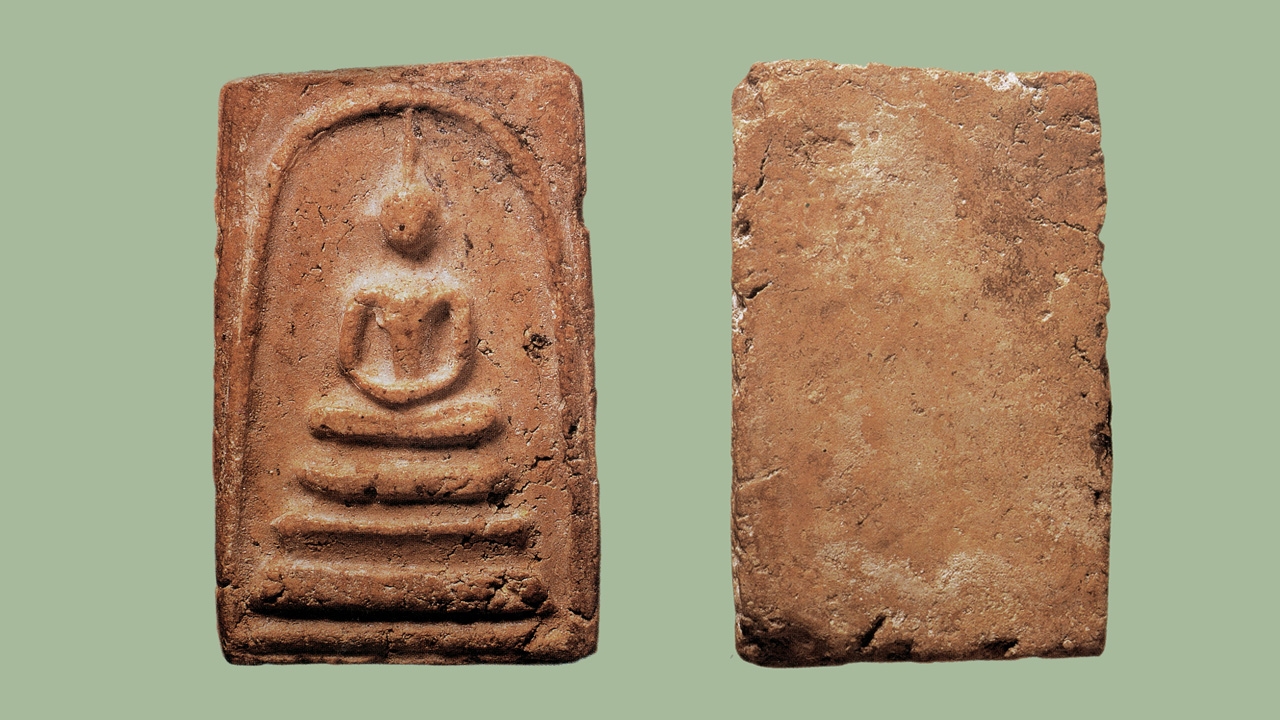
Among the five standard Phra Somdej Wat Rakang Khositaram amulet designs created by Somdej Phra Buddhachan (Toh Prommarangsi)—which include the Large Style, Chedi Style, Lotus Bud Style, Base Sawed Style, and Bodhi Leaf Style—excluding the Large Style which is considered the most valuable and sought after, the Chedi Style is similarly popular but generally rarer. This rarity likely stems from its much more limited production volume.
Phra Somdej expert Ajarn Wichai Uthaisutthivijit (Lim Krungthai) described the Chedi Style in the book “Centennial Commemoration of Somdej Phra Buddhachan (Toh Prommarangsi)” as having a slightly more robust shape than the Large Style, with a round face and broad chest. The layered base integrates smoothly with rhythmic steps, and the meditative posture resembles the Chiang Saen Buddha image, as created by Somdej Phra Buddhachan. He suggested that Somdej Phra Buddhachan likely designed the Chedi Style to echo the four-sided aspect of the Emerald Buddha housed at Wat Phra Sri Rattana Satsadaram (Wat Phra Kaew).
Triyampawai explained the Chedi Style’s characteristics in the first volume of the Explanation of Amulets book, stating it is a style of exceptional beauty characterized by the harmonious relationship of the outer lines, and the pronounced emphasis on convex curves and depth. Regarding the relationship of the outer lines: from the tip of the ushnisha (top knot) down to the corners of the lower base on both sides, the shape forms a pagoda or cone-like silhouette. If one imagines the ushnisha tip as a hub and stretches threads down to the lower base corners, then slightly loosens the threads, almost no part of the Buddha image or throne protrudes beyond this imaginary line. This is why it is named the "Chedi Style". In terms of curves and depth, the design clearly reflects influences from the Chiang Saen school of Buddhist art, known for its full-bodied, robust Buddha figures and sharply defined proportions.
(Triyampawai classified the design of the five standard Phra Somdej Wat Rakang amulet styles—created by the royal goldsmiths—as belonging to the refined Buddhist art group, drawing from classical ancient Buddhist art traditions such as the Sukhothai, Chiang Saen, and U Thong schools. The styles influenced include the principal Buddha (Large Style), Chedi Style, Base Sawed Style, Lotus Bud Style, and Bodhi Leaf Style.) .

The Emerald Buddha, or “Phra Phuttha Maha Mani Rattana Patimakorn,” which is considered the prototype for the Phra Somdej Wat Rakang Chedi Style, was enshrined in the ordination hall of Wat Phra Sri Rattana Satsadaram within the Grand Palace. King Rama I graciously ordered the creation of seasonal attire for the statue for summer and rainy seasons, with the attire changed accordingly. Later, during King Rama III’s reign, a winter costume was also commissioned. The summer attire resembles that of a great monarch, made of gold with enamel, decorated with diamonds and various gems, and topped with a crown adorned with a large diamond. The rainy season attire is styled like a cloak, made from gold with carved rice grain patterns, encrusted with gems, resembling a draped cloak. The headdress (a traditional ornament worn in classical dance or by nobility, evolved from high hair buns adorned with flowers to precious metal crowns such as chada or mongkut) is made from gold with dark blue enamel. The hair curls turn to the right and are decorated with small gems, accompanied by an enamel halo. The winter attire consists of a golden enamel cloak with floral patterns inlaid with rubies, petals made from garnet, a central gem, and the cloak’s edges decorated with emeralds and topaz. The outer edges are set with diamonds.
Several past Phra Somdej experts have noted various characteristic defects in the Chedi Style amulets. “The Science of Phra Somdej” believes some of these features relate to the "attire" of the Emerald Buddha, hypothesizing that when carving the mold, the craftsman used the Emerald Buddha wearing its rainy season costume, which features a cloak-like drape and a crown with a halo-like top covering the head. The crown’s base has numerous hair curls, with circular hair buns on top. The following ideas address these characteristic mold features.
First, the relatively large size of the "head" of the Chedi Style amulet compared to the body likely results from the craftsman carving the hair ornament that covers the Buddha’s head into the design, making the head appear disproportionately large.
Second, the middle part of the hair on the Chedi Style amulet often shows undulations resembling garlands covering the hair. This likely reflects the hair ornament of the crown—whether chada, mongkut, or the Emerald Buddha’s crown—which typically resembles garlands encircling the center. Some types show one garland, others multiple garlands of gradually smaller sizes. (Ajarn Prakit Limsakul or Plai Chumphon from Thairath newspaper said that some Phra Somdej amulets, on close inspection, show up to three garlands covering the hair.) The crown’s hair ornament features a halo that bulges near the center. The crafted ripples in the hair probably symbolize the top of the hair ornament covering the Buddha’s head. (Important Buddha statues enshrined in major Bangkok temples have diverse hair ornament forms as well.)
Third, the Chedi Style amulet often displays two parallel Sangkhata (monk’s robe) lines running from the left shoulder down nearly to the lower arm, with the robe’s hem lifted under the right armpit. These traits align with the cloak-style rainy season costume of the Emerald Buddha.
the design of the Phra Somdej amulet styles by Somdej Phra Buddhachan (Toh) blends the craftsmanship of the artists and mold carvers with the doctrinal symbolism passed down from Somdej Phra Buddhachan himself. Certain stylistic features reflect the original prototypes used to design the amulets. Deep study of these Buddhist art styles can enhance understanding and appreciation of the authentic Phra Somdej amulets created by Somdej Phra Buddhachan.
“The Science of Phra Somdej” concludes this section with insights from Nirnam of Precious magazine, assistant professor Rangsan Tosuwan, who interestingly distinguishes between the Phra Somdej Wat Rakang Large Style (principal Buddha style) and the Chedi Style. (Nirnam divides the Chedi Style into five types, with the famous "Je Jaew" being the second type.) The following points serve educational purposes:
1. The left mold edge of the Chedi Style amulet extends down to the bottom corner of the glass case, while in the Large Style, this edge reaches only about the midpoint of the case (around the elbow area).
2. The hair on the second type of Chedi Style (Je Jaew style) features ripples resembling a garland in the middle, absent in the Large Style.
3. The shoulder thickness from the top of the shoulder to under the armpit is symmetrical on both sides in the Chedi Style, whereas in the Large Style, the right shoulder is thicker than the left.
4. The glass case frame of the Chedi Style is smaller than that of the Large Style.
5. The Chedi Style (second type, Je Jaew) shows a clear line of the robe strap running from shoulder to under the armpit, which may be less visible if the mold impression is shallow, while the Large Style lacks this strap line.
6. The inner right arm of the Chedi Style often has excess material, a mold defect found in the deepest parts. Even if the mold is worn or the impression shallow, this is still visible.
7. The left elbow of the Chedi Style lacks the robe’s hem running from elbow to knee, which is present in the Large Style.
8. The proportions of the Chedi Style amulet are smaller compared to the Large Style.
9. The back of the Chedi Style amulet is "flat back" (smooth), unlike some other styles.
10. The materials composing the Chedi Style amulet are identical to those of the Large Style.
11. The surface texture and overall appearance are crucial factors for evaluation.
12. The presence of relic granules and contraction marks on the material are clearly visible in both Large and Chedi Styles.
13. The signature needle holes, a distinctive feature of Phra Somdej Wat Rakang Khositaram, appear in the Chedi Style as well.
14. The presence of "ant trails" or signs of material degradation on the amulet’s surface is evident in the Chedi Style too.
Further reading is available on the Facebook page "Phra Somdej Science" by Pol. Lt. Col. Komsan Sanongpong. Thanks are extended to Assistant Professor Rangsan Tosuwan for providing images of a master-class Chedi Style Phra Somdej Wat Rakang amulet for educational purposes, and to the current owner of this finely preserved amulet. (Nirnam categorized the Chedi Style into five types; this amulet belongs to the second type, the same as the famous "Je Jaew".) It shows signs of use with a white-brownish tone, soft and dense texture, no craquelure (typical for soft, dense amulets), visible relic granules, porous needle holes, and characteristic "worm trails" on the surface. The amulet perfectly fits the mold frame, with a flat back and signs of natural aging on all four edges. This specimen is an excellent reference for studying Phra Somdej Wat Rakang amulets. Additional articles can be found in the “Science of Phra Somdej” column.
Author Pol. Lt. Col. Komsan Sanongpong, former forensic police officer
Facebook page –Phra Somdej Science