

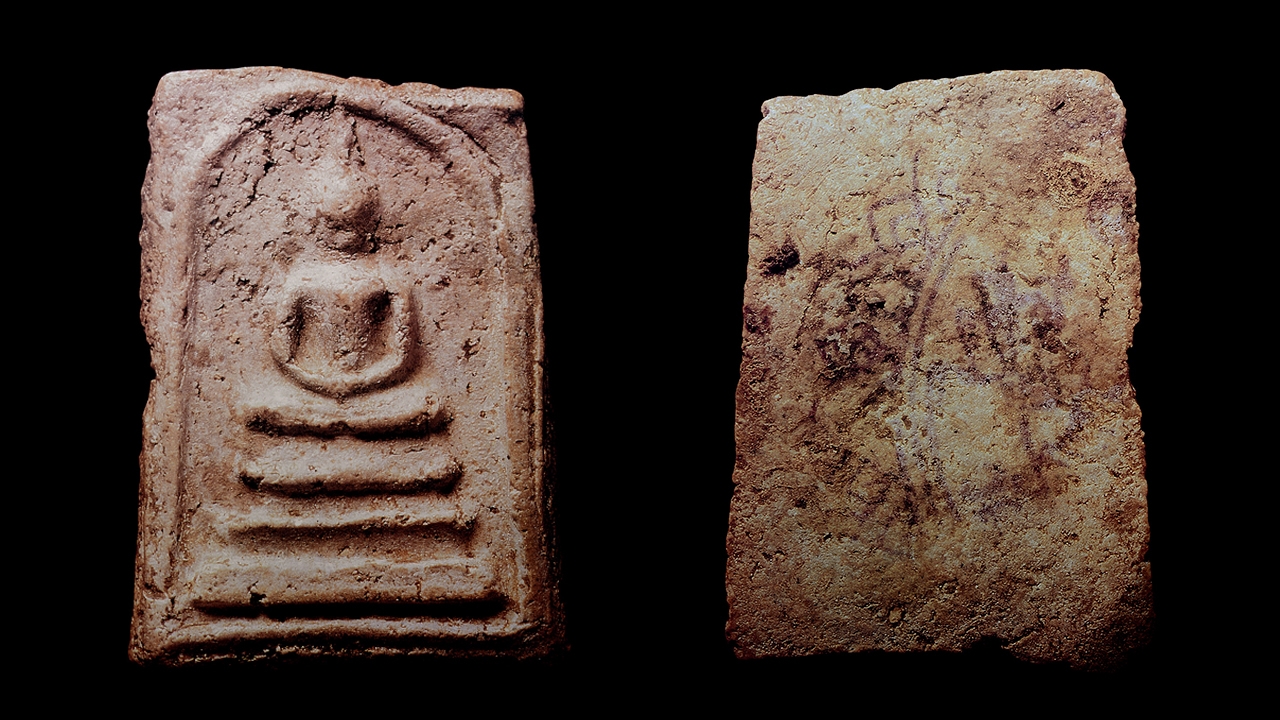
Triyampawai discussed the creation of the Somdej Buddha of Wat Bang Khun Prom in his 1964 book on amulets, stating, “The Somdej Buddha amulet from the Wat Bang Khun Prom batch refers to those enshrined in the Wat Mai Amataros stupa at Bang Khun Prom, Phra Nakhon. Siemian Tradoung, the ancestor of the Thanakoset family and restorer of Wat Mai Amataros (also called Wat Mai Bang Khun Prom), invited the Venerable Somdej to conduct the creation ceremony of the Somdej Buddha amulets at Wat Intrawiharn. These amulets were then enshrined in the principal stupa of Wat Mai Amataros. Due to the need for a large quantity, molds of all rectangular types from Wat Rakhang were used, even some mold styles discontinued at Wat Rakhang, such as the Thread Line and Double Base molds.”
Regarding the production of the Somdej Buddha of Wat Bang Khun Prom between 1868 and 1870, credible evidence and reliable references suggest that, besides using original molds from Wat Rakhang, a considerable number of new molds were carved. It is interesting to explore their characteristics and how they compare or differ from Wat Rakhang's molds. Before delving deeper into the molds, "The Science of Somdej Buddha" allow me to first present the basic understanding of the mold shapes of the Somdej Buddha of Wat Bang Khun Prom.
Triyampawai stated in the first volume of "Encyclopedia of Amulets" that all molds used for creating the Somdej Buddha of Wat Bang Khun Prom were carved by Luang Wijarn Chianai, referred to as the nine standard mold shapes. These include five mold shapes from Wat Rakhang — Large, Stupa, Base with Sand, Lotus Bud, and Bodhi Leaf styles (all of which were further carved upon in the Somdej Buddha of Wat Bang Khun Prom) — and four unique to Wat Bang Khun Prom: Sangkhati (monk's robe), Thread Line, Double Base, and Garuda Chest molds.
(Some later evidence has led to a new theory that the four molds unique to Wat Bang Khun Prom may have originally been Wat Rakhang molds as well, as Triyampawai noted in his earlier book. These early molds were carved by local craftsmen, such as the group of Mr. Thet, nephew of Venerable Somdej Toh. Later, official royal goldsmiths adjusted the mold designs. Ajarn Pram U Arun, a senior Somdej Buddha expert, once said he had seen Somdej Buddha amulets of Wat Bang Khun Prom made from Wat Rakhang material in all mold types, especially the Reclining mold, which is widely accepted today. Before the major opening of the treasure vault, these were often found to be made of Wat Rakhang material.)

Studying the molds of the Somdej Buddha of Wat Bang Khun Prom is quite challenging because some mold types have many sub-variants due to the large number of molds produced, leading to debates such as . whether certain molds used to create some Somdej Buddha amulets of Wat Bang Khun Prom originated from Wat Rakhang or from Wat Bang Khun Prom themselves. Some experts say the way to distinguish whether a mold is from Wat Rakhang or Wat Bang Khun Prom is by examining the flared edge on the front of the Buddha. If an amulet pressed from that mold shows a flared edge on the front, it is definitely a mold carved specifically for the Somdej Buddha of Wat Bang Khun Prom. If there is no flared edge, it is probably a Wat Rakhang mold. This difference relates directly to each temple's mold-making technique, which typically varies. In other words, Wat Rakhang's Somdej Buddha molds were usually carved from soapstone. Then, a suitably sized lump of mixture for one amulet would be pressed onto the mold (Niranam mentioned having seen Wat Rakhang Somdej Buddha amulets without the four-side trimmed edges, with the back surface spreading in a circular pattern, although these are very rare). Then, a wooden board would be pressed and tapped to compact the mixture fully into the mold, resulting in sharp details. (Some sources say the mold was pressed down onto the mixture, but this method would not compact the mixture fully; combined with other information about soapstone molds from the reigns of Rama IV to Rama V, usually carved on large flat soapstone slabs, it is unlikely the mold was pressed down onto the mixture. So, this latter method seems unnecessary.) Some Wat Rakhang Somdej Buddha amulets showing fingerprint-like marks on the back might be from finger pressing after removing the wooden board once the mixture was semi-dry, or the wood grain on the board might resemble fingerprints.
The newly made molds for the Somdej Buddha of Wat Bang Khun Prom were mostly probably made of wood. Reliable sources indicate they might have been carved from Mok wood or heartwood. ( Ajarn Prakit Limsakul or Phlai Chumphon from Thairath newspaper mentioned that Mok wood is a tough type of wood with properties suitable for carving amulet molds.) The wooden molds were carved on wooden plates, then cut into smaller sizes fitting the mold dimensions. Many wooden molds were likely made and then used to press amulets by pressing the wooden mold onto a flat surface with the amulet mixture underneath (this explains why the backs of most Somdej Buddha amulets of Wat Bang Khun Prom are flat). Compared to the Wat Rakhang pressing method, this method often results in less densely pressed amulets. This pressing technique also creates a distinctive feature of the Somdej Buddha of Wat Bang Khun Prom: the flared edges on the top of the amulet. When the wooden mold is pressed into the mixture and then lifted, the mixture around the edges of the mold rises vertically, forming raised flared edges when trimmed from top to bottom. Some amulets without flared edges might be due to narrow trimming that removes the flared edges, or because the wooden mold was oversized so that the flared edges were far from the mold's frame and always cut off. Lastly, if soapstone molds from Wat Rakhang were used with their pressing method, no flared edges would appear. (It is also possible that some Somdej Buddha molds of Wat Bang Khun Prom were carved specifically from soapstone, producing amulets with especially sharp details and no flared edges. Some sources say such examples are found in Garuda Chest molds.)
The molds for the Somdej Buddha of Wat Rakhang were likely made from soapstone, while most of the molds newly carved for Somdej Buddha amulets of Wat Bang Khun Prom—produced to be enshrined in the large stupa of Wat Mai Amataros—were likely made of wood, based on various evidence including the amulets themselves. "The Science of Somdej Buddha" believes that this knowledge can help further identify authentic Somdej Buddha amulets created by Venerable Somdej Toh.
"The Science of Somdej Buddha" I conclude this section by presenting the detailed examination approach of the stupa-shaped Somdej Buddha of Wat Bang Khun Prom from Niranam of Precious magazine, assisted by Associate Professor Rangsarn Tosuwan. Niranam noted that the newly carved stupa-shaped molds of Wat Bang Khun Prom come in two subtypes, modeled after the second stupa mold of Wat Rakhang (called the "Jejew" mold). The following are key distinguishing points:
1. The 'ant trail' (shrinking marks on the back edge) appears in Wat Rakhang Somdej Buddha amulets.
2. The flared edge on the front appears in Wat Bang Khun Prom Somdej Buddha amulets.
3. The back of Wat Bang Khun Prom Somdej Buddha amulets is flat with ant trail marks scattered generally, unlike the ant trail marks confined to edges in Wat Rakhang amulets. The shrinking or ant trail marks in Wat Rakhang amulets are larger and more distinct than in Wat Bang Khun Prom ones.
4. The front mold edges on all four sides of the stupa-shaped Wat Bang Khun Prom amulets stand perpendicular to the base, forming a noticeable ridge, while those of Wat Rakhang do not form such ridges.
5. The wavy marks on the hair of Wat Rakhang stupa molds form what ancient people called a 'garland over the hair.' The first subtype of Wat Bang Khun Prom stupa mold hair resembles a banana flower petal and superficially looks like the lotus bud mold of either Wat Bang Khun Prom or Wat Rakhang. However, under magnification, it appears as excess material protruding on the left side of the amulet. The second subtype's hair is simply elongated and plain.
6. The left and right shoulders of Wat Rakhang stupa-shaped amulets are equally thick, whereas in both subtypes of Wat Bang Khun Prom stupa molds, the left shoulder is thicker than the right.
7. In the second stupa mold of Wat Rakhang, a clear sash line runs from the chest to the right armpit, and a long sangkhati line runs from the chest top to the navel. In both subtypes of Wat Bang Khun Prom stupa molds, these sash and sangkhati lines do not appear, no matter how clear the mold impression is.
8. At the third base layer (from the bottom), the right side resembles a ship's bow in both the second stupa mold of Wat Rakhang and both Wat Bang Khun Prom stupa subtypes.
9. At the right corner of the shrine arch of the second stupa mold Wat Rakhang amulet, a raised line runs from the arch corner to the first base layer corner. In the first Wat Bang Khun Prom stupa subtype, there is a cracked print mark at the lower corner of the first base layer on the right side, while the second subtype has a cracked mark at the lower left corner.
10. The stupa-shaped Wat Bang Khun Prom amulets with clear mold impressions may show faint ears, but usually, these are obscured by encrustation or incomplete pressing.
11. In the stupa-shaped Wat Bang Khun Prom amulets, the right foot clearly overlaps the left foot, similar to Wat Rakhang stupa molds.
12. The edges of the trimmed borders on all four sides slightly bulge on the back.
For more information, follow the Facebook page "The Science of Somdej Buddha" by Police Lieutenant Colonel Komsan Sanongpong. Special thanks to Associate Professor Rangsarn Tosuwan for kindly providing photos of exemplary Somdej Buddha amulets of Wat Bang Khun Prom to share knowledge, and thanks to the current owner of this highly beautiful stupa-shaped Somdej Buddha amulet of Wat Bang Khun Prom (classified by Niranam as the second subtype). The mold is accurate according to references, with a slightly smaller shrine arch than Wat Rakhang's, showing slight collapse at the top possibly from pressure or impact during softening. The amulet has sharp details, an aged lime material with a light brown hue, and moderate encrustation covering both front and back. It bears the temple's purple seal stamped during the official treasure vault opening in 1957. The back is flat with wrinkles and small ant trail marks throughout. The front shows slight flared edges at the bottom and left side, a characteristic common in Wat Bang Khun Prom amulets. This serves as an excellent reference for studying Somdej Buddha amulets of Wat Bang Khun Prom. Additional articles can be found in the "Science of Somdej Buddha" column.
Author Police Lieutenant Colonel Komsan Sanongpong, former forensic police officer
Facebook page –The Science of Somdej Buddha