

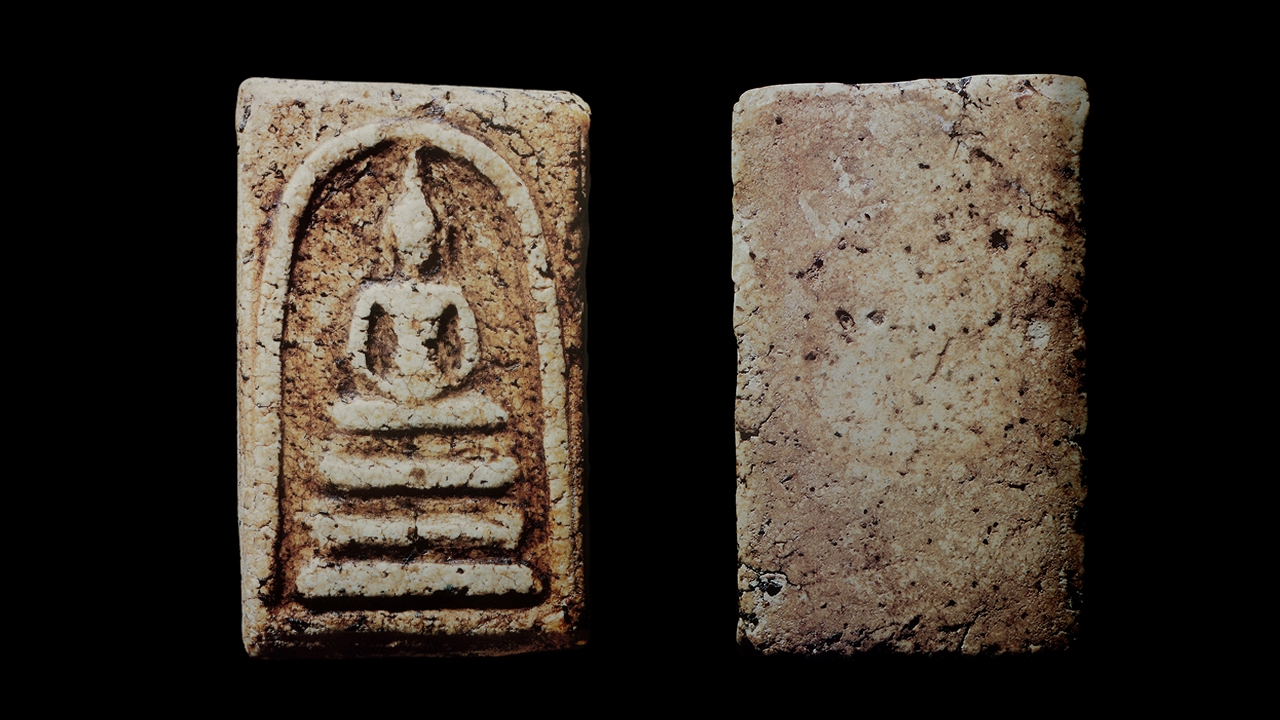
The Phra Somdej Wat Rakang Base Saem mold, formerly known as “chest groove, elongated ears, Base Saem,” is the most frequently found mold among all the standard molds of Phra Somdej Wat Rakang. These standard molds include the Large mold, Chedi mold, Base Saem mold, Bud lotus bud mold, and Bodhi leaf mold. Meanwhile, the Bodhi leaf mold is the rarest among them (collectors in the past often did not acknowledge this mold as made by Somdet To, partly due to its scarcity and lack of popularity).
/ “Chest groove” seen on the chest area of this mold results from the craftsmen’s intention to carve the mold to depict the sash line. Some sub-molds may have a solid chest making the sash line invisible, or some may show a deeper groove due to mold wear, mold re-carving, or other factors. However, / An anonymous Phra Somdej expert commented on this: “The term chest groove for the Phra Somdej Wat Rakang Base Saem mold actually refers to a solid chest, not a deep groove. When the mold is pressed sharply and clearly, a sash line runs from the center of the chest down to the navel, resembling a chest groove at a glance. But upon closer examination, this sash line is raised, not a recessed groove...”
This mold often features “elongated ears” on both sides, usually as straight lines (though some resemble ceremonial ear decorations), extending from the sides of the head nearly to the shoulders. This imitates the ears of ancient Buddha statues, which often have long ears with a groove in the middle for earrings, symbolizing the Buddha’s royal status before ordination, as wearing earrings made the ears elongated.
The term “Base Saem,” which gives this mold its name, refers to the presence of a seam line above the third base layer (counting from the bottom) and the second base layer. An anonymous source noted that the seam line above the second (middle) base starts from the right side base of the Buddha image and is often uneven, not a continuous straight line, tapering faintly toward the left side. Compared to the seam under the lap, that line is clearer and lies between the Buddha’s pedestal base and the third base layer. However, the seam line on the Base Saem mold of Phra Somdej Wat Bang Khun Prom is much sharper.
It is interesting that the Phra Somdej Wat Rakang Base Saem mold exhibits several distinct characteristics clearly differing from other molds of Wat Rakang, deserving an understanding of its design origins.
Firstly, Mr. Kiti Thamcharat, a Phra Somdej expert, stated in the book Precious by Assistant Professor Rangsarn Tosuwan that the Phra Somdej Wat Rakang Base Saem mold “is the only mold in the Wat Rakang Kositaram series with relatively shallow and more prominent mold art, not as bulky as other molds of Wat Rakang.”
Secondly, the Buddha in the Base Saem mold sits in the diamond meditation posture, unlike other standard molds of Wat Rakang, which sit cross-legged flat. This can be observed from the indentation below the neck area resembling the diamond posture where the shanks cross and the soles face upward on the knees. Professor Prakit Limsakul (alias Phlai Chumphon) in Thairath Newspaper elaborated that the diamond sitting posture also appears in other molds, referencing Triyampawai’s classification of the lotus bud mold into: large mold with flat crossed legs, open mold with diamond crossed legs, stout mold with diamond crossed legs, small mold with flat legs, and tapered bud mold with diamond crossed legs.

Thirdly, “ The Science of Phra Somdej” reported that the Buddha figure of the Wat Rakang Base Saem mold appears to float above the base, unlike other molds where the Buddha’s weight rests on the base, which appears to flex downward in layers. When examining the base of this mold, all three layers, including the seam line above the base that gives the mold its name, seem to float independently and do not interlock as in other Wat Rakang molds.
“The Science of Phra Somdej” offers an interpretation of these three unique features: The high production quantity of this mold suggests it was made for a special occasion requiring many amulets. The shallow carving indicates a rushed mold-making process to produce many molds quickly. Some pieces show line patterns similar to those of Phra Somdej Wat Bang Khun Prom, which also had hurried carving that somewhat affected beauty. The design of the Base Saem mold likely draws heavy influence from the early rectangular five-, six-, and seven-layer base molds from Wat Ket Chaiyo, which also depict the Buddha figure floating above the base. It is also possible that the three-tiered base and seam line design were crafted to complement the diamond sitting posture, symbolizing the strength and uniqueness of Buddhist art. Important Thai Buddha statues in the diamond posture, such as Phra Phuttha Sihing at Wat Phra Singh in Chiang Mai, another Phra Phuttha Sihing in Nakhon Si Thammarat, and Phra Nirantrai created by King Rama IV, show statues elongating upward in this posture. Thus, the supporting base design likely needed to extend upward accordingly.
“The Science of Phra Somdej” ends this discussion by summarizing Mr. Kiti Thamcharat’s knowledge on the Wat Rakang Base Saem mold from Assistant Professor Rangsarn Tosuwan’s book Precious for educational purposes:
1. The crown of the head is sharper and clearer than in other Wat Rakang molds.
2. The shoulder to arm has a graceful curved line, and the Buddha sits in the diamond meditation posture.
3. The thorned glass cover arch resembles split rattan, similar to the Wat Rakang Large mold (the Wat Bang Khun Prom Base Saem mold is smaller).
4. The Buddha’s right ear is clearly separated from the head with the upper part curving outward, while the left ear is close to the head.
5. The Buddha’s right arm is bent at the elbow.
6. The left arm is more curved than the right arm.
7. The sash line runs down to the Buddha’s palm; it is very fine and shallow, often invisible if not fully pressed.
8. The waist flares outward (the Wat Bang Khun Prom Base Saem mold has a V-shape).
9. The center of the diamond crossed legs dips slightly inward (not so in the Wat Bang Khun Prom Base Saem mold).
10. The seam line under the base is less distinct than that of the Wat Bang Khun Prom Base Saem mold.
11. The lowest base is large, with beveled edges slanting outward; the middle base is the smallest with lion-head-shaped sides; the top base is larger than the middle but smaller than the bottom, with ends beveled upward and slightly inward curved.
More details can be found on the Facebook page "Phra Somdej Science" by Police Lieutenant Colonel Komsan Sanongpong. Thanks to Assistant Professor Rangsarn Tosuwan for kindly providing photos of a prime Wat Rakang Base Saem amulet—an example with a solid chest, showing moderate wear, no visible sash line, a white-yellow hue, dense strong material with crackling patterns and lacquer residue inside. It also has visible sacred powder granules, tiny porous marks, and characteristic wormhole traces on the back indicating genuine old amulet material. The mold is accurate to the standard, showing elongated ears nearly reaching the shoulders on both sides, a large split rattan arch, lacquer stains in pits on front and back, perfectly cut mold edges, a smooth back with characteristic cracking that shows age, and general surface sinking and wrinkles. This specimen serves as an excellent study model for understanding Wat Rakang amulets. More articles are available in the "Science of Phra Somdej" column.
Author Police Lieutenant Colonel Komsan Sanongpong, former forensic police officer
Facebook page –Phra Somdej Science