

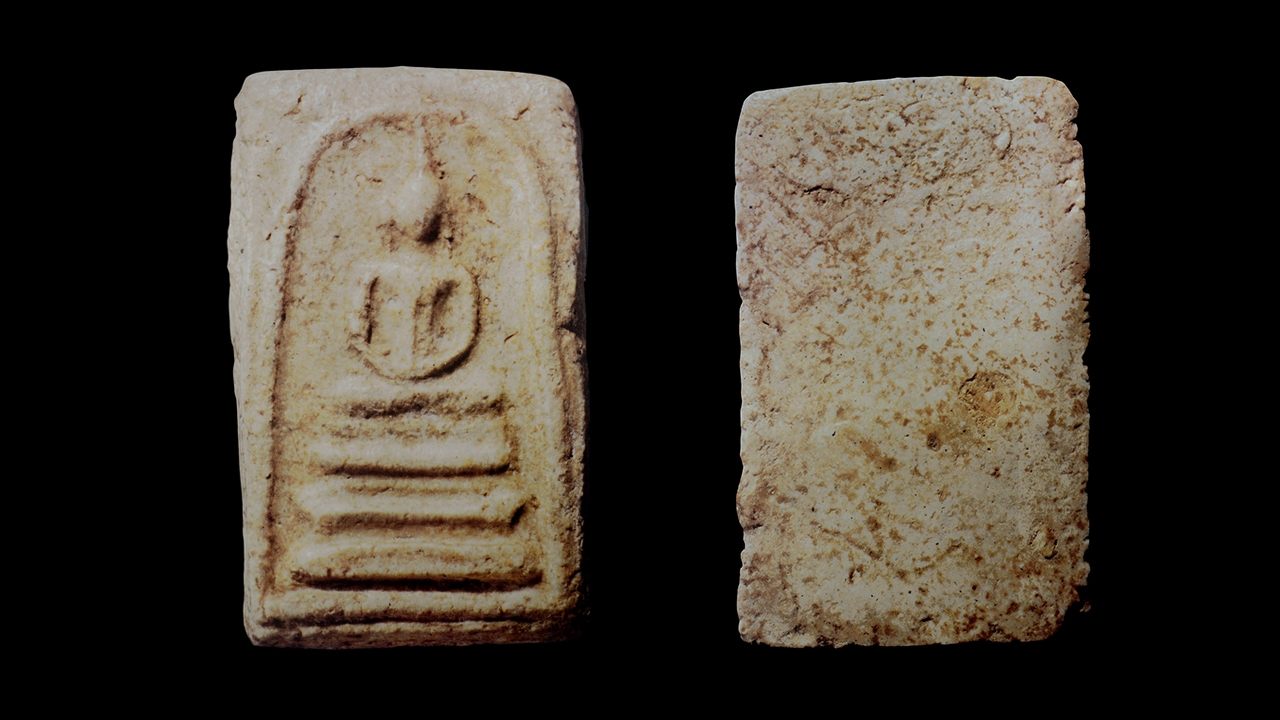
The Triyampawai scripture states that Phra Somdej Wat Bang Khun Phrom has 9 standard amulet molds, namely: Large mold, Chedi mold, Sam base mold, Lotus bud mold, and Bodhi leaf canopy mold. (The first 5 molds are originally those of Wat Rakang, which were later re-carved by Wat Bang Khun Phrom.) Thread mold, Sangkhati mold, Double base mold, Garuda head with monk's bowl mold, with the last 4 molds being unique to Wat Bang Khun Phrom (Regarding the Reclining mold, it was recognized among collectors later when the Great Chedi relic chamber was opened in 1957 CE, where a few of this mold were found. Professor Prakit Limsakul, or Plai Chumphon of Thairath newspaper, noted that this mold had been found even before the major relic chamber opening, but overall, the numbers remain quite limited).
While the Sam base mold of Phra Somdej Wat Rakang is the most commonly found among all Wat Rakang amulets, the most frequently discovered mold during the major relic chamber opening at Wat Bang Khun Phrom was not the Sam base mold but the thread mold, found in numbers close to the sangkhati mold.Sangkhati mold,The Bodhi leaf canopy mold is rare in both Wat Rakang and Wat Bang Khun Phrom collections.
The first 5 molds of Phra Somdej Wat Bang Khun Phrom, when examined through Buddhist art style, mold shape, and credible documents, appear mostly to be molds copied from Phra Somdej Wat Rakang molds. They generally are smaller and shallower overall, especially the split rattan arch, which tends to be smaller, less refined, and less artistically elegant (possibly due to the rush in carving many molds within a limited time). The last 4 molds seem mostly to be newly carved molds.
It is possible that the molds in the latter group, such as the thread mold, theSangkhati mold,and double base mold, were made from existing ancient molds originally from Wat Rakang, which had ceased production. These were re-carved by local skilled artisans, such as the group led by Mr. Thet, a nephew of the revered Somdej Toh (as mentioned in Triyampawai’s book “Adapted Amulets”). However, most molds found during the major relic chamber opening at Wat Bang Khun Phrom, across all 9 molds, show signature lines very close to those of the standard Wat Rakang molds previously collected. Senior amulet expert Ajarn Prajam U-Arun opined that the molds for Wat Rakang and Wat Bang Khun Phrom standard amulets were carved by the same group of artisans, known as the Royal Goldsmith group. This raises questions: if so, what did the ancient molds of Wat Rakang, such as thread, sangkhati, and double base molds, really look like? Did the Royal Goldsmith artisans use these ancient molds as templates to carve the Wat Bang Khun Phrom molds placed inside the Great Chedi relic chamber? If not, what templates did they use? These questions are intriguing for scholars of Phra Somdej amulets, and “The Science of Phra Somdej” plans to explore this topic at an appropriate time.Sangkhati mold,Double base mold, etc., if they truly existed, what was their appearance, and did the Royal Goldsmith artisans use these ancient molds as models for carving Wat Bang Khun Phrom molds enshrined in the Great Chedi? If not, what did they use as templates? This is an interesting topic for Phra Somdej researchers, which “The Science of Phra Somdej” will present in due course.
Regarding the first 5 molds of Phra Somdej Wat Bang Khun Phrom, which directly imitate Wat Rakang, aside from reduced artistic refinement, there is also a relaxation in the "mold shape" standards. Wat Rakang strictly defines the mold shapes, as previously discussed in “The Science of Phra Somdej,” where the designer of the Large mold applied principles of perspective (drawing to scale and 3D appearance) to create multiple blocks. The artisan carving the Large mold would have sat viewing the principal Buddha image in Wat Rakang’s ordination hall from a slightly left front angle. Each mold block strictly adheres to this perspective principle. Some have noted that differences among Large mold blocks lie only in minor details; the mold shape, unique characteristics, and distinguishing features are consistent and similarly located across blocks. However, this approach is much harder to apply to Phra Somdej Wat Bang Khun Phrom molds like the Large mold or others, because the artisans carving the molds often did not strictly follow the "mold shape" pattern, possibly due to the rush to produce many molds within a limited time or absence of clear mold shapes or sketches. It may have been a form of live carving.Sketcheswhich may not have been clear, possibly resulting in spontaneous carving.

Phra Somdej Wat Rakang is considered a masterful work of art, with meticulous care from mold design through carving, and a strict, clear "mold shape" pattern. Although multiple mold blocks exist for the same mold, artisans consistently follow the defined shape for every block (in modern terms, carving according to a drawing). In contrast, some molds of Phra Somdej Wat Bang Khun Phrom, although modeled on Wat Rakang molds, show that artisans did not strictly adhere to the "mold shape" of the template during carving. This can be described as "mold shape relaxation," making the study of Wat Bang Khun Phrom molds more challenging. "The Science of Phra Somdej" believes that when evaluating some molds of Phra Somdej Wat Bang Khun Phrom, assessing the material, relic residue, and mold imperfections is crucial for authenticity, since studying mold shapes is much harder than for Wat Rakang molds, especially among the first 5 molds.
"The Science of Phra Somdej" concludes this section by presenting an evaluation approach for Phra Somdej Wat Bang Khun Phrom’s Sam Base mold, the second mold classified by the anonymous author of Precious magazine, assisted byAssistant ProfessorRangsarn Tosuwan, as follows (The anonymous author divided the Sam Base mold into 3 subtypes: Subtype 1 resembles Wat Rakang’s Sam Base mold subtype 1 (Wat Rakang has 4 subtypes); subtype 2 is unique to Wat Bang Khun Phrom; subtype 3’s mold art resembles the Double Base mold of Wat Bang Khun Phrom).
1. The upper area is wider than the lower (common in both Wat Bang Khun Phrom and Wat Rakang).
2. The mold border line is thicker and raised (more so than subtype 1).
3. The lower right base corner of the Buddha is cut at a sharp slant, while the lower left base corner is flat—this is important.
4. The Buddha’s hair is long and tapered like a chedi spire.
5. The face is an oval half-cut shape.
6. Both ears are straight lines extending to the shoulders; the Buddha’s right ear is higher than the left—this is very important.
7. The chest is narrow (narrower than subtype 1).
8. TheSangkhati lineruns as a double line from the chest down to the palm. At first glance, it looks like a chest groove, but under a microscope, it appears as a curled line, similar to subtype 1.
9. The lap area shows a horizontal figure eight, faintly showing the right foot overlapping the left foot.
9. The seam line under the lap is shorter than both knees and sharper than that of Wat Rakang’s Sam Base mold.
10. The seam line under the lap is thicker and sharper than subtype 1.
11. The protective arch (split rattan arch) is as thick as subtype 1 and thicker than subtype 3.
For more reading, visit the Phra Somdej Science page by Police Lieutenant Colonel Komsan Sanongpong, with thanks to Assistant Professor Rangsarn Tosuwan for kindly providing photos of a master Phra Somdej Wat Bang Khun Phrom for educational purposes, and gratitude to the current owner of this amulet. This is a very beautiful Phra Somdej Wat Bang Khun Phrom Sam Base mold (subtype 2 as classified by the anonymous author) with correct mold shape according to scriptures, sharp and elegant features, yellowish tone, relic residue covering the front and back. The back is smooth with general wrinkles, and the front shows a slight edge curl on the Buddha’s left side, a common feature in Wat Bang Khun Phrom amulets. This serves as an excellent model for studying Phra Somdej Wat Bang Khun Phrom. Further articles are available in the "Science of Phra Somdej" column.
Author: Police Lieutenant Colonel Komsan Sanongpong, former forensic police officer.
Facebook page: –Phra Somdej Science