

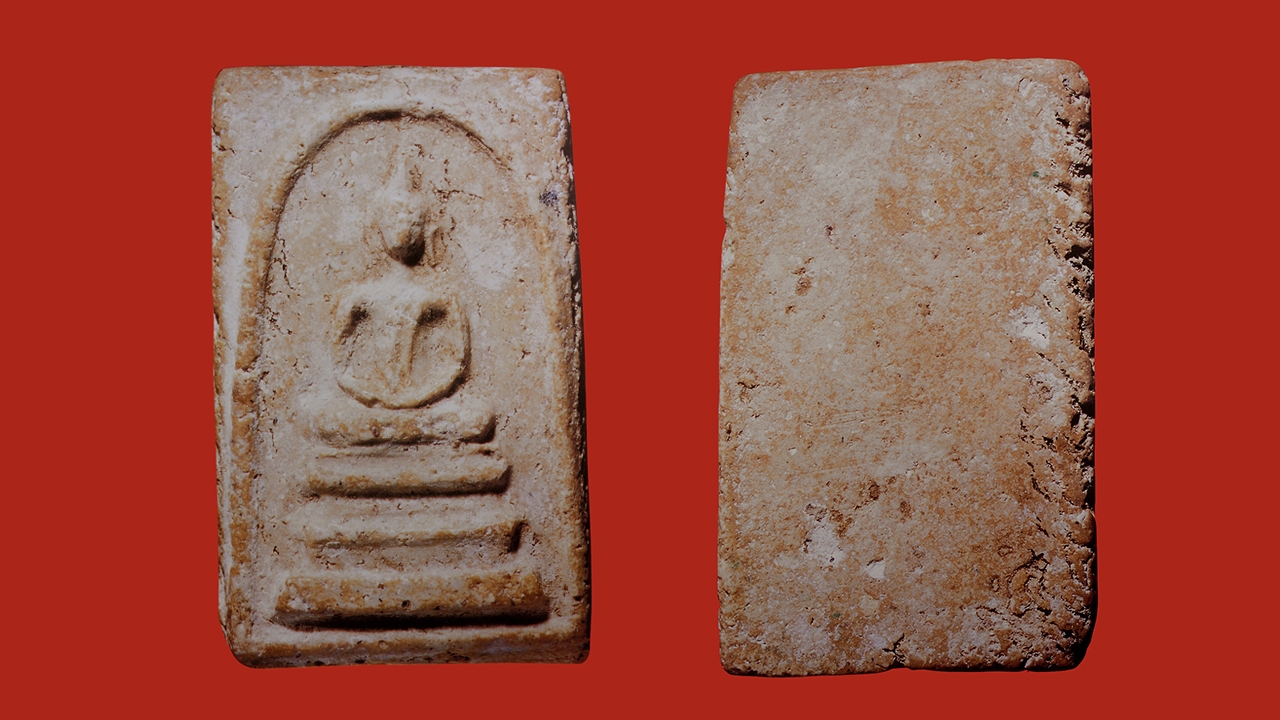
The collecting of Somdej amulets by Somdej Phra Phutthachan (Toh Prommarangsee), particularly the Somdej Wat Rakang, has an interesting aspect presented by “The Science of Somdej”: the expansion or acceptance of new amulet molds as authentic creations of Somdej Toh.
There are two case studies. A good example illustrating this is the case of the Somdej Wat Rakang in the Bodhi Leaf mold. Originally, most collectors did not accept this mold as created by Somdej Toh. An anonymous Somdej expert from the Precious magazine, under Assistant Professor Rangsarn Tosuwan (published between 1995 and 1999), once stated that they had never seen this mold with the material composition typical of Somdej Wat Rakang. At that time, Precious magazine also did not classify this mold as made by Somdej Toh. “The Science of Somdej” suggested that the collectors’ lack of interest then might have been due to the rarity of this mold. However, over time, this mold gained increasing recognition. One reason supporting its creation by Somdej Toh was the discovery of Somdej Wat Bang Khun Phrom amulets in the Bodhi Leaf mold when opening the large pagoda treasury at Wat Mai Amataros in 1957 (the new treasury). Triyamphawai reported finding only 17 pieces of this mold, a notably small number compared to others, which led to the belief that a Somdej Wat Rakang amulet in this mold was also produced. Ajarn Prakam U-Arun An expert on Somdej amulets said that before this major treasury opening, Somdej Wat Bang Khun Phrom amulets in this mold (old treasury) were also very rare. Today, the Somdej Wat Rakang in Bodhi Leaf mold is considered a high-value collectible. “The Science of Somdej” plans to further explain this mold in a future opportunity.
The second case study is also a classic example: the Somdej Wat Rakang Lotus Bud Hairprint mold. Initially, collectors believed there was only one subtype of this mold, namely the narrow lion base (most famously represented by Khun Montree’s piece). Anonymous described this mold in Precious magazine: “This Lotus Bud Hairprint mold has been known since my grandfather’s time. It is named so because the hair of the Buddha image resembles a lotus bud, especially clear in some pieces. This differs from other Wat Rakang molds, like the large mold and the cross-base mold, which have longer, slender hair, or the stupa mold that shows a garland-like notch over the hair. The Lotus Bud Hairprint mold is characterized by deep relief, less delicate, emphasizing thickness and dignity. Its features are thick and solid, from the chest to the lowest base. The chest and base lines are thick and solid, unlike other molds. The arch covering the glass is especially thick, like a split rattan placed on the base. In my study, there is only one subtype of this mold.” However, it is possible that Anonymous combined the wide lion base and narrow lion base molds, which differ only slightly in length, into a single subtype.

Later, someone introduced Somdej Wat Rakang amulets with a wide lion base mold into the market, classifying it as a second subtype of this mold. Ajarn Prakit Limsakul or Phlay Chumphon of Thairath newspaper said that the wide lion base Lotus Bud Hairprint mold of Somdej Wat Rakang was only recognized as a standard subtype in the amulet community about twenty years ago.
Ajarn Prakit further explained the knowledge of the Lotus Bud Hairprint mold referencing Triyamphawai’s book, which identifies five subtypes: Large mold with flat base, Clear mold with diamond-cut base, Sturdy mold with diamond-cut base, Small mold with flat base, and Slim Lotus Bud Hairprint mold with diamond-cut base.
Somdej amulets by Somdej To especially Somdej Wat Rakang have been popular collectibles for a long time, possibly since their creation. Accepted molds and materials have been informally defined with guidance from respected amulet experts, creating practical knowledge accepted within the collector community. The accepted molds attributed to Somdej To have evolved over time, generally expanding acceptance of new molds, as illustrated above. Academic forensic studies represent a new approach with credible principles that may lead to discovering more molds truly created by Somdej To.
“The Science of Somdej” concludes this article by presenting evaluation criteria for the Somdej Wat Rakang Lotus Bud Hairprint mold with narrow lion base, or subtype one according to Anonymous, for educational purposes as follows:
1. The hair resembles a lotus bud.
2. The forehead area gradually slopes upward from the brow to support the base of the hair.
3. Both ears are raised ridges with thick curved lines resembling traditional ceremonial decorations, extending to the shoulders on both sides. The flesh around both shoulders down to the armpits is especially thick, differing from other molds.
4. The left knee is rounded, while the right knee is more curved and sloped.
5. On the chest’s right side, the sole of the foot protrudes clearly beneath the chest.
6. The seam line starts as a small base mark before becoming a seam, clearly visible above the second base layer.
7. The seam’s origin under the chest at the right base corner connects with the third base layer’s corner.
8. The material composition is dense.
9. Thicker than the large mold and cross-base mold, noticeably similar in thickness to the stupa mold.
Further reading is available on the Facebook page "The Science of Somdej" by Police Lieutenant Colonel Komsan Sanongpong. Thanks to Assistant Professor Rangsarn Tosuwan for kindly providing photos of a master Somdej Wat Rakang amulet for educational purposes and to the current owner of this beautifully preserved narrow lion base Lotus Bud Hairprint amulet. This specimen is textbook-accurate, with a soft, dense material (often lacking typical crack patterns), visible granules of sacred powder, small porous holes known as needle pores, worm trails on the back, a smooth back with natural aging signs such as edge chips and oil-like stains. It serves as an excellent study model for Somdej Wat Rakang amulets.
Author Police Lieutenant Colonel Komsan Sanongpong, former forensic police officer
Facebook page –The Science of Somdej