

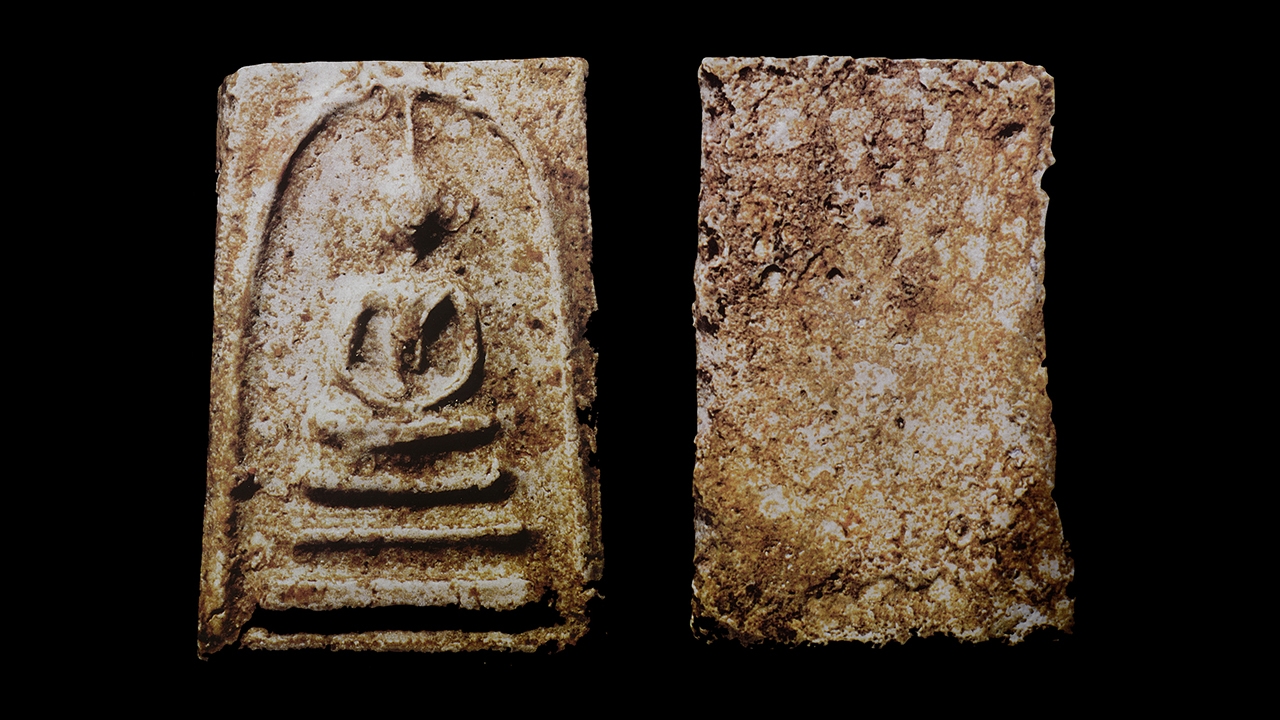
It has been said that Phra Somdej amulets of Somdej To exhibit the 32 auspicious physical marks of the Buddha, a metaphor meaning these amulets often show complete and detailed features resembling a human form (comprising 2 eyes, 2 ears, 1 nose, 1 mouth, 2 arms, 2 legs, 2 hands, 10 fingers, 10 toes, totaling 32 marks). For instance, they often display details of the ears (พระกรณ), arms (พระกร), and shins (พระชงฆ์)." ,
Generally, Somdej To’s Phra Somdej amulets show a summarized version of these features without extensive human-like detail, unlike older amulets such as Phra Rod Lamphun, Phra Kamphaeng Soom Kor, and Phra Pong Suphan, which have more intricate details clearly depicting eyes (พระเนตร), nose (พระนาสิก), mouth (พระโอษฐ์), and feet (พระบาท) in well-defined pieces. Among Somdej To’s nine standard mold types—large print, pagoda print, cross base print, Lotus Bud Hairprint, Bodhi leaf print, thread print, monk’s robe print, double base print, and Garuda chest print (the first five include versions from Wat Rakang and Wat Bang Khun Phrom, the last four exclusively from Wat Bang Khun Phrom)—the Lotus Bud Hairprint particularly stands out. The “Science of Phra Somdej” notes that, upon close inspection, some Phra Somdej amulets display all four facial features—eyes, nose, mouth, and feet—together in one piece, particularly in the Lotus Bud Hairprint mold. These features appear in amulets from both Wat Rakang and Wat Bang Khun Phrom. Although other mold types occasionally show facial traits, these are rare and not analyzed here. The Bodhi leaf print sometimes shows clear feet features but may be a modified mold with an added Bodhi leaf carving.
Phra Somdej Lotus Bud Hairprint from Wat Rakang Currently accepted as a standard mold, this type has two subtypes: the traditionally accepted narrow lion base and the more recently recognized wide lion base. Facial features like eyes, nose, and mouth appear in some narrow lion base pieces, though very few; the famous piece owned by Khun Montree possibly shows such traces. Most wide lion base amulets lack facial features but share a similar overall design. The left foot often extends slightly below the right foot in narrow lion base amulets, whereas in the wide lion base, the feet appear crossed with no distinct foot details; some wide lion base pieces show no foot shape at all.
Regarding Phra Somdej Lotus Bud Hairprint from Wat Bang Khun Phrom (Wat Mai Amataros), Niranam, from Precious Magazine under Assistant Professor Rangsarn Torsuwan, classifies them into three molds: 1. Narrow lion base 2. Large seated with crossed feet 3. Small print The small print is very rare; its mold style resembles the monk’s robe print from Wat Bang Khun Phrom but with a Lotus Bud Hairprint style hair, also called “Thit Tum” print, meaning monk’s robe with Lotus Bud Hairprint hair. Facial features, especially the nose, appear in these prints, notably in the large seated with crossed feet mold (featured on the cover of Precious Magazine issue 20, published in 1997), though very scarce.

Niranam explains that the narrow lion base mold from Wat Bang Khun Phrom closely resembles Wat Rakang’s Lotus Bud Hairprint. The lion base (second tier base) is narrower in this mold than in Wat Rakang’s or the large seated with crossed feet mold, hence the name “narrow lion base.”
For the large seated with crossed feet mold from Wat Bang Khun Phrom, Niranam describes the mold art as elegant and robust, more numerous than other molds from this temple. Its Buddhist art differs from Wat Rakang’s Lotus Bud Hairprint. A distinguishing feature is the clearly visible slender left foot extending diagonally downward beyond the lap’s lower edge, giving the mold its name.
It is said that Somdej To’s Phra Somdej amulets possess all 32 auspicious marks. However, pieces with clear facial features are almost nonexistent, raising questions about whether such amulets truly display faces. Nevertheless, available evidence suggests that mold carvers did include facial features in some molds, especially the Lotus Bud Hairprint from both Wat Rakang and Wat Bang Khun Phrom, along with numerous detailed lines. Professor Prakit Limsakul , orPhlai Chumphonfrom Thairath newspaper, is one researcher who has studied Phra Somdej amulets with faces in the column “Miracles from the Amulet Shelf” with great interest.
“Science of Phra Somdej” I would like to conclude this section by explaining how to identify defects in the Lotus Bud Hairprint mold “Large Seated with Crossed Feet” from Wat Bang Khun Phrom, as described by Niranam, for educational purposes as follows:
1. The mold’s upper boundary line is closer to the glass arch than in other molds.
2. The outer background surface outside the glass arch is higher than the inner surface.
3. The glass arch line is thinner than that of the narrow lion base mold.
4. The hair resembles a lotus bud, with a garland-like cluster at its base.
5. The face resembles a matte fruit.
6. Both ears are shaped like ceremonial Bai Sri decorations.
7. One monk’s robe line slopes upward toward the shoulder.
8. Another monk’s robe line is straight.
9. The right arm’s groove is narrower than the left arm’s groove.
10. The slender foot clearly extends below the lap’s lower edge.
11. The third tier base is thick and large.
12. The right front base edge is beveled up to the glass arch.
13. The left front base edge is blunt and does not reach the glass arch.
14. At the lower left glass arch edge, the mold’s boundary line lies closely alongside the glass arch line.
For further reading, visit the Facebook page “Phra Somdej Science” by Police Lieutenant Colonel Komsan Sanongpong. Special thanks to Assistant Professor Rangsarn Torsuwan for kindly providing images of an exemplary Wat Bang Khun Phrom Lotus Bud Hairprint amulet, Large Seated with Crossed Feet mold (classified into narrow lion base, large seated with crossed feet, and small molds). This beautifully crafted piece accurately matches textbook descriptions, with the left foot hanging diagonally downward, giving the mold its name. It shows front and back residue, a pale coloration, and faint flared edges likely trimmed closely. The back is smooth, typical of most Wat Bang Khun Phrom Phra Somdej. The upper left back shows sponge-like residue. The edges are neatly trimmed on all sides, making this a prime study example.
Written by Police Lieutenant Colonel Komsan Sanongpong, former forensic police officer
Facebook page –Phra Somdej Science