

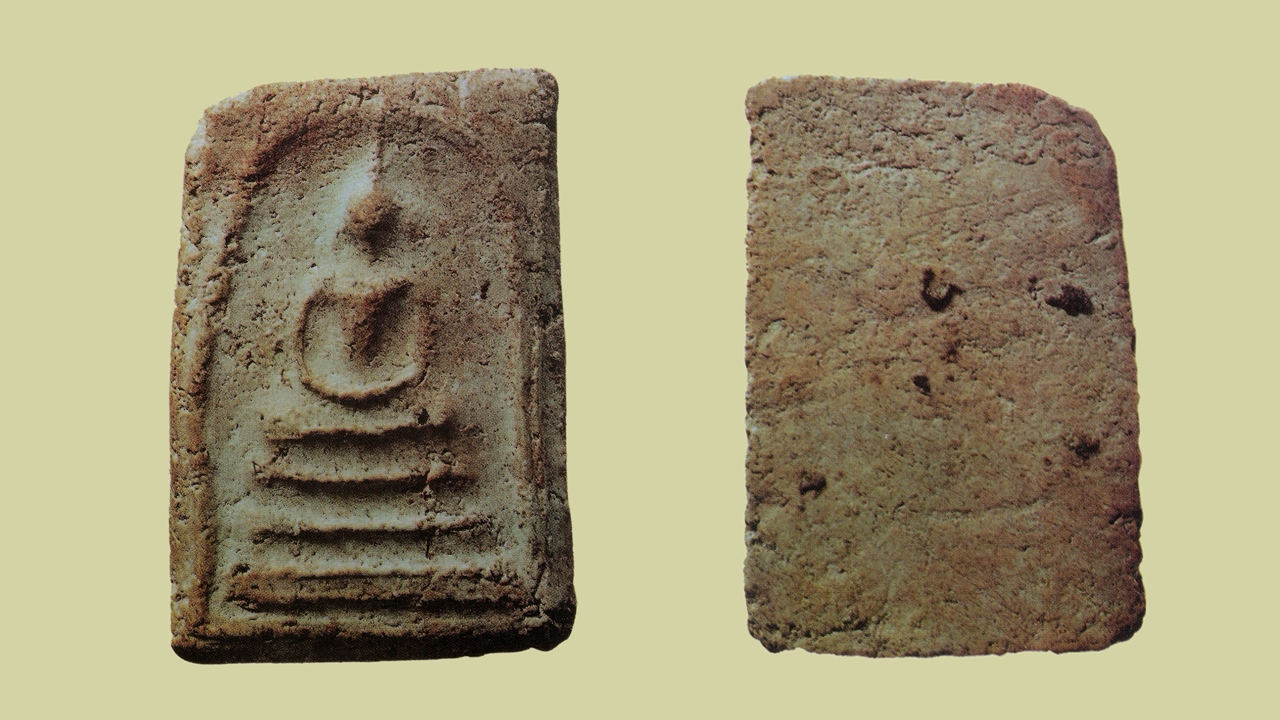
According to the Triyamphwayan scripture, Wat Bang Khun Phrom Phra Somdej has nine standard molds. The first five molds—Large mold, Chedi mold, Base Sam mold, Lotus Bud mold, and Bodhi Leaf mold—mostly replicate the molds of Wat Rakhang, which were already popular collectibles. The remaining four molds—Thread Line mold, Sangkhati mold, Double Base mold, and Garuda Chest mold (Professor Prakit Limsakul, also known as Phlai Chumphon, from Thairath newspaper, mentioned that the Garuda Chest mold also exists in Wat Rakhang.Currently, the amulet community believes these molds were created later specifically for producing Wat Bang Khun Phrom Phra Somdej amulets, especially to be placed in the Great Chedi's reliquary in 1870 CE. It is interesting that among all Wat Bang Khun Phrom Phra Somdej molds, the Large mold is the most valued and sought after. It is notable to examine how its mold carving resembles the large mold of Wat Rakhang Phra Somdej.
An anonymous contributor to Precious magazine, associated with Assistant Professor Rangsarn Tosuwan, categorized the Wat Bang Khun Phrom Phra Somdej Large mold into three subtypes: 1. Deep mold 2. Shallow mold 3. Deep mold with a line beneath the lap Subtypes 1 and 3 share Buddhist artistic styles similar to Wat Rakhang Phra Somdej molds. (The anonymous contributor further divided Wat Rakhang Phra Somdej Large mold into four subtypes, with subtype 1 being the Principal Buddha mold featuring a line beneath the lap)The anonymous contributor statedthat subtype 2 is the V-shaped chest mold.He added thatthis moldactuallyalso features a line beneath the lap, but it is closer to the chest, so in some examples the line is less clearly visible. Subtype 3 is the cylindrical chest mold, and subtype 4 is the hair piercing arch mold.) One quick observation isthatwhile in Wat Rakhang Phra Somdej Large molds all subtypes have the left mold edge extending down to the arch covering the glass case near the elbow of the Buddha, in Wat Bang Khun Phrom Large mold subtypes 1 and 3, the left mold edge extends only down to the glass case near the Buddha's shoulder.
Regarding Wat Bang Khun Phrom Phra Somdej Large mold subtype 2 (the shallow mold) experts often say this mold uniquely represents the Wat Bang Khun Phrom Phra Somdej Large mold because its Buddhist features clearly differ from the Wat Rakhang Large mold. The anonymous contributor also noted that the Large mold commonly traded is mostly the shallow subtype.

The “Science of Phra Somdej” column discussed the concept that the mold carvers of Wat Bang Khun Phrom, especially for the first five molds, likely belonged to the same group who carved the Wat Rakhang molds. They used the Wat Rakhang molds as templates but often "relaxed the mold design"—meaning they did not strictly follow the exact mold forms as done in Wat Rakhang molds. Even though multiple molds were carved within the same style, the general "mold framework" or "drawing" remained consistent across molds.
For Wat Bang Khun Phrom Phra Somdej Large mold subtypes 1 and 3, this relaxation was minimal, showing strong similarity to the Wat Rakhang Large mold template. However, the shallow subtype 2 shows greater relaxation, possibly due to the need to produce many amulets quickly.
An interesting observation is that the shallow Large mold of Wat Bang Khun Phrom resembles the Large Thread Line mold of the same temple. However, the Large Thread Line mold's second-tier base on both left and right sides lacks the lion's head base, unlike all Large mold subtypes which feature lion's head bases on the second-tier base.Some Phra Somdej expertshave opined that the Large Thread Line mold also features lion's head bases on the second tier, based on similarities in base shape. However, this lion's head base might result from the carver's incidental iron tip flicks or mold surface carving,which created features resembling lion's head bases.The “Science of Phra Somdej” column leans toward the view that all Thread Line molds lack lion's head bases. This distinction is considered a crucial point for differentiatingbetween Wat Bang Khun Phrom Phra Somdej Large Thread Line molds and the Large molds themselves.)
The “Science of Phra Somdej” column concludes this segment by outlining guidelines for assessing the Wat Bang Khun Phrom Phra Somdej Large "Shallow mold," the most commonly encountered subtype, to aid further study.These are as follows:. . .
1. A distinguishing feature from the Deep and Deep with line beneath lap subtypes is that the left mold edge of the Buddha figure extends as a long line from the top border down to the first base tier of the glass case.. . .2. The glass case arch is shallower compared to the Deep and Deep with line beneath lap subtypes.
. . .
3. The hair of the Wat Bang Khun Phrom Phra Somdej Large Shallow mold is longer than that of the Deep and Deep with line beneath lap subtypes.. . .. . .
4. The right shoulder area of the Buddha is thicker, while the left shoulder area is thinner.
5. The left knee of the Buddha is positioned above the third base tier.
6. The right knee aligns with the third base tier.
7. Both sides of the second base tier display lion's head bases.
8. These amulets exist in both old and new reliquaries, and it is assumed some were never enshrined, though none have been found yet.
9. Regarding the back mold of Wat Bang Khun Phrom Phra Somdej, the key difference from the Wat Rakhang Khositaram back mold is that the cut edges on all four sides are raised ridges resembling a woven tray edge. Other back marksindicatethe common defects in the Large mold back: wrinkles from shrinkage, fine line-like marks resembling fibers,, and linear cracks or breaks.For more information, visit the "Phra Somdej Science" page by Police Lieutenant Colonel Komsan Sanongpong. Thanks are extended to Assistant Professor Rangsarn Tosuwan for kindly providing images of master-class Wat Bang Khun Phrom Phra Somdej,and to the current owner of this particular amulet, which is a stunning example of the Wat Bang Khun Phrom Phra Somdej Large Shallow mold. Its mold is textbook correct and distinctive to Wat Bang Khun Phrom (the arch line is smaller and shallower than Wat Rakhang's). The second base tier shows lion's head bases that mark the difference between the Large mold and the Large Thread Line mold, though not very distinctly.
It has a light brown tone with slight temple dirt covering parts of the front and back. The back is smooth, with a slight raised ridge visible on the left mold edge. No flared edges are visible, likely due to narrow trimming that removed them all.This amulet serves as an excellent study model for learning about Wat Bang Khun Phrom Phra Somdej. For more articles, see the "Science of Phra Somdej" column.Written by Police Lieutenant Colonel Komsan Sanongpong, a former forensic police officer.Facebook page:–Phra Somdej ScienceRead more from the "Science of Phra Somdej" column.