

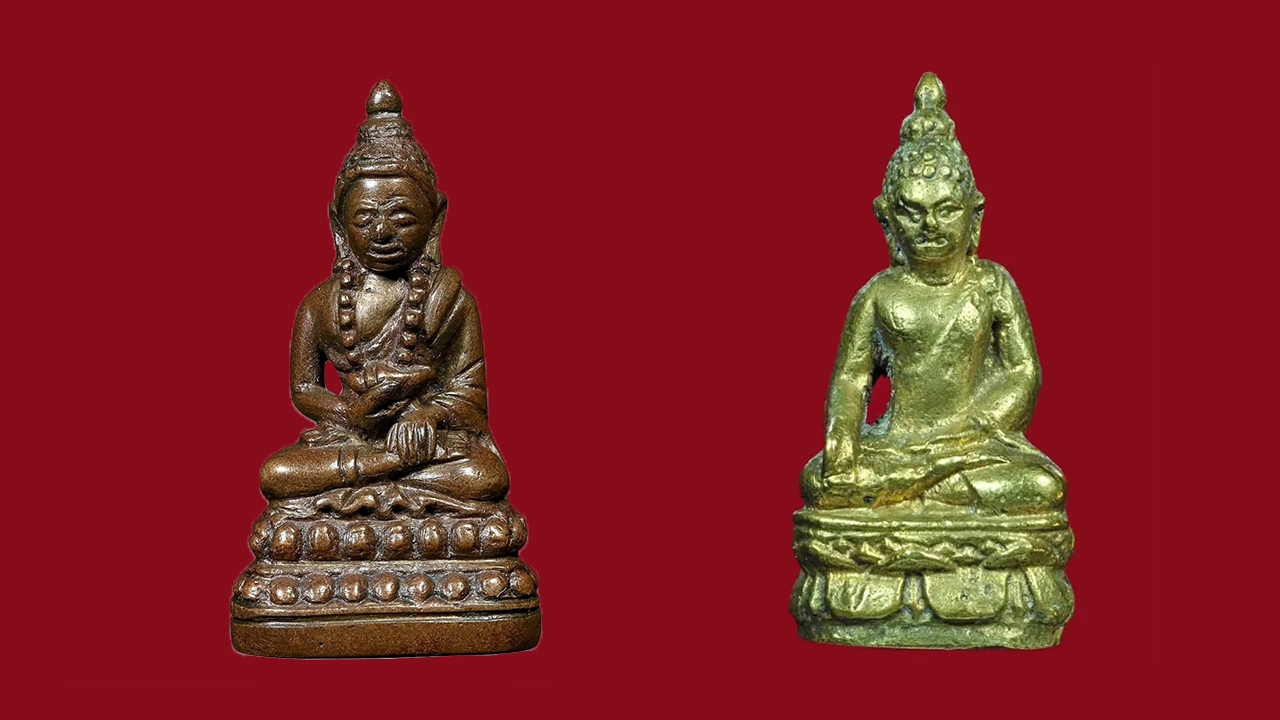
Amid the world of amulets "Phra Kring" is regarded as a masterpiece of fine art, notable not only for its spiritual power but also for its complex craftsmanship and beautiful Buddhist artistry. It also has a unique characteristic, a "sound" that comes from inside the statue when shaken. Many know of its sacred reputation, but few realize that the true roots of Phra Kring link to beliefs about "healing diseases" and "wholeness and prosperity" according to traditional beliefs.
The word "Phra Kring" refers to a small Buddha statue that contains metal pellets inside. When shaken, it produces a "kring-kring" sound, which gives it its name. In ancient belief, this ringing sound symbolizes the voice of the Dhamma, serving as a reminder to mindfulness. It is also believed to be the sound of "Medicine Buddha (Phra Bhaisajyaguru)" the Buddha of healing.
Phra Kring originated in China (Chinese Phra Kring) as a Buddha image in the Mahayana Buddhist tradition, representing the Medicine Buddha who vows to help all beings overcome physical and mental suffering. Later, the art of making Phra Kring spread to Thailand, especially during the time of Somdet Phra Sangharaja (Phae) of Wat Suthat Thepwararam, who made Thai Phra Kring famous and highly valuable to this day.
The difficulty and uniqueness of its creation make Phra Kring a costly amulet. The process involves
ancient casting techniques which require master craftsmen to create molds and cast the statues.
Inserting the ringing pellets is done before sealing the base of the statue, considered a crucial secret.
Metal composition The formula for mixing metals (such as the sacred nine-metal alloy) is designed for beauty and spiritual power, requiring advanced metallurgical knowledge.
Thus, Phra Kring is not just an ordinary amulet but a sacred object combining "science, art, and faith" However, for novice collectors, "fake Phra Kring" are widespread in the market. It is advised to study the mold shapes, critical details, and creation history from reliable sources before deciding to purchase or venerate.
Thanks for the images from the Sanam Phra Viphavadi column by Seeka Ang.