

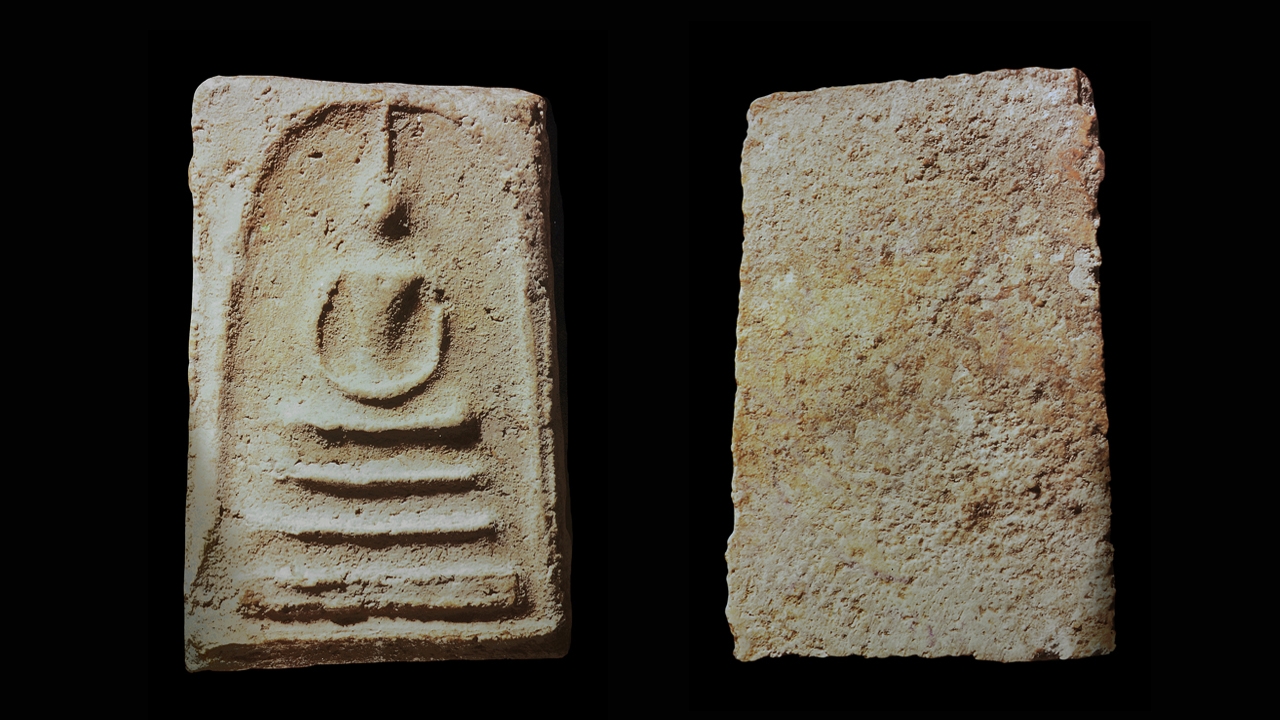
Traditionally, when seeking Phra Somdej amulets, people often mention three popular styles that are worshipped together for good fortune, commonly called "Yai Dai Dee" This name originates from the amulet styles conveying positive meanings. "Yai" means the Large style Phra Somdej (found at both Wat Rakang and Wat Bang Khun Prom). The word "Dai" refers to the Thread Line style Phra Somdej (unique to Wat Bang Khun Prom), while "Dee" signifies the Chedi style Phra Somdej (found at both Wat Rakang and Wat Bang Khun Prom).
The Thread Line style Phra Somdej Wat Bang Khun Prom is an important amulet classified within the "Yai Dai Dee" set. This style is as commonly encountered as the Sangkhati style Phra Somdej Wat Bang Khun Prom among those created by Somdej To. Meanwhile, the Prok Bodhi style (both Wat Rakang and Wat Bang Khun Prom) is the rarest, and the Ges Bua Tum style from both temples is the second rarest (excluding the Sai Yasna style).
It is interesting why the Thread Line style Phra Somdej Wat Bang Khun Prom is found in great numbers, comparable to the Sangkhati style, from both old collections (removed from the Great Chedi at Wat Mai Amataros before 1957) and new collections (discovered when opening the Great Chedi in 1957). "The Science of Phra Somdej" suggests this abundance partly results from the mold’s simpler line details compared to other Wat Bang Khun Prom styles, allowing many molds to be carved quickly with numerous subtypes, especially the Thread Line style, leading to mass production.
An anonymous writer from Precious Magazine, affiliated with Assistant Professor Rangsarn Tosuwan, classified the Thread Line (or Base Thread Line) style of Phra Somdej Wat Bang Khun Prom into seven subtypes: 1. Large (Large Thread Line - shallow mold, quite similar to the Large style Wat Bang Khun Prom), 2. Hua Bai Sri Ears, 3. Narrow Base, 4. Round Arm with Long Topknot, 5. Loop Arm, 6. Wide Arm, 7. V-shaped Chest. These seven subtypes share characteristics: the mold edges on all four sides are raised and flared (except when trimmed, making it less visible), the outer surface around the glass dome is higher than inside, the statue’s left knee protrudes higher than the right, the left side of the third base tier is lower than the left knee, the right side of the third base tier is lower than the left side and equal to or lower than the right knee. The second base tier, both left and right sides, has no lion head support, while the first base tier features raised lines along its edge (except for the Large Thread Line subtype, where the first tier is a solid bar like the Large Wat Bang Khun Prom style).

The anonymous writer emphasized that "If closely observed, the left knee of the principal Buddha is raised and higher than the left side of the third base tier. Additionally, the right knee is recessed below the right side of the third tier, causing the statue’s principal Buddha figure to tilt slightly to the left (the statue’s right side) with a subtle lean." Based on this fact, "The Science of Phra Somdej" views this as key evidence that the Thread Line style molds were newly carved between 1868 and 1870 CE to produce amulets for the Great Chedi. Credible sources state that most Wat Bang Khun Prom molds were newly carved using Wat Rakang molds as prototypes. The Thread Line style’s slight rightward tilt reflects influence from the Wat Rakang Large style mold carved by royal goldsmiths, similar to the Wat Bang Khun Prom Large style molds. (Professor Prakit Limsakul or Plai Chumphon from Thairath Newspaper explained that the Large style evolved into Thread Line, Chedi style became Sangkhati, and Base Saem became Double Base.) According to the "relaxation of mold shapes" theory previously discussed, "The Science of Phra Somdej" proposes an evolution from closely modeled Wat Rakang Large molds to more relaxed forms: starting with Wat Bang Khun Prom Large style deep mold with under-lap lines, then Large style deep mold, Large style shallow mold, Large Thread Line style, followed by other Thread Line subtypes.
the Thread Line style Phra Somdej Wat Bang Khun Prom is an important amulet categorized within the "Yai Dai Dee" set alongside the Large and Chedi styles, and it is among the most commonly found Wat Bang Khun Prom amulets, comparable to the Sangkhati style. "The Science of Phra Somdej" concludes this article by outlining criteria to evaluate the Large Thread Line style Phra Somdej Wat Bang Khun Prom, which some say closely resembles the Large shallow mold style, for educational purposes as follows:
1. The face of the Large Thread Line style resembles that of the Large shallow mold style Wat Bang Khun Prom.
2. The Large Thread Line style Buddha figure lacks ears.
3. The statue’s left shoulder, where it connects to the left arm, is recessed, not protruding like the right shoulder.
4. Both arms are slightly curved with bent elbows in the Large Thread Line style.
5. The lap area is prominently raised, and the left elbow shows robe lines extending down to the lap, a feature absent in the Large style except for the deep mold with under-lap lines. Only the Large deep mold with under-lap lines has robe lines descending to the lap. 6.
The left knee is raised considerably above the third base tier (counting from the bottom). 7. The right knee and the right side of the third base tier are nearly level in height.
8. The inner walls in the three base tiers gently slope upward supporting the raised lines of the tiers, with a slight incline compared to the inner floor of the glass dome. This is similar to the Ges Bua Tum style Wat Rakang.
9. The second base tier of the Large Thread Line style lacks lion head supports at both ends, unlike the Large style which has them.
10. Both Large and Large Thread Line styles depict the Buddha sitting, facing about 15 degrees to the right, as if slightly twisted to the statue’s right side, while the three base tiers remain straight. This causes the left lap to appear higher than the left base tier, and the right lap to seem lower than the right base tier. Further reading is available at the Facebook page "Phra Somdej Science" by Pol. Lt. Col. Komsan Sanongpong. We thank Assistant Professor Rangsarn Tosuwan for kindly providing images of the master Phra Somdej Wat Bang Khun Prom for educational purposes, and also thank the current owner of this beautiful Large Thread Line style amulet, whose features perfectly match the textbook descriptions. Notably, the left knee is highly raised and the left shoulder recessed, key traits of this subtype. The second base tier lacks lion heads, differing from the Large shallow mold style. The amulet has a light brown tone with residue from the old temple repository on both front and back, a smooth back, and a slightly raised frame edge on the left front side. This specimen serves as an excellent model for studying Wat Bang Khun Prom amulets. Additional articles can be found in the
"The Science of Phra Somdej" column.
Written by Pol. Lt. Col. Komsan Sanongpong, former forensic police officer. Facebook page:
– Phra Somdej Science
Read more columns in The Science of Phra Somdejseries.