

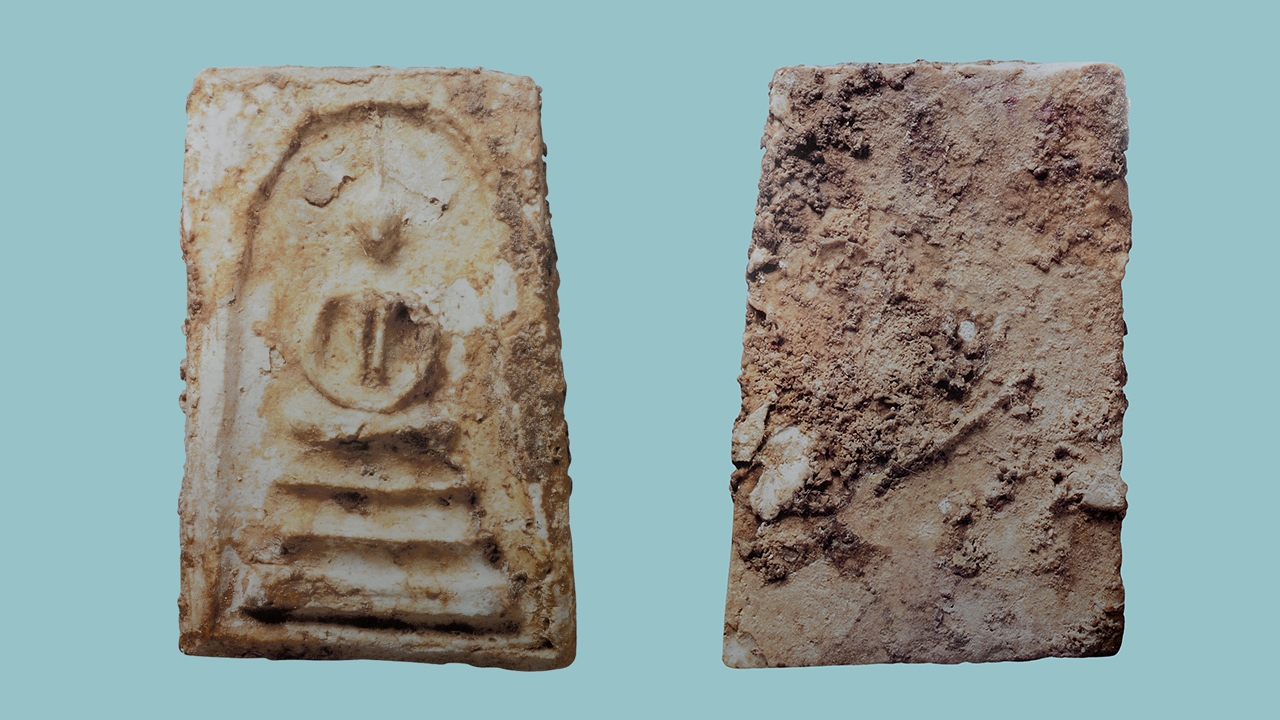
Phra Somdej Wat Bang Khun Phrom (Wat Mai Amataros) is said within the amulet community to have two batches: the old batch and the new batch. In reality, both come from the same source or deposit—the Great Chedi of Wat Mai Amataros—just recovered at different times, not from different locations.
The old batch of Phra Somdej Wat Bang Khun Phrom refers to those taken out from the Great Chedi shortly after it was sealed in 1870 CE (B.E. 2413), continuing up until before the major opening in 1957 CE (B.E. 2500). These may have been removed through official ceremonies organized by the temple or through illicit excavations that had been ongoing. Many of these later pieces were sold at Sanam Luang, the major amulet market of that era. This old batch may also include Phra Somdej Wat Bang Khun Phrom that was made but never sealed inside the Chedi, as explained by senior expert Ajarn Prijam Oo Arun.
The new batch refers to those recovered during the official opening of the Chedi in November 1957 CE (B.E. 2500). One main reason the temple allowed this opening was the rampant thefts that had become uncontrollable despite watchmen being posted. It is said that in just October 1957 alone, thieves secretly dug into the Chedi and removed thousands of amulets.
Nine molds of Phra Somdej Wat Bang Khun Phrom have been found: Large mold, Chedi mold, Base Sam mold, Bud Bloom mold, Bodhi Leaf mold, Thread Line mold, Sangkhati mold, Double Base mold, and Garuda Head mold. Four of the latter molds are unique to Wat Bang Khun Phrom. Additionally, rare examples of Reclining and Lead Teakwood molds have also been discovered in very small numbers. The two most commonly found molds in both the old and new batches are the Sangkhati mold and the Thread Line mold. Examining the engraving style, both molds show that the craftsmen roughly scraped, swiped, and stabbed the mold plates without much precision. The line designs are simple, though some pieces still display fine craftsmanship, suggesting the same artisans who carved Phra Somdej Wat Rakhang molds. Some unconfirmed Sangkhati molds might even be ancient molds originally carved for Wat Rakhang, as Triyampawai suggested in "Pra Kruang Prayot". This likely reflects the urgency to produce the 84,000 amulets, a sacred number representing the Buddhist scriptures, within a limited time.
Ajarn Prakit Limsakul, known as Phlai Chumphon from Thairath Newspaper, explains that the Thread Line mold originates from the Large mold, possibly starting from Wat Rakhang’s Large mold, then to Wat Bang Khun Phrom’s Large mold, and finally evolving into the Thread Line mold. The Sangkhati mold likely derives from the Chedi mold. Some Sangkhati subtypes resemble the Bud Bloom mold, also called the "Dti-Tum" mold, especially those with shallow embossing. Overall, "The Science of Phra Somdej" notes that this mold was influenced by the ascetic posture mold. The Double Base mold is an offshoot of the Base Sam mold. Regarding the Garuda Head mold, Triyampawai cited reliable sources claiming it was originally carved by Somdej Toh himself during the early phase of rectangular frame amulet production (circa 1866 CE / B.E. 2409). If so, it raises intriguing questions about whether the Garuda Head molds found today are original or later recarvings by royal craftsmen or the Ten Artisan groups, or possibly both.

An anonymous author from Precious Magazine, affiliated with Assistant Professor Rangsarn Tosuwan, wrote about the Sangkhati mold of Phra Somdej Wat Bang Khun Phrom. This is one of the two most commonly encountered molds of Phra Somdej. The anonymous author categorized the Sangkhati mold into four subtypes: Large mold, Straight Shoulder mold, Round Arm mold (Dti-Tum mold), and Elephant Ear mold. However, currently many prefer to classify them into two types: with ears (Elephant Ear) and without ears. The anonymous author explained that all Sangkhati subtypes actually have ears (auricles), but those less clearly attached are not visible. The Elephant Ear type has ears set apart from the amulet’s head, with a distinct shape. The author also highlighted the unique characteristics of this mold. “Other molds of Phra Somdej Wat Bang Khun Phrom, when worn or rubbed, develop a yellowish-brown surface with a glossy sheen. However, the Sangkhati mold, when worn or rubbed, shows a light greenish tint resembling jasmine flower stems. This distinctive trait is unique to the Sangkhati mold of Phra Somdej Wat Bang Khun Phrom.”
Phra Somdej Wat Bang Khun Phrom in the Sangkhati mold is among the most commonly found types, along with the Thread Line mold. Understanding this mold is valuable for those seeking authentic Phra Somdej amulets made by Somdej Toh.
"The Science of Phra Somdej" To conclude, I present the classification approach of the anonymous author regarding the most common Sangkhati subtype—the Straight Shoulder mold (also called “no ears” type by many today)—to aid study and identification:
1. The mold’s four edge guiding lines flare upward, forming raised ridges.
2. The arching frame line is slender, long, and not thick like split rattan.
3. The hair top (kesa) is slimmer and extends to touch the arching frame, as if piercing it, but does not break through.
4. The face shape is a rhomboid (diamond-like).
5. In well-defined pieces, the ears are slim and slightly curved, resembling a traditional offering tray (bai sri), a distinctive trait shared with other Phra Somdej molds.
6. The shoulders and upper chest form parallel straight lines, giving rise to the name “Straight Shoulder mold.”
7. The Sangkhati robe line is a deep, sharp groove running from the chest top down to the hand, hence the name “Sangkhati mold.”
8. The lap area clearly shows tapered feet hanging down.
9. The left side groove below the lap curls inward toward the third base tier.
10. The left lion base tip is closer to the arching frame than the right lion base tip.
11. The right tip of the first base tier is closed off.
12. The left tip of the first base tier is open.
For further reading, visit the Facebook page "Phra Somdej Science" by Police Lieutenant Colonel Komsan Sanongpong. Thanks to Assistant Professor Rangsarn Tosuwan for kindly providing photos of the master amulet from Wat Bang Khun Phrom for educational purposes, and to the current owner of this beautiful Phra Somdej Wat Bang Khun Phrom, Straight Shoulder subtype (classified as “no ears” or with faint ears). This mold is among the most frequently found, alongside the Thread Line mold, with thick residue covering both front and back—especially the back, resembling dirt crust—with a whitish-yellow color. The mold is accurate to reference texts, featuring a fairly straight line across the shoulders, a hallmark of this subtype. The piece is sharply defined, fully embossed, with slight raised edges on three sides, except the bottom edge, which often shows more pronounced raised edges in Wat Bang Khun Phrom amulets. The back is smooth with faint purple ink stamp traces at the top—a typical feature of most Wat Bang Khun Phrom backs. The edges are trimmed close on three sides, except the bottom, which is cut inside the mold frame. This piece serves as an excellent study model for Phra Somdej Wat Bang Khun Phrom.
Author Police Lieutenant Colonel Komsan Sanongpong, former forensic police officer
Facebook page –Phra Somdej Science