

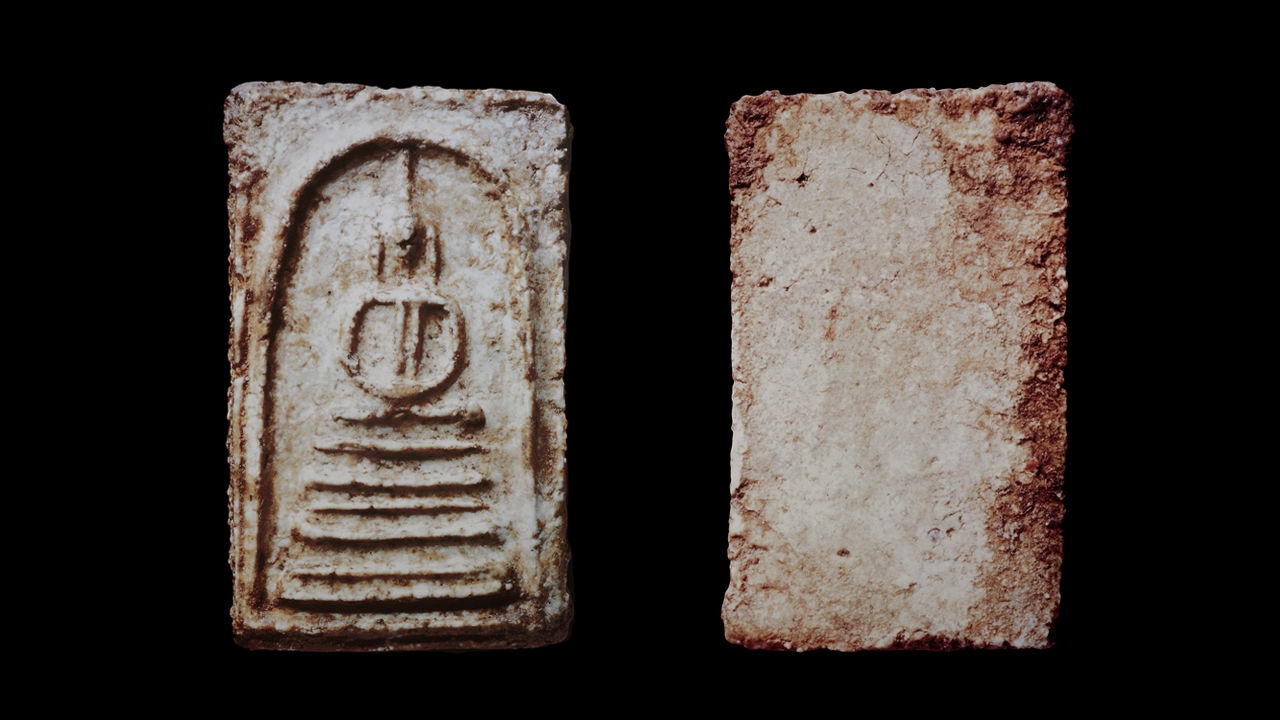
Distinguishing the mold shapes of Somdej Buddha amulets is a fundamental principle and the basis for studying standard molds attributed to Somdej Phra Phutthachan (Toh Prommarangsi). Many experts emphasize that when examining Somdej amulets, the mold shape should be assessed first; if the mold is incorrect, other factors need not be considered. However, some Somdej experts advise evaluating mold shape alongside material composition and age, noting that understanding mold shapes takes considerable study. Therefore, beginners might start by examining the amulet's material; if it closely matches expectations, then gradually move on to mold shape assessment. This method "Somdej Science" is considered suitable for those beginning to study Somdej Buddha amulets as well.
Two main challenges arise in assessing Somdej mold shapes: first, distinguishing whether an amulet originates from Wat Rakang Kositaram or Wat Bang Khun Phrom; second, identifying the specific mold shape.
For the first challenge, the simplest method is to look for shrine residue—if present, the amulet is regarded as from Wat Bang Khun Phrom (including Wat Rakang amulets deposited in Wat Bang Khun Phrom’s shrine, known as “two-shrine amulets”). Next, examining the amulet’s material helps: Wat Bang Khun Phrom amulets usually have lime-based material, whereas Wat Rakang amulets consist of older composite materials and tend to have a coarser texture. However, some Wat Bang Khun Phrom amulets, especially from older shrines (removed before the major opening in 1957), closely resemble Wat Rakang amulets and show almost no shrine residue, complicating identification. Thus, mold shape becomes decisive, as each temple has its distinctive molds. One simple aid is that Wat Bang Khun Phrom amulets often show a raised edge on the front, while Wat Rakang amulets typically do not.
The five standard mold shapes of Wat Rakang Somdej amulets—Large Mold, Chedi Mold, Saem Base Mold, Lotus Bud Mold, and Bodhi Leaf Mold—generally pose little problem in distinguishing molds because each has clearly different features. However, Wat Bang Khun Phrom (Wat Mai Amataros) has four additional unique molds besides these five (some created using molds from Wat Rakang and others made anew between approximately 1868 and 1870). These are the Thread Mold, Monk’s Robe Mold, Paired Base Mold, and Garuda Chest Mold. These can present difficulties in mold identification; examples often encountered include
Wat Bang Khun Phrom Large Shallow Mold (unnamed source notes three sub-molds; two resemble Wat Rakang Large Mold and Chest V Mold, while the shallow mold is unique to Wat Bang Khun Phrom) which resembles Wat Bang Khun Phrom Thread Mold Large Mold (which has seven sub-molds).
Wat Bang Khun Phrom Lotus Bud Mold Small Mold (with three sub-molds; two others being Narrow Lion Base Mold and Large Seated with Drooping Feet Mold) resembles Wat Bang Khun Phrom Monk’s Robe Mold with Rounded Arm or Robe Bud Mold (four sub-molds; three others are Large Mold, Straight Shoulder Mold, and Elephant Ear Mold).
Wat Bang Khun Phrom Paired Base Mold (one sub-mold) closely resembles Wat Bang Khun Phrom Saem Base Mold Mold 3 (three sub-molds). Among similar molds, this pair is the most alike and hardest to distinguish, especially for novices.

Most Somdej experts agree that the Paired Base mold is unique to Wat Bang Khun Phrom and does not appear in Wat Rakang. The Saem Base mold, however, appears in amulets from both Wat Rakang and Wat Bang Khun Phrom. Professor Prakit Limsakul or Phlai Chumphon of Thairath Newspaper explains that Wat Bang Khun Phrom’s Paired Base mold originated from Wat Rakang’s Saem Base mold. The strong similarity between these two molds likely results from their being carved around the same time, using the same model (Wat Rakang Saem Base mold as the template), or possibly by the same craftsman (suspected to be the same team that carved Wat Rakang molds), thus producing nearly identical molds.
"Somdej Science" This section concludes with knowledge from Nirnam of Precious magazine and Assistant Professor Rangsarn Tosuwan, used in evaluating Wat Bang Khun Phrom’s Paired Base mold. Also included are key distinguishing features between this mold and Wat Bang Khun Phrom Saem Base Mold (Mold 3), which are very similar. For educational purposes, the following points are highlighted:
1. All four edges of the mold have raised borders, often showing scratch marks from lifting the stamp during cutting. There is usually a raised material flare on the front because Wat Bang Khun Phrom (Wat Mai Amataros) cuts by pressing the stamp down on the front and then lifting it upward or trimming excess material sideways. This causes residual flared material attached to the stamp edge when lifted. In contrast, Wat Rakang Kositaram cuts from the back toward the front, so it lacks front flares but instead shows termite damage on the amulet’s back.
("Somdej Science" also suggests the possibility that the raised border results from pressing a wooden mold onto a layer of amulet material underneath, compressing it to the mold’s exact dimensions. When lifting the mold, some material adheres to the mold’s edges, causing a flare if the cut includes the border area. Narrower cuts remove the flare entirely. Wat Rakang amulets, usually pressed with soapstone molds and material pressed from behind with wood or similar tools, then cut from back to front or front to back while still on the mold, show minimal or no flares.)
2. The arch frame lines are very thin and sharply defined.
3. The topknot (usnisa) is elongated to reach the arch frame.
4. The face is an oval half-ellipse but relatively small, proportionate to the amulet size.
5. The ears are straight, sharply defined; the right ear (from the front) is higher than the left and extends down to the shoulder.
6. The robe lines form a deep central groove known as the “chest groove.”
7. The chest area has two robe lines rising to the shoulders, curling inward. This mold’s defects are clear here and differ from Wat Bang Khun Phrom Saem Base mold, where the robe lines flare outward toward both armpits. In the Paired Base mold, the robe lines ascend straight to the shoulders. In clear examples, the chest lines from both shoulders are higher than the robe lines.
8. The lap line is straight, differing from Wat Bang Khun Phrom Saem Base Mold 3, where the lap line shows two knee-like bulges with overlapping narrow curves, though faintly.
9. The under-lap line on the left side is noticeably longer than the knees, unlike Wat Bang Khun Phrom Saem Base mold where the line length matches both knees.
10. The third base layer line and the under-base line lie closer together than other lines.
11. The under-base line on the left is shorter than other lines, unlike Wat Bang Khun Phrom Saem Base Mold 3, where it is not short.
12. The first base layer (lowest) is a straight thick bar with a deep indentation in the center, resembling a double base line, and is more deeply indented than in Wat Bang Khun Phrom Saem Base Mold 3.
13. The back mold is mostly smooth; amulets with a scaly back are rare.
14. Surface and shrine residue: Most Wat Bang Khun Phrom Somdej amulets have shrine residue due to being enshrined in pagoda shrines for over a century. The shrine’s environment—hot during the day and cold at night—causes changes in the amulet’s condition, producing lime and stone deposits unique to Wat Bang Khun Phrom amulets. This characteristic is exclusive and important for authentic amulet identification, as amulets from other shrines show different residues.
For further reading, visit the Somdej Science page by Police Major Komsan Sanongpong. Special thanks to Assistant Professor Rangsarn Tosuwan for kindly providing images of the master Wat Bang Khun Phrom Somdej amulet for educational purposes. Thanks also to the current owner of this exquisite Paired Base mold Wat Bang Khun Phrom Somdej amulet, which is well-preserved with full shrine residue covering the entire piece. Its back has red residue resembling fermented soy sauce oil, with a white tone. The mold shape matches traditional descriptions, showing the distinctive three-layer dual base lines that give the mold its name. The two robe lines run straight up to the chest lines (unlike the Saem Base mold where robe lines flare to both armpits). The head and body are smaller than the Saem Base mold, and the lap line is straight (the Saem Base mold’s lap line resembles the number eight). The front edge shows the raised border or possibly a mold frame ridge, commonly found on Wat Bang Khun Phrom amulets. The back is smooth and neatly edged. This specimen is an excellent reference model for studying Wat Bang Khun Phrom Somdej amulets.
Author Police Major Komsan Sanongpong, former forensic police officer
Facebook page –Somdej Science