

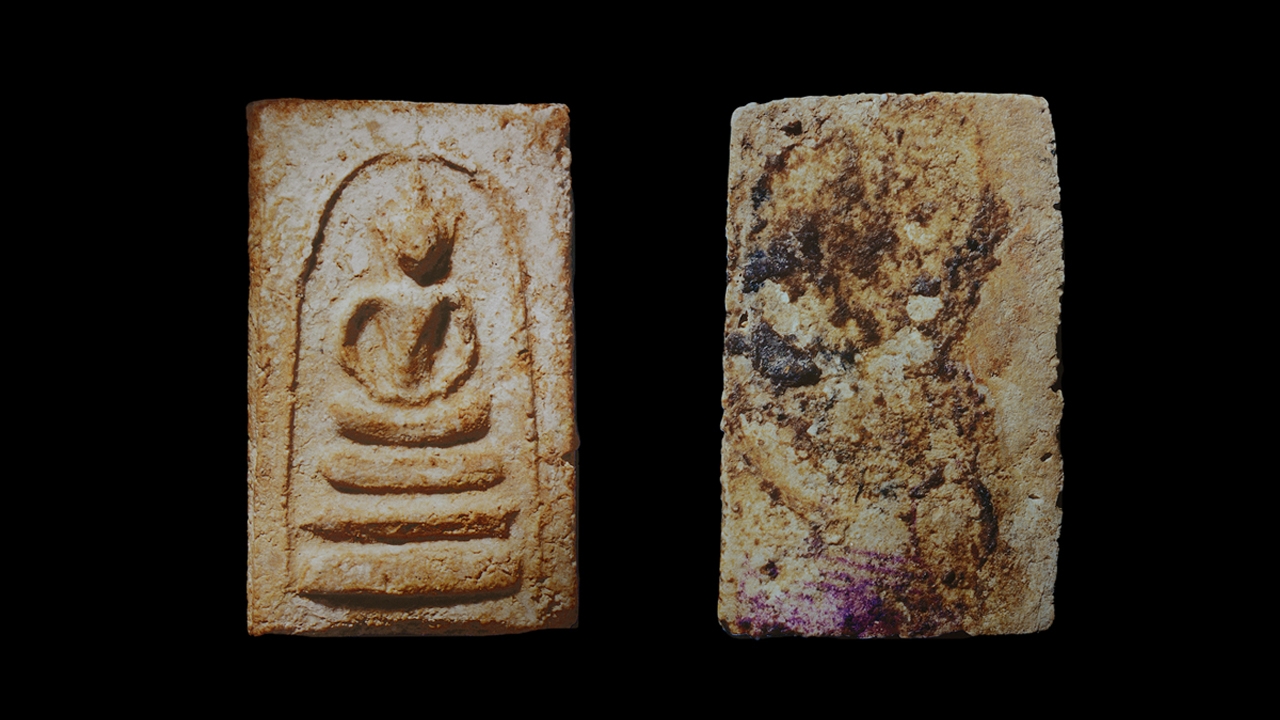
The Somdej Buddha amulet with the Garuda chest pattern is nowadays sought after mainly as a Wat Bang Khun Phrom Somdej, even though some specimens have such a dense composition that they approach the quality of Wat Rakang Somdej amulets. Nevertheless, collectors tend to consider them as Wat Bang Khun Phrom Somdej. Currently, the value is primarily based on the amulet's pattern, and once identified as this pattern, it is usually accepted without question as definitely a Wat Bang Khun Phrom Somdej. It is interesting to ask whether, in fact, this Somdej amulet pattern exclusively belongs to Wat Bang Khun Phrom.
In the book “Pra Kruang Prayot” by Triyamvawai, the Somdej amulet of this pattern is discussed, citing reliable sources stating that “it is said that Mr. Thet (believed to be the nephew of the Most Venerable) living on Dinso Road was the first to carve the mold to present to the Most Venerable, which is understood to be the thread pattern, the double base pattern, and the Sangkhati pattern, among others. Regarding the Garuda chest pattern, it is believed that the Most Venerable himself created it. Later, a royal court official from the Thonburi Palace, working in the Department of Fine Arts, redesigned it, adapting and improving the old style to achieve a more beautiful form. Ultimately, Luang Wijarn Jianai, the royal goldsmith under King Rama IV, carved the mold, which is considered a very beautiful design...”
Triyamvawai also states that the Garuda chest pattern exists in both Wat Rakang and Wat Bang Khun Phrom amulets. (Also known as the Kaiser pattern) with subtypes as follows: the open mold type with 2 subtypes exists only in Wat Bang Khun Phrom; the broad mold type with 4 subtypes exists in both Wat Rakang and Wat Bang Khun Phrom; the compact mold type with 2 subtypes exists in both Wat Rakang and Wat Bang Khun Phrom; and the small mold type with 1 subtype exists only in Wat Bang Khun Phrom.
In the subsequent era continuing up tothe present dayvarious Somdej amulet experts have reclassified the subtypes, reducing them to just a few, and generally agree that this amulet pattern exists only in Wat Bang Khun Phrom Somdej. (However, Professor Prajam U Arun, a senior Somdej expert, provided interesting information that he has seen Somdej amulets of all patterns, including the Garuda chest pattern, with dense composition similar to that of Wat Rakang Somdej.)
An anonymous author from Precious Magazine divides this amulet pattern into 4 subtypes: large, medium, small (very rare), and bent-arm or kite-shaped. The molds for the large and medium subtypes are very similar.
However, when considering information from credible old texts and various related evidence, “The Science of Somdej” sees that the Somdej amulet with the Garuda chest pattern is connected and shares some features with Wat Rakang Somdej amulets, such as “the absence of raised edges,” and “the presence of crack-like lines (crack marks along or parallel to the back edge),” and “the beak-like line at the corner of the lower base.” Allow me to elaborate as follows.
Regarding the “raised edge” which is usually absent in this amulet pattern, “The Science of Somdej” believes this likely results from the mold-making technique, similar to that used for Wat Rakang Somdej molds: carving designs into a hard material such as soapstone, possibly carving multiple designs on a single sufficiently large stone slab. The amulet is pressed by placing a suitable-sized lump of material onto the soapstone slab, then cutting the amulet’s edges with a sharp tool. This edge-cutting might be done while the amulet remains on the soapstone slab, from back to front, and if the material is still moist, it can cause “crack marks along or parallel to the edges, sometimes called crack-like lines.” Such edge-crack traces found on some amulets of this pattern support this idea (unlike other Wat Bang Khun Phrom Somdej patterns, which generally lack cracks on the back edges). Alternatively, the edge cutting may be done front to back when the amulet is removed from the mold and placed on a base. Regardless of the cutting method, this pattern usually lacks raised edges, a trait shared with most Wat Rakang Somdej amulets (unlike other Wat Bang Khun Phrom Somdej amulets, which typically have raised edges at the front caused by pressing the mold onto the amulet material). The “beak-like line at the corner of the lower base” is also characteristic of soapstone mold carving. It marks the start of carving the amulet by scraping the surface with a blade. The Department of Fine Arts’ manual states that carving begins with the arch line, then proceeds to the lower base. Notably, the right side of the arch line extending downward (unique to this pattern, as other patterns have a closed lower arch line) clearly shows a “beak-like line connecting from the arch’s tip to the lower corner of the base.” The anonymous author describes this as the “key point” in identifying this amulet pattern (other Wat Bang Khun Phrom molds generally lack this beak-like line at the lower base corner because they are carved from soft wood, allowing direct pressure from steel tools without scraping). Considering this, it aligns with Triyamvawai’s statement that the Garuda chest pattern exists both in Wat Rakang amulets (pressed from Wat Rakang molds) and Wat Bang Khun Phrom amulets (either pressed from Wat Rakang molds or newly carved molds for Wat Bang Khun Phrom). Initially, this amulet pattern was designed by the Most Venerable Somdej Toh, before being developed further by the Department of Fine Arts artisans and royal goldsmiths.
Professor Prakit Limskul, also known as Phlai Chumphon from Thairath newspaper, stated that the primitive or rustic style of this amulet pattern reflects the personality of the Most Venerable Somdej Toh, who designed the early molds.

trusted older references and opinions from senior Somdej experts state that the Somdej amulet with the Garuda chest pattern exists in both Wat Rakang and Wat Bang Khun Phrom. However, current mainstream collectors consider this pattern to belong solely to Wat Bang Khun Phrom. “The Science of Somdej” believes that in the future, as more evidence emerges, the truth about whether this amulet pattern also exists from Wat Rakang will become clear. Regardless of origin, this will not affect the value or the faith of devotees in the Somdej amulets created by the Most Venerable Somdej Phra Phutthachan (Toh Prommarangsi).
“The Science of Somdej” I conclude this discussion by presenting a method to distinguish similarities and differences between Wat Bang Khun Phrom Somdej amulets with the Garuda chest pattern, Large Pattern compared with Medium Pattern which are very similar, following the approach of the anonymous author, as follows.
1. All four edges lack the typical mold border found in other Wat Bang Khun Phrom Somdej patterns, and no raised edge marks (scraping marks caused by cutting from the front and lifting the cutting tool) appear on the front. This may be because the Garuda chest pattern Wat Bang Khun Phrom amulets tend to be thicker. The bamboo cutting tool must be carefully aligned exactly with the mold border, and after cutting off excess material beyond the mold border, the tool is likely dragged sideways to remove the excess, rather than lifted upward, preventing raised edge marks.
(Regarding the absence of raised edges in this pattern, “The Science of Somdej” also considers it possible that the mold resembles that of Wat Rakang Somdej, as explained above.)
2. The arch line (covering the Buddha image) is thinner and finer than that in other Somdej amulet patterns. Master Triyamvawai called it the wire-line arch.
3. The head is large and rounded like a bowl, which gives the pattern its name, “Garuda chest.” In well-pressed amulets, the ears, eyes, nose, and mouth are clearly visible.
4. The hair is shaped like a short lotus bud reaching the arch line.
5. The ears are thick and large, shaped like Bai Sri (traditional ceremonial fans).
6. A special characteristic is that the left shoulder is more raised and slopes downward toward the right shoulder.7. This is because the upper left shoulder is the starting point of the Sangkhati robe, which must be higher. In well-defined amulets, the Sangkhati line rises from the left shoulder down to the chest, forming a thick and beautiful plate.7.
Another important point called the “key point” is a thin curved line running from the right end of the arch line connecting to the tip of the first base layer. 8. The first base layer’s ends on both sides are flat (perpendicular to the lower edge).
9. There is a long, narrow indentation in the middle between the second and third base layers.
10. None of the three base layers show the lion-head base characteristic.
11.
In well-defined amulets, the base’s unique features provide excellent identification clues. Specifically, the right end of the second base layer touches the arch line, whereas the right end of the second base layer is separated from the arch line, and the first and second base layers are about the same length. Differences1. In the large pattern, the right arm is curved and farther from the body than the left arm, making it seem that the right arm is more extended. In the medium pattern, both arms hang straighter with less curve, and the spacing between the arms and the body is more even and proportional.2. In the large pattern, the waist or lap curves like a boat, and both knees taper clearly above the lap. In the medium pattern, the waist curves less, and the knees do not taper sharply upward.
Author
Police Lieutenant Colonel Komsan Sanongpong, former forensic police officer
Facebook page
– Pra Somdej Science
Read the column The Science of Somdejfor more