

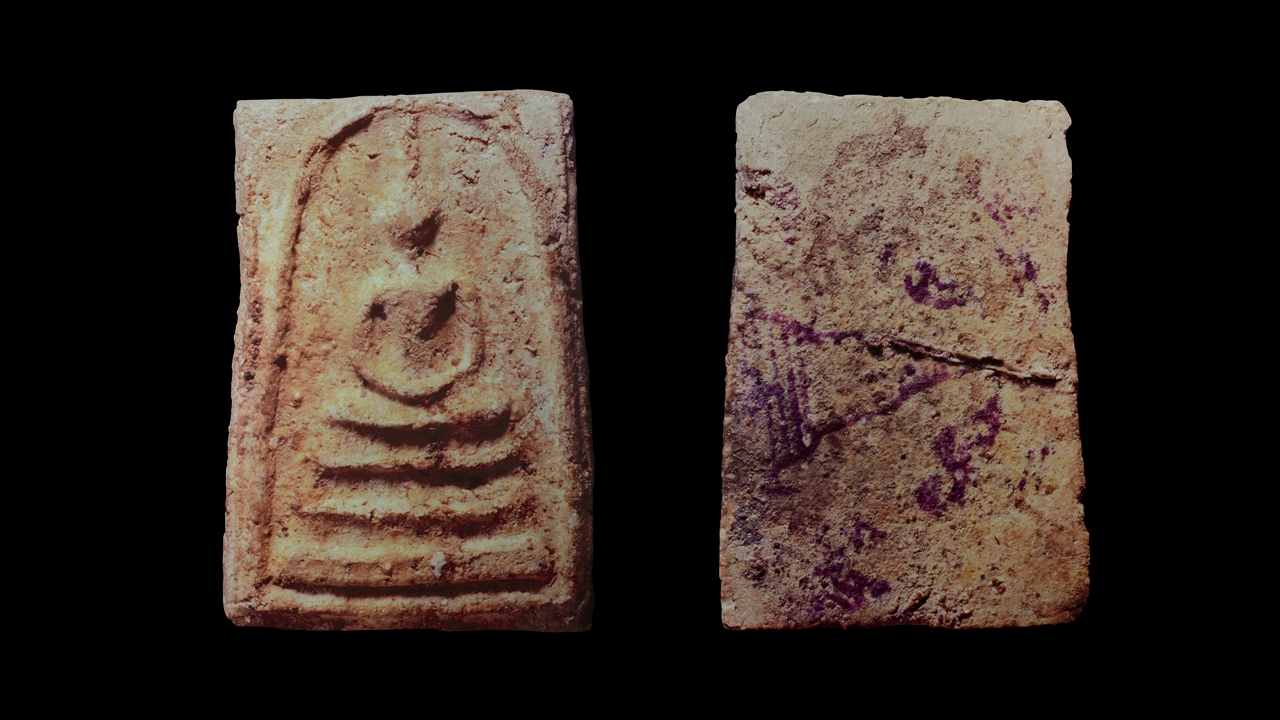
Wat Bang Khun Phrom Phim Yai Phra Somdej amulets, according to Nirnam of Precious magazine, are classified into three subtypes: 1. Deep mold large type 2. Shallow mold large type 3. Deep mold large type with lines under the base Among these, the shallow mold large type, characterized by distinctive carving, is the most commonly found. The deep mold large type, carved from molds based on Wat Rakang’s large V-shaped chest design, is found less frequently. The deep mold large type with lines under the base, also derived from Wat Rakang’s large molds, is very rare. The terms deep or shallow mold refer to the amulet’s prominent features: deep molds have a noticeably raised body and base protruding from the surface, with thicker arms and arch lines, resembling high relief sculpture (often protruding more than half the actual shape). In contrast, shallow molds have smaller bodies, arms, bases, and thinner arch lines, overall appearing flatter, similar to low relief sculpture.
The theory of examining Phra Somdej molds by Somdej To mainly focuses on the front mold of the amulet, whether from Wat Rakang or Wat Bang Khun Phrom. Wat Rakang Phra Somdej amulets are crafted with strict adherence to detailed molds designed in advance (modern craftsmen call this “drawing”), following methods taught by royal craftsmen influenced by Western techniques. Even with multiple molds of the same design, the structure and details remain consistent, especially if carved by the same craftsman, showing identical signature lines. In contrast, Wat Bang Khun Phrom molds are less strict; although some molds are copied from Wat Rakang’s first five molds (large type, stupa type, base with lines, lotus bud head, Bodhi leaf canopy), some may be freshly carved without a new design draft. Each mold block can vary greatly, making it harder to understand the mold design without also considering the material composition and patina, which are important aids.
When examining Phra Somdej molds, besides the front, the back must also be considered. “The Science of Phra Somdej” once highlighted the importance of the back mold. Some experts can determine authenticity simply by looking at the back. Professor Prakit Limsakul, also known as Phlai Chumphon from Thairath newspaper, noted that old amulet collectors would rarely let others see the back of their Phra Somdej unless during an actual sale. This tradition explains why Phra Somdej amulets are often framed with backs fully enclosed even today.
According to Nirnam, Wat Rakang Phra Somdej backs can be divided into four main types: Smooth back type – This type closely resembles the back of most Wat Bang Khun Phrom Phra Somdej amulets. Board back type – Similar to the smooth back but showing transverse border lines, usually two to three, caused by wooden board edges pressing the back of the amulet to compact it into the mold. Custard back type – Named for its resemblance to the surface texture of custard dessert. Betel nut sheath back type – Characterized by rough, parallel longitudinal grooves, believed to result from the uneven surface of the wooden board used in pressing. However, some masters classify Phra Somdej backs differently.Different classifications ofPhra Somdej backs include eight types: needle-tip porous, ant trail marks, worm trail marks, moss or tofu-like wrinkles, betel nut sheath marks, custard marks, fingerprint marks, and crack lines. “The Science of Phra Somdej” has previously detailed these types. (Note: an amulet’s back may exhibit multiple features simultaneously.)
For Wat Bang Khun Phrom Phra Somdej, roughly speaking, most backs are smooth, likely due to the manufacturing method of pressing molds onto a flat base of amulet material.The flat base of the amulet materialSome experts have detailed that Wat Bang Khun Phrom backs are not only smooth but can be further subdivided into various patterns, though overall smoothness predominates.

Nirnam explained that some large Wat Bang Khun Phrom Phra Somdej backs differ from Wat Rakang’s large backs. Besides dark brown patina and tofu-like patina, the most important feature is that all four edges form raised ridges, whereas Wat Rakang backs show ant trail marks along edges, sometimes with edge chipping visible. Wat Bang Khun Phrom backs have wave-like textures, likely because when preparing the amulet material, after grinding, the paste was spread flat on a surface without pressing firmly against the base. Even when the mold is pressed down, wave patterns remain. When cutting the amulet edges from front to back, some show raised lower edges and often curled upper edges as previously noted.
Nirnam summarized four back types found on Wat Bang Khun Phrom Phim Yai amulets: Transverse splinter lines paired with parallel wrinkles resembling woven basket edges on the back border, wrinkles like freshly steamed custard, board-like grooves, and smoothed areas resembling clay or putty pressed and scraped flat within a mold. These smoothed scrape marks arise from pressing and leveling the material within a confined mold. It is presumed some Wat Bang Khun Phrom amulets were made by pressing the material onto molds similarly to Wat Rakang, producing these scrape patterns on the back.
Examining Phra Somdej molds requires assessing both front and back. Expert Ajarn Prakam U Arun, a Phra Somdej specialist, said that experienced individuals can identify authenticity and mold type just by viewing the back. Back patterns vary widely for Wat Rakang and Wat Bang Khun Phrom amulets. Understanding the back molds can help enthusiasts recognize genuine Somdej To amulets.
“The Science of Phra Somdej” This article concludes by compiling Nirnam’s method for examining Wat Bang Khun Phrom Phim Yai Deep Mold Phra Somdej from Precious magazine for educational purposes:
1. The mold’s left border line on the amulet starts at the top edge and extends down to the arch covering the shoulder, differing from Wat Rakang’s large mold which ends near the elbow.
2. The mold’s right border line starts at the top and runs continuously down to the bottom arch edge.
3. The hair tuft is longer than on Wat Rakang’s large mold and longer than Wat Bang Khun Phrom deep mold with lines under the base.
4. The upper area outside the right arch slopes downward toward the amulet’s edge, caused by the mold shape.
5. The face shape resembles a bael fruit.
6. The right shoulder area is thick.
7. The left shoulder area is thin.8. The width from left shoulder to right shoulder or chest is narrower than the deep mold with lines under the base.9. The arch line is thick, like a split rattan.
10. The left knee protrudes higher than the third base layer.
11. The third base layer on the left is lower than the left knee.
12. The second base layer is lion-shaped, also called the lion base.
13. The right knee is level with or lower than the third base layer.
14. The right third base layer is higher or level with the right knee.
15. Because the right knee is lower than the left, the Buddha image appears to sit slightly turned toward the right.
For more information, visit the pagePhra Somdej Scienceby Pol. Lt. Col. Komsan Sanongphong, with thanks to Assistant Professor Rangsarn Tosuwan for providing images of master Wat Bang Khun Phrom Phra Somdej amulets for educational use. Also, thanks to the current owner of this beautiful deep mold Phim Yai Wat Bang Khun Phrom amulet, notable for its deep, clear mold resembling high relief sculpture with distinct light and shadow, matching textbook specifications. Note the left border line running from top down to the shoulder.
(In Wat Rakang’s large mold, this line ends near the elbow.) The amulet’s color is brown with patina covering both front and back. The back is mostly smooth (with some custard-like texture at the bottom), showing slight raised edges on the left and bottom, along with traces of the purple stamp ink from the temple. The front displays a clear curled edge on the right side, common in Wat Bang Khun Phrom amulets. This piece serves as an excellent study example.
For more articles, see the The Science of Phra Somdej column by Pol. Lt. Col. Komsan Sanongphong, former forensic police officer.Facebook page– Phra Somdej Science