

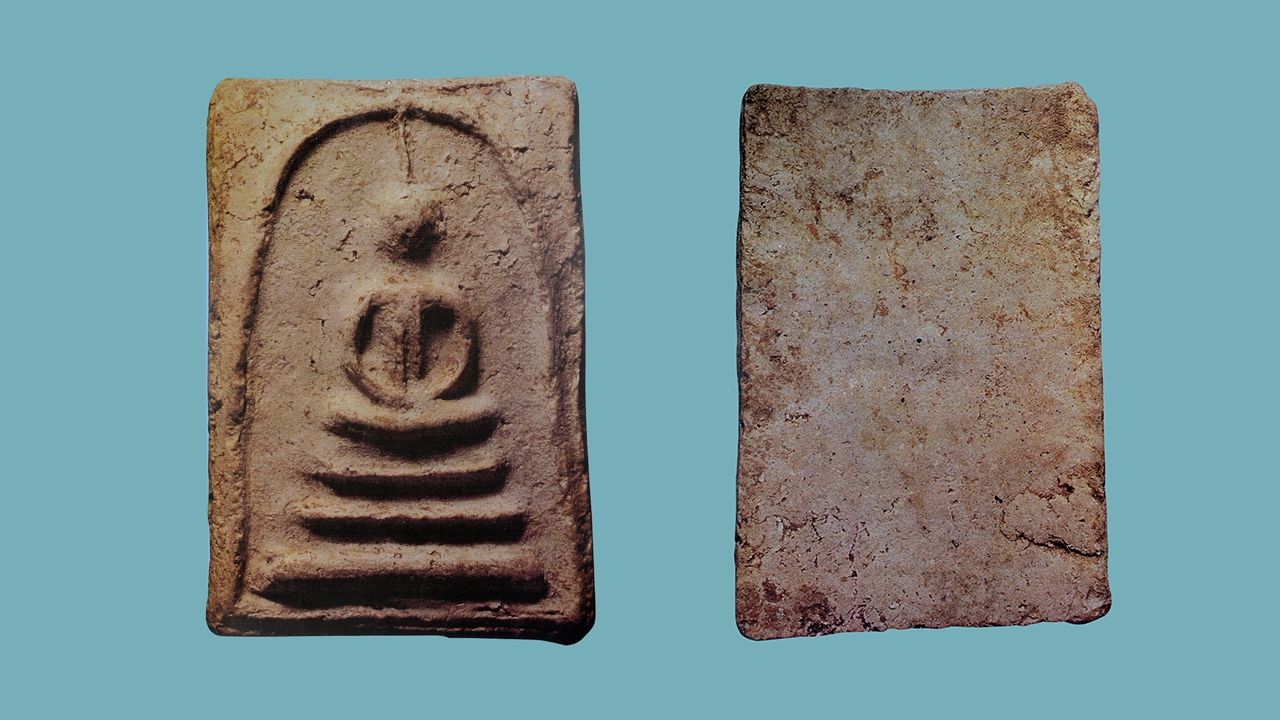
Phra Somdej Wat Bang Khun Prom in the Sangkhati print style is considered one of the most commonly found types of Phra Somdej Wat Bang Khun Prom, comparable to the Thread Line print style. The name “Sangkhati” print style originates from two raised parallel lines resembling the Buddhist monk's robe sash, which appear as deep, sharp grooves running from the top of the chest down to the hands. “The Science of Phra Somdej” It is believed that this Phra Somdej print style was influenced by the concept of depicting the posture of ascetic practice. The Sangkhati lines resemble the slender skeletal structure, similar to the Phra Somdej Wat Ket Chaiyo in Ang Thong Province, which was created by Somdej Phra Buddhachan (Toh Prommarangsi).
Niranam from Precious Magazine classifies Phra Somdej Wat Bang Khun Prom in the Sangkhati print style into four subtypes as follows:
Large Print This subtype is rarer than the others. The amulet is relatively thick, robust, and majestic. Its mold shape closely resembles the Large Print Phra Somdej Wat Bang Khun Prom more than the other subtypes.
Straight Shoulder Print This is the most commonly found subtype. The shoulders and the top of the chest run parallel in a straight line, hence the name “Straight Shoulder Print.”
Round Arm Print or Sangkhati-Lotus Bud Head Print (Ti-Tum) This mold design blends the Sangkhati style with the smaller Lotus Bud Head print. Especially in the smaller Lotus Bud Head prints with shallow impressions, they closely resemble the Sangkhati print. Niranam divides the Lotus Bud Head print into three subtypes: Narrow Lion Base, Large Sitting with Feet Dangling, and Small Print, with the Small Print being very rare.
Elephant Ear Print This mold distinctly shows the ears. Niranam notes that all Sangkhati subtypes of Phra Somdej Wat Bang Khun Prom have ears, though some are less visible. The Elephant Ear subtype features ears that clearly stand apart from the head. Nowadays, collectors often divide the subtypes into two groups: with ears (Elephant Ear) and without ears, where the latter may refer to the other three subtypes: Large, Straight Shoulder, and Round Arm or Ti-Tum.Print Style.
Niranam also mentions the unique characteristics of this particular Phra Somdej Wat Bang Khun Prom print style: “Other Phra Somdej Wat Bang Khun Prom amulets, when used or rubbed, develop a yellowish-brown surface with a shiny, glossy sheen. However, the Sangkhati print, when similarly used or rubbed, shows a light greenish hue resembling jasmine stems. This characteristic is unique to the Sangkhati print only.”
Based on these observations, “The Science of Phra Somdej” infers that the Sangkhati print, which is one of the most commonly found alongside the Thread Line print, was created during the same period from the same batch of materials. It likely contains some unique components that distinguish it from other print styles. Considering one of its subtypes, the Ti-Tum print, it is possible that the Lotus Bud Head prints modeled after Wat Rakhang were carved and produced before the Sangkhati molds.SangkhatiThis suggests that the remaining four molds modeled after Wat Rakhang (Large Print, Chedi Print, Sand Base Print, and Bodhi Leaf Print) were carved and produced before the distinctive Bang Khun Prom molds: Thread Line and Sangkhati (standard print group). These two were possibly the last molds created at Bang Khun Prom, explaining why they were produced in the highest quantities to reach the traditional 84,000 pieces, matching the number of Buddhist scriptures.SangkhatiRegarding the paired base print, it was likely carved alongside the Sand Base print. The Garuda Chest Head print may have had its mold partly carved during the creation of Wat Rakhang molds, with additional molds created later to produce large quantities for Bang Khun Prom.

For the Reclining Buddha print, the book “Amulet Prints and Buddha Statues for Worship” by Lt. Col. Luang Bannayutchamnarn (Sawad Nakasiri) states: “Phra Somdej of Phutthachan from Wat Bang Khun Prom were stored in the same cache. Even before the cache was opened, many were found (dropped). There are many Phra Somdej not stored in caches made and distributed at once. There are many kinds with different materials, including sitting, standing, and reclining types, too many to record entirely. Interested parties should consider further themselves.” Many modern amulet experts now accept that this print includes pieces from both Wat Rakhang and Wat Bang Khun Prom, with molds likely carved since the creation of the standard Wat Rakhang Phra Somdej.
.
Niranam divides the Sangkhati print into four subtypes. The hardest to distinguish, due to its similarity to the Lotus Bud Head print, is the Round Arm or Ti-Tum print. The arms in this subtype are rounded, resembling strands of noodles lying flat against the base of the amulet. This print overlaps characteristics of both the Sangkhati and Lotus Bud Head prints of Wat Bang Khun Prom: the mold belongs to the Sangkhati group, evident from the thick, large arch frame, robust three-tiered base, and the Sangkhati lines running from chest to hand. However, the overall shape is compressed, similar to the Lotus Bud Head or some Chedi subtypes.SangkhatiandSangkhatiExamining the overall mold, the amulet appears compressed (shortened), akin to the Lotus Bud Head or some Chedi subtypes. Ajarn Prakit Limsakul, or Phlai Chumphon, Thairath Newspaper states that the Sangkhati print was also influenced by the Chedi print.
“The Science of Phra Somdej” Concluding this segment, here are criteria to study the Lotus Bud Head, Round Arm, or Ti-Tum prints of Niranam’s classification for educational purposes:
1. The arch frame is thick, similar to the Lotus Bud Head print of Wat Bang Khun Prom.
2. The amulet body is robust, resembling the Lotus Bud Head print.
3. The hair is short and rounded, shorter than other Sangkhati prints.
4. The face is large and oval-shaped.
5. When well-pressed, both ears appear as slender, curved shapes.
6. The arm loops and arm lines are rounded like strands of noodles, which inspired the name Round Arm print.
7. TheSangkhatiline runs from the chest down to the palm.
8. When clear, the slender feet can be seen.
9. The three-tiered base is thick and solid.
10. The ends of the first-tier base on both sides are squared and solid.
For more information, visit the page Phra Somdej Science by Police Lieutenant Colonel Komsan Sanongpong. Thanks to Assistant Professor Rangsarn Tosuwan for kindly providing images of the master-class Phra Somdej Wat Bang Khun Prom for educational purposes. Also, thanks to the current owner of this amulet, a beautiful Phra Somdej Wat Bang Khun Prom in the Sangkhati print, Round Arm or Ti-Tum subtype. This subtype is among the most common, along with the Thread Line print. It has light surface abrasion on both front and back, a brownish hue, correct mold shapes per the scriptures, and distinct rounded arms unique to this subtype. The amulet is robust, blending Lotus Bud Head and Sangkhati features, with sharp, full impressions and small lifted edges on all four sides, a characteristic often found in Wat Bang Khun Prom amulets. The back is mostly smooth with slight ripples, typical of most Wat Bang Khun Prom backs, with neatly cut edges, serving as an excellent study example.
Author Police Lieutenant Colonel Komsan Sanongpong, former forensic police officer
Facebook page –Phra Somdej Science