

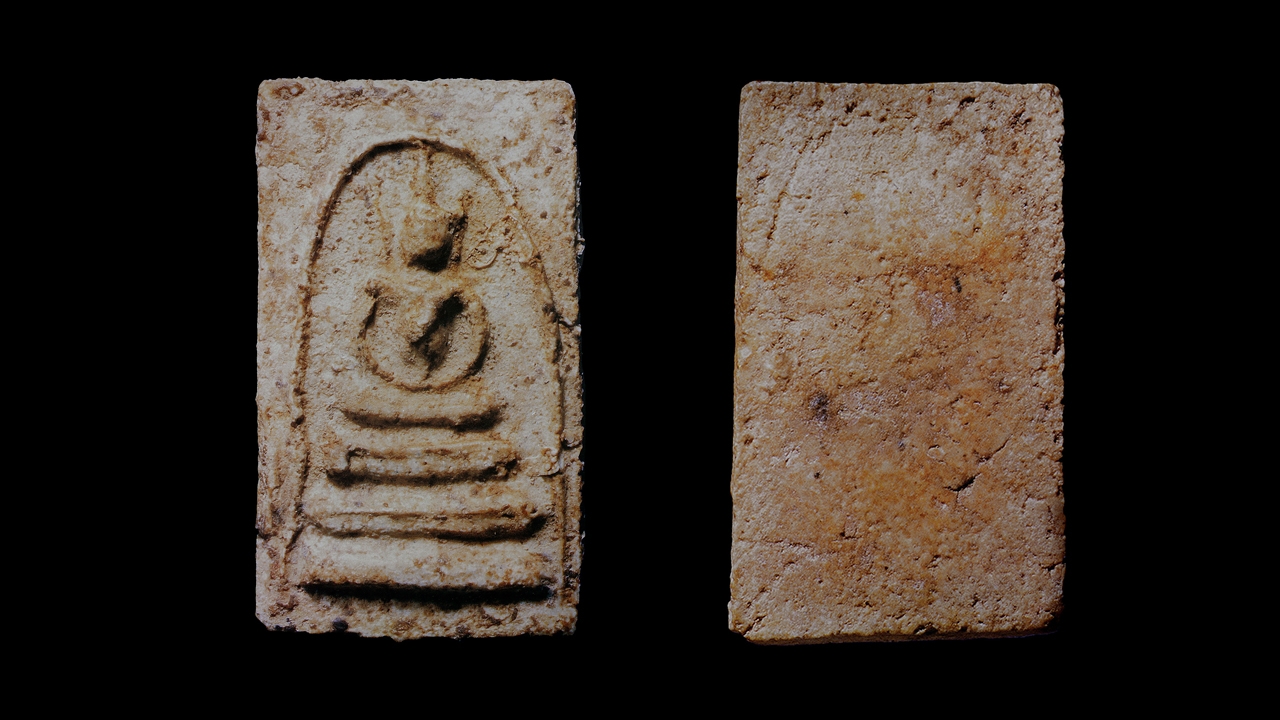
Phra Somdej Wat Bang Khun Prom in the Garuda Chest Head Bowl mold derives its name from the statue's distinctive features: a prominently raised chest resembling a Garuda's chest and a relatively large head shaped like a monk's alms bowl. According to the treatise by Triyampawai, this mold was personally designed by Somdej Toh himself, alongside the early Wat Rakhang Somdej, created by local craftsmen such as Mr. Thet, Somdej Toh’s grandson. Teacher Prakit Limsakul, also known as Phlai Chumphon, Thairath newspaper states that this Phra Somdej mold has an ancient, rustic, or primitive style, reflecting the personality of its designer, known as "Khrua Toh." Ancient texts also note that this mold often shows fingerprints on the back, caused by pressing the material tightly—more so than other molds. Such fingerprint impressions are still seen today on Phra Somdej of this mold type. For forensic purposes, these latent fingerprint patterns could be analyzed to determine whether the person pressing the mold was the same across different statues.
Interestingly, this Phra Somdej mold is among the most debated regarding its subtype classification, due to differing expert opinions that persist to this day without consensus. For example, a subtype called "large mold" by one expert might be identified as "medium mold" by another, while what some call "medium mold" is referred to as "large mold" by others. Each expert uses different criteria to assess mold characteristics. To avoid confusion, many experts today refer to this mold simply as the “Head Bowl” mold, avoiding subtype distinctions except for the clearly distinct "Kite Chula" mold. For this analysis, "The Science of Phra Somdej" will reference the classification system of Nirnam from Precious magazine. Nirnam divides the subtypes into four categories as follows:
Large mold At first glance, it closely resembles the medium and small molds. Shared features among these three subtypes include: deeper mold carvings than other Phra Somdej molds; narrower and finer 'covering arch' lines; absence of molding borders on all four sides; wider trimming margins from the 'covering arch' compared to other molds; and greater thickness similar to the chedi (stupa) mold.

Medium mold It bears many similarities to the large mold, but differs distinctly in the arms: the medium mold’s arms hang straighter and are evenly spaced from the body on both sides, whereas the large mold’s arms spread wider with the right arm set farther from the body than the left. The neck curves less and does not taper sharply upward as in the large mold.
Small mold This is quite similar to the medium mold and may be mistaken for the same. The differences include a narrower 'covering arch,' a slimmer, V-shaped Garuda chest, and on the second tier base's left side, the upper edge is sliced off in a long diagonal toward the statue’s left extremity.
Broken arm mold, or Kite Chula mold (Some sources further subdivide into small and large Kite Chula molds.) True to its name, the torso from neck to nape resembles a kite shape, with a short body and overall less aesthetically pleasing features compared to other molds. Notably, this mold appears only in large cache openings around 1957 CE (B.E. 2500) or newer caches, and is absent in older caches (found before large openings). The reason for this remains a point of interest.
According to ancient texts, the Garuda Chest Head Bowl mold was personally designed by Somdej Toh. However, the popular standard molds seen today include four subtypes: large, medium, small, and Kite Chula. This mold remains one of the most confusing in terms of subtype classification, due to varying expert methods. "The Science of Phra Somdej" concludes this section by presenting Nirnam’s criteria for analyzing the medium mold for educational purposes.
1. None of the four edges show molding borders, unlike other Wat Bang Khun Prom molds, nor do they display chipping marks ('edge flares') at the front caused by front-cutting with a bamboo punch lifted upward. It is believed that the typically thicker Garuda Chest Head Bowl molds require precise punching, aligning exactly with the mold borders. After trimming excess material beyond the mold, the punch was likely slid sideways to remove leftovers, preventing edge flares from appearing.
(Regarding the absence of 'edge flares' in this mold, "The Science of Phra Somdej" also suggests it may be because the mold resembles those of Wat Rakhang Somdej.)
2. The 'covering arch' lines are thinner and narrower than those in other Phra Somdej molds; teacher Triyampawai calls this the 'wire arch.'
3. The head is large and round like a monk’s alms bowl, hence the mold’s name 'Head Bowl.' In well-struck statues, ears, eyes, nose, and mouth are clearly visible.
4. The hair resembles a short lotus bud reaching the 'covering arch.'
5. The ears are thick and large, shaped like a traditional ceremonial tray (bai sri).
6. A special feature is the left shoulder’s raised prominence compared to the right, slanting from left to right. This occurs because the top of the left shoulder is the starting point of the sangkhati (monk’s robe), which must be higher. In well-defined statues, the raised sangkhati line runs from the left shoulder down to the chest, forming a thick, beautiful plate.
7. Another key identifier, called the 'critical point,' is a thin curved line (resembling a bird’s beak) connecting the right end of the 'covering arch' to the tip of the first tier base.
8. Both sides of the first-tier base have a cross-sectional face perpendicular to the lower edge.
9. Between the middle of the second and third tier bases, there is a long indentation in the center.
10. None of the three tiers show lion-head base characteristics.
11. In well-struck statues, the base has excellent defining features: the tip of the second tier base on the statue’s right side touches the 'covering arch,' while the left side tip is set apart. The lengths of the first and second tier bases are roughly equal.
12. Both arms hang straighter and curve less than in the large mold, spaced evenly from the torso and proportionate.
13. The neck or chest curves less, and the knees do not taper sharply upward compared to the large mold.
14. The back can be either smooth or have a betel leaf pattern.
For more information, visit the Facebook page "The Science of Phra Somdej" by Police Lieutenant Colonel Komsan Sanongpong. Thanks to Assistant Professor Rangsarn Tosuwan for kindly providing photos of the master model Phra Somdej Wat Bang Khun Prom, Garuda Chest Head Bowl large mold, for educational purposes. Thanks also to the current owner. This statue is a beautifully preserved example, covered with a thick brown cache residue commonly found on authentic Wat Bang Khun Prom Phra Somdej molds. It features the correct mold traits according to texts: no bottom arch line and absence of edge flares found on other molds. A thin line resembling a 'bird’s beak' connects the right end of the arch with the bottom corner of the first tier base, which Nirnam identifies as the critical point for evaluating this mold. The back is smooth with brown cache residue, making it an excellent study model for Wat Bang Khun Prom Phra Somdej.
Author Police Lieutenant Colonel Komsan Sanongpong, former forensic police officer
Facebook page –The Science of Phra Somdej