

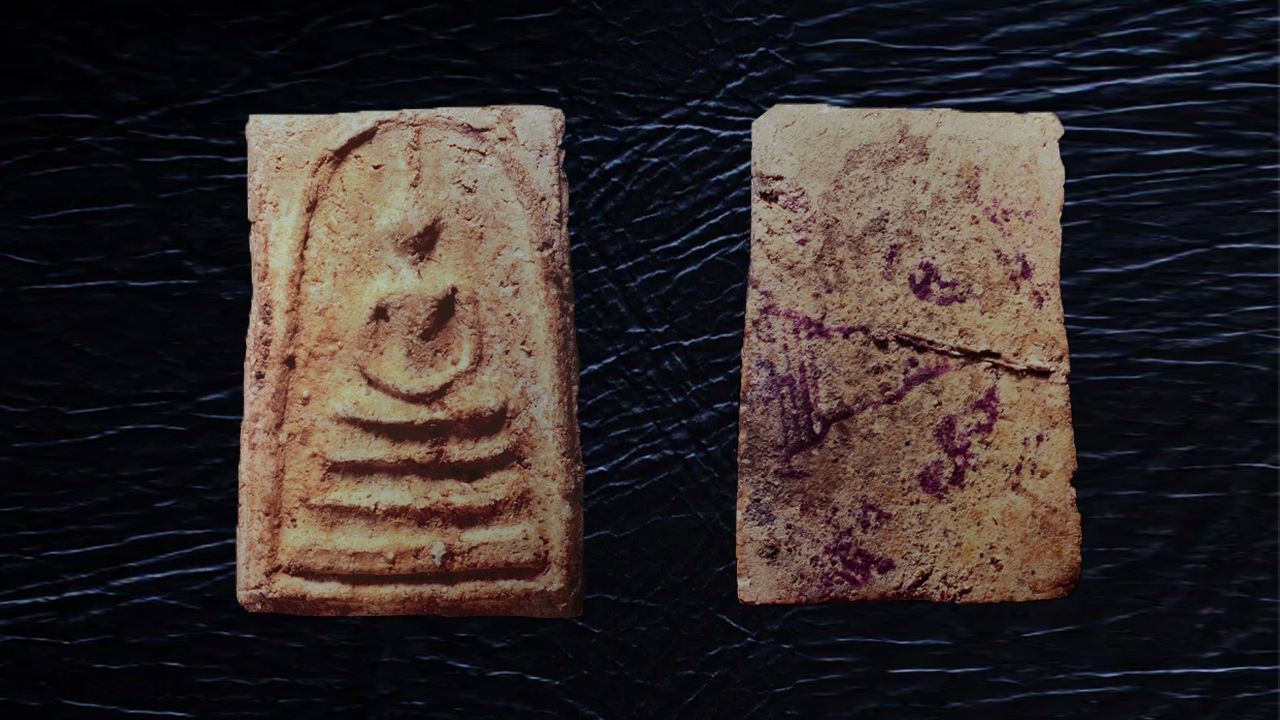
An in-depth study of ancient texts. "The Science of Phra Somdej." Summary of 15 Buddha image characteristics and identification methods for the Phra Somdej Wat Bang Khun Prom Large, Deep-Print amulet, for educational purposes following the Precious magazine's standards.
The study and collection of powder-based amulets, especially the Phra Somdej family, is both an art and a science requiring precise attention to mold shape. This article presents a guideline for examination. "Phra Somdej Wat Bang Khun Prom Large, Deep-Print" Compiled and extracted knowledge from the records of 'Anonymous' of Precious magazine, to preserve as an educational resource for proper conservation study.How to examine the back of the Phra Somdej Wat Bang Khun Prom Large amulet: distinctive features of an authentic Phra Somdej.
Statistical data and patterns indicate that the Phra Somdej Wat Bang Khun Prom Large, Deep-Print has unique identifying points that clearly differentiate it from the Phra Somdej Wat Rakhang Kositaram. These can be categorized into 15 key Buddha image features based on the mold structure as follows.
When examining mold defects and Buddha image features of this amulet series, collectors can observe and list them according to the proportions of the amulet as follows.
1. Mold boundary line on the left side of the amulet. Starting from the top edge of the amulet down to the arch covering the glass, near the shoulder area. This differs from the Phra Somdej Wat Rakhang Kositaram Large print, where the mold boundary on the left side starts at the top edge and goes down to the arch covering the glass at the level of the elbow.
2. Mold boundary line on the right side of the amulet starts from the top edge and extends all the way down to the bottom edge of the arch covering the glass.
3. The hair curls (พระเกศ) are longer than those of the Phra Somdej Wat Rakhang Kositaram Large print. They are also longer than the hair curls of the Phra Somdej Wat Bang Khun Prom Large, Deep-Print with a line beneath the lap.
4. The surface area above and outside the right side of the arch covering the glass slants toward the cutting edge of the amulet, a feature caused by the mold.
5. The face of the Phra Somdej Wat Bang Khun Prom Large, Deep-Print, resembles a bael fruit in shape.
6. The surface of the right shoulder area is thick.
7. The surface of the left shoulder area is thin.
8. The width from left shoulder to right shoulder, or the chest width of the amulet, is narrower than that of the Phra Somdej Wat Bang Khun Prom Large, Deep-Print that has a line beneath the lap.
9. The arch covering the glass of the Phra Somdej Wat Bang Khun Prom Large, Deep-Print is thick, resembling split rattan.
10. The left knee of the amulet protrudes higher than the third tier of the base.
11. The third tier base on the left side is lower than the left knee of the amulet.
12. The second tier base is shaped like a lion's head, also called the lion base.
13. The right knee of the amulet is even with or lower than the third tier base.
14. The third tier base on the right side is higher than or level with the right knee.
15. Since the right knee is lower than the left knee, the main Buddha image appears to be sitting slightly tilted or turned toward the amulet's right side.
Understanding the dimensions and mold structure in such detail not only reduces the risk of miscollection but also helps preserve the traditional methods of assessing Buddhist art, a cultural heritage of Thailand, according to international standards.
Author Police Lieutenant Colonel Komsan Sanongpong, former forensic police officer.
Facebook page –Phra Somdej Science