

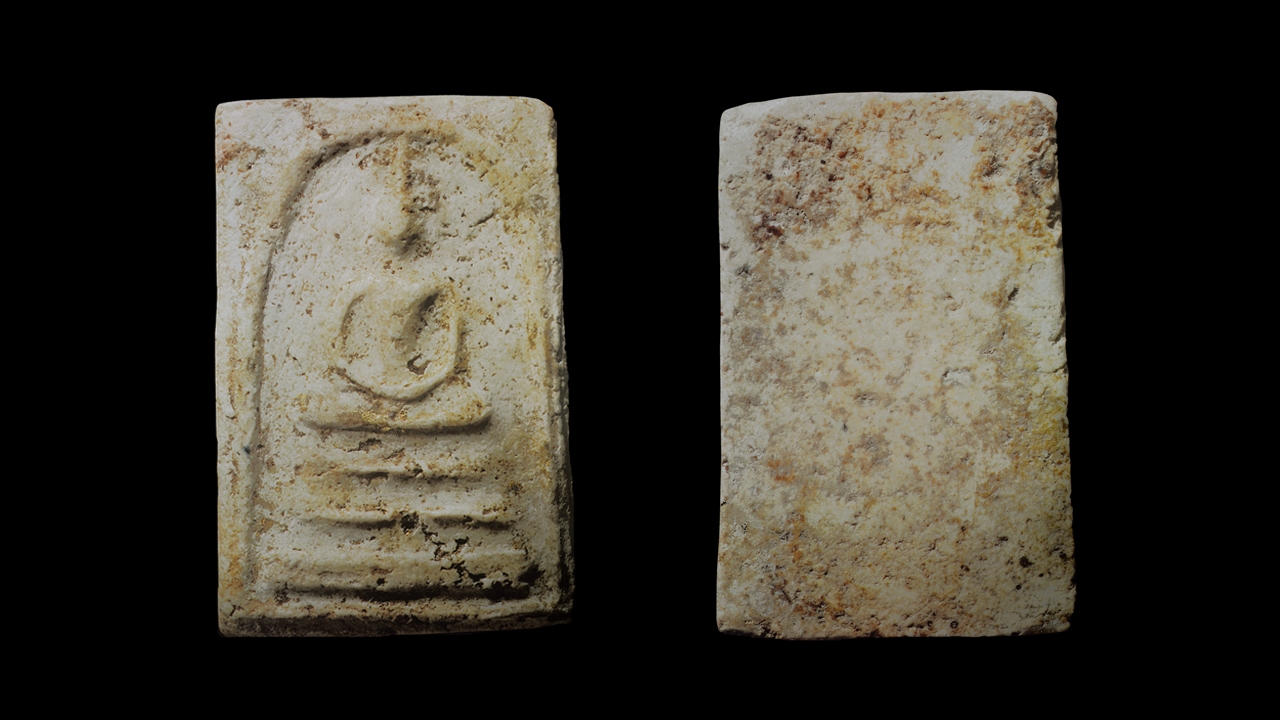
Among the Somdej amulets of Somdet Phra Phutthachan (Toh Prommarangsi), the Somdej Wat Bang Khun Prom thread line print is considered one of the simplest in Buddhist iconography. Its mold details are minimal, showing only the essential lines to represent the Buddha image. These lines resemble wires or threads, which is the origin of the print’s name. The mold’s design reflects the basic form common to all Somdej prints. Some have described this thread line print as a sketch-like version of the large standard Somdej print.
Due to its fundamentally simple characteristics, Professor Prakit Limsakul, also known as Phlai Chumphon, writing for Thairath, stated that it is an example of primitive or folk-style artistry. From an artistic standpoint, such a print would logically be an earlier creation than more complex prints, such as the five standard prints of Somdej Wat Rakang—large print, chedi print, base cross print, lotus bud print, and Bodhi leaf print. However, most contemporary amulet collectors believe the thread line print exists only from Wat Bang Khun Prom and not from Wat Rakang. It is intriguing to ask whether the Somdej thread line print might actually exist from Wat Rakang as well.
The 1964 book "Applied Amulets" by Triyampawai discusses the creation of Somdej Wat Bang Khun Prom amulets in 1870, stating, “Somdet Phra Phutthachan conducted a ceremony at Wat Indrawiharn and then enshrined the amulets in the main chedi of Wat Mai Amataros. Due to the need for large quantities, molds of all rectangular Wat Rakang types were used, including some types no longer produced at Wat Rakang, such as the thread line print. ...” According to this credible source, the thread line print was originally produced by Wat Rakang craftsmen in the early period before palace goldsmiths made the standard Wat Rakang molds. This aligns with artistic principles.
Nevertheless, the "Science of Somdej" column has noted that the thread line prints appearing today in the market mostly derive their design from the large standard prints of both Wat Rakang and Wat Bang Khun Prom, crafted by palace goldsmiths. The overall Buddhist art style is “perspective,” showing depth and a slight turn of the Buddha image to the right, though less distinctly than the large standard prints. This suggests that current standard thread line prints are newly carved molds made during preparations for producing Somdej Bang Khun Prom amulets. Considering the unique material composition typical of Wat Bang Khun Prom amulets, these were likely not made from ancient Wat Rakang molds. If they were, they would lack the Western-influenced perspective art style introduced by the palace goldsmiths.

However, the "Science of Somdej" respectfully agrees with earlier experts that it is highly possible the Wat Rakang thread line print exists. Yet, based on available evidence, the ancient mold thought to be discontinued at Wat Rakang was probably not used to produce the Wat Bang Khun Prom amulets when they were enshrined in the large chedi. Also, the Wat Rakang thread line print possibly made early by local craftsmen likely differs in material composition from the popular standard prints.
the thread line print is currently believed to exist only at Wat Bang Khun Prom, subdivided into seven subtypes (including the large thread line print, which closely resembles the large shallow print of Wat Bang Khun Prom). However, credible historical and artistic evidence suggests the ancient Wat Rakang thread line print was likely produced as well. The "Science of Somdej" column believes that academic and forensic examination approaches will help gather further evidence. In the future, with sufficient supportive evidence and reliable knowledge, a framework may be established to authenticate the Wat Rakang thread line print, if it exists, possibly extending to other ancient print types.
The "Science of Somdej" concludes this installment by outlining criteria for evaluating the Wat Bang Khun Prom large thread line print, which some say closely resembles the large shallow print of Wat Bang Khun Prom. This is presented here for educational purposes as follows:
1. The Buddha’s face on the large thread line print closely resembles that of the large shallow print of Wat Bang Khun Prom.
2. The large thread line print lacks ears in its artistic depiction.
3. The left shoulder of the Buddha image, connecting to the left arm, shows a depression rather than a raised shoulder as on the right side.
4. Both arms curve slightly and bend at the elbows.
5. The lap area is noticeably raised, and a line of the robe extends from the left elbow down to the base of the lap, a feature not seen in the large shallow print except for the deep large print with a line under the lap.
6. The left knee protrudes significantly higher than the third layer of the base (counting from the bottom).
7. The right knee and the right side of the third base layer are roughly level with each other.
8. The inner walls of the three-tiered base are slightly inclined upward to support the raised lines of each tier, similar to the concave base interior seen in the lotus bud print of Wat Rakang.
9. The second tier of the base at both ends lacks lion head supports, unlike the large print of Wat Bang Khun Prom, which features lion heads on both sides.
10. The Buddha image in both the large print and large thread line print faces roughly 15 degrees to the right, as if slightly turned, while the three-tiered base remains straight. This creates the visual effect of the left lap appearing higher than the left base, and the right lap seeming lower than the right base.
For further reading, visit the Facebook page "Science of Somdej" by Police Lieutenant Colonel Komsan Sanongphong. Special thanks to Assistant Professor Rangsarn Tosuwan for kindly providing images of the master-class Wat Bang Khun Prom Somdej amulet for educational purposes. Gratitude is also extended to the current owner of this beautifully preserved large thread line print Wat Bang Khun Prom amulet, which perfectly matches the textbook features. Notably, the left knee is prominently raised, and the left shoulder dips, key traits of this subtype. The second tier of the base lacks lion heads on both sides, differing from the large shallow print which features them. The lowest base tier is a full rectangular block, unlike other subtypes with a central groove. The amulet shows a light brown tone with encrustations on both front and back, which is smooth at the back and slightly raised along the printing frame’s left edge at the front. This amulet serves as an excellent model for studying Wat Bang Khun Prom Somdej amulets. Additional articles are available in the "Science of Somdej" column.
Author Police Lieutenant Colonel Komsan Sanongphong, former forensic police officer
Facebook Page –Science of Somdej