

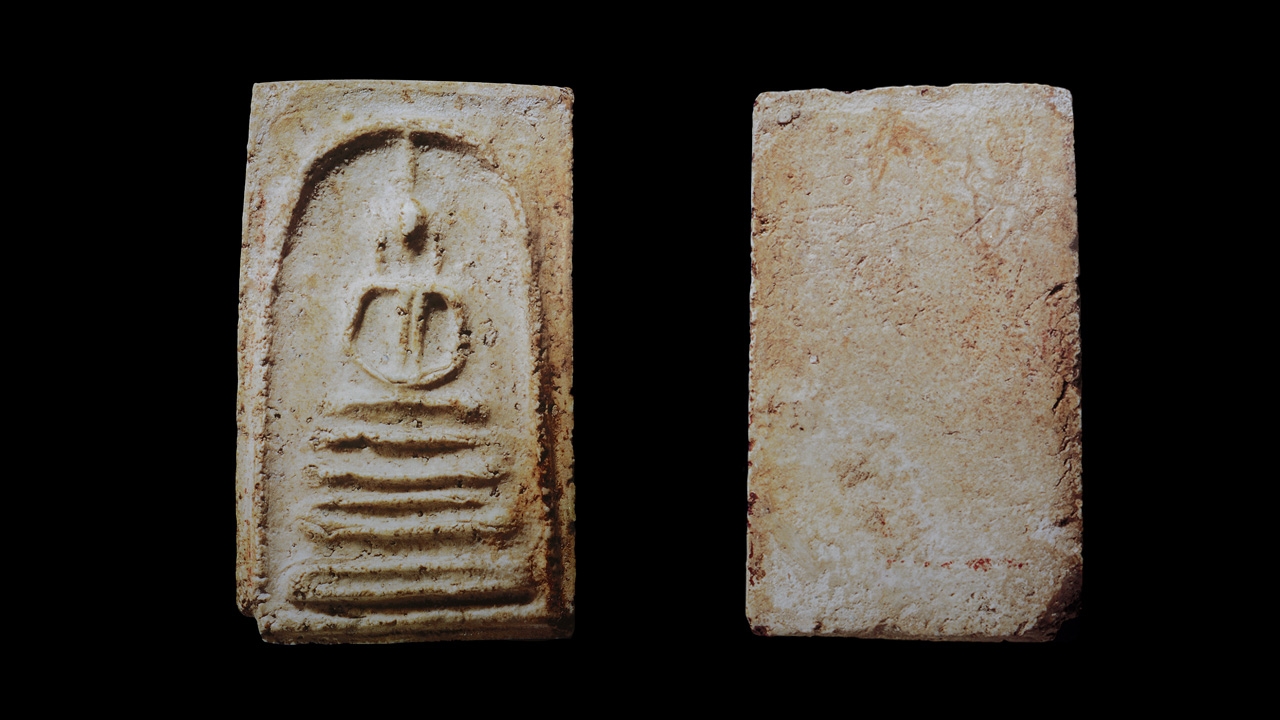
The Phra Somdej Wat Bang Khun Phrom Double-Base mold is distinguished by its triple-layered base featuring paired lines supporting the Buddha figure, which gives this mold its name. This mold type was commonly found during the opening of the main pagoda at Wat Mai Amataros (Wat Bang Khun Phrom) in 1957 CE. An anonymous contributor to Precious magazine stated that the Phra Somdej Wat Bang Khun Phrom Double-Base mold exists only at Wat Bang Khun Phrom; it is not found at Wat Rakhang Kositaram. Furthermore, the third sub-mold of the Base-Sam mold, which closely resembles the Double-Base mold, is also absent from Wat Rakhang Kositaram.
The anonymous source divided the Phra Somdej Wat Bang Khun Phrom Base-Sam mold into three subtypes. Besides the third subtype, which closely resembles the Double-Base mold, the first subtype is similar to Wat Rakhang's Base-Sam mold subtype one (which has four subtypes), while the second subtype is unique to Wat Bang Khun Phrom.
However, the “Pra Kruang Prayot” (Applied Amulet) text by Triyampawai states that the Double-Base mold also existed at Wat Rakhang. It mentions that an ancient mold was once used to create this mold type for Wat Rakhang but was discontinued, and this same ancient mold was then used to produce the Phra Somdej Wat Bang Khun Phrom. This narrative resembles that of the Thread-Line mold, which Triyampawai also attributes to an ancient Wat Rakhang mold.
Regarding the Thread-Line mold of Phra Somdej Wat Bang Khun Phrom, “The Science of Phra Somdej” has noted that the material and popular molds currently observed were likely not made from ancient molds but from newly carved molds by the same craftsmen who created the standard mold of Phra Somdej Wat Rakhang. One reason is that numerous molds of the Thread-Line type were produced (with seven distinguishable sub-mold forms) to create a total of 84,000 amulets corresponding to the number of Buddhist scriptures. The Thread-Line mold is the most commonly encountered among Phra Somdej Wat Bang Khun Phrom.Comparable tothe Sangkhati mold. Another reason is the presence of "perspective" or realistic depth effects in the Thread-Line mold, a characteristic of Western-style art crafted by royal artisans or goldsmiths, similar to what appears in the large mold of Phra Somdej Wat Rakhang. This suggests it was not made from ancient molds by local craftsmen.
In the case of the Double-Base mold, “The Science of Phra Somdej” hypothesizes that the currently known standard mold, which exists only in one subtype, was likely not created from ancient molds made by local craftsmen but from newly carved molds. Judging by the mold’s line patterns, the craftsmen who carved these molds were probably from the same family or possibly the same individual. Ancient molds for the Double-Base type may exist, but more evidence is required regarding their material and mold characteristics.

Another plausible hypothesis is that the molds for the Double-Base and Thread-Line types were created simultaneously with the five standard molds of Wat Rakhang. Evidence includes Phra Somdej Wat Bang Khun Phrom specimens with dense material closely resembling Wat Rakhang’s. Senior expert Prajam U-arun once noted seeing almost all types of Phra Somdej Wat Bang Khun Phrom made from material like Wat Rakhang. Nevertheless, the prevailing view today is that the Double-Base and Thread-Line standard molds are exclusive to Wat Bang Khun Phrom.
“The Science of Phra Somdej” previously observed that the Double-Base and Base-Sam molds have unique features not found in the rectangular-frame molds from either Wat Rakhang or Wat Bang Khun Phrom. These include the base and Buddha figure appearing to float without weight, and a body posturethat resemblesthe practice of various ascetic postures seen in some sub-molds, akin to those of Phra Somdej Wat Ket Chaiyo.
Examining the line patterns, the Double-Base mold of Phra Somdej Wat Bang Khun Phrom shows precise and meticulous carving—comparable to most Base-Sam molds, which were modeled after Wat Rakhang’s Base-Sam mold. The Thread-Line mold, however, features a somewhat looser but still careful carving style, likely made slightly later. The Sangkhati mold’s carvings are generally rougher and lack artistic refinement, probably due to the haste in mold carving. It is assumed that among all Phra Somdej Wat Bang Khun Phrom molds, the Sangkhati mold was the last to be carved.
Most experts agree that the Phra Somdej Double-Base mold exists only at Wat Bang Khun Phrom and is not found at Wat Rakhang. Professor Prakit Limsakul, also known as Phlai Chumphon from Thairath, explains that the Phra Somdej Wat Bang Khun Phrom Double-Base mold originated from Wat Rakhang’s Base-Sam mold. The Double-Base mold also closely resembles the third subtype of Wat Bang Khun Phrom’s Base-Sam mold to the extent they are nearly indistinguishable. The hypothesis that an ancient Double-Base mold made by local craftsmen once existed at Wat Rakhang, or that the molds for this type (and possibly others) were created simultaneously with the standard molds of Wat Rakhang, remains an intriguing topic awaiting verification. These theories are fascinating and await further proof.
“The Science of Phra Somdej” closes this section by sharing knowledge from the anonymous contributor to Precious magazine and Assistant Professor Rangsarn Tosuwan, who provided criteria for examining the Phra Somdej Wat Bang Khun Phrom Double-Base mold. This includes key points distinguishing this mold from the similar Base-Sam (third subtype) mold. For educational purposes, the following distinctions are noted:
1. The mold edges on all four sides feature raised borders and often show scraping marks from lifting the stamp during cutting. There is usually an excess clay bulge at the front because the Wat Bang Khun Phrom method presses the mold down onto the front and then lifts it upward or trims the excess from the sides. This differs from Wat Rakhang, where cutting is done from back to front, resulting in no bulging but instead a rough texture on the back of the amulet.Therefore, bulging clay is absent, replaced by a rough back surface on Wat Rakhang’s Phra Somdej.
(“The Science of Phra Somdej” also suggests that the bulging edges might result from pressing a wooden mold onto a clay sheet underneath, causing the clay to sink to the mold’s size. When the mold is lifted, some clay adheres to the edges, creating a bulge if cut at or near the edge. Cutting narrower would remove the bulge entirely. Conversely, Wat Rakhang likely uses a soapstone mold onto which a clay lump is pressed from the back with a wooden board, then cut—this method rarely creates bulges.)
2. The arch frame line is very fine, sharp, and narrow.
3. The topknot (usnisha) is long and extends to the arch frame.
4. The face is a small, oval half-ellipse, proportionate to the amulet size.
5. The ears are straight and sharply defined; the right ear (or left from the front view) is lower than the left and extends to the shoulder.
6. The robe lines are deep grooves in the center, called the “chest groove.”
7. The chest area has robe lines on both sides running up to the chest and curling inward; this mold flaw is clearly different from the Base-Sam mold. . In the Base-Sam mold, the robe lines spread outward toward the armpits, while in the Double-Base mold they run straight up to the chest. Also, in the Double-Base mold, the chest lines from both shoulders are higher than the robe lines meeting them.
8. The lap line is straight, differing from the Base-Sam third subtype, which has curved knees overlapping horizontally, though not clearly.
9. The supplementary line beneath the lap on the amulet’s left side is noticeably longer than the knees, differing from the Base-Sam mold where this line is about equal to both knees.Comparable tothe left and right knees.
10. The third base layer line and the supplementary line beneath the base are much closer together than other lines.
11. The supplementary line beneath the third base layer on the left side is shorter than the others, unlike the Base-Sam third subtype where this line is not short.
12. The first (bottom) base layer is a large, straight block with a deep concave center, appearing as paired base lines, and is more deeply concave than the Base-Sam third subtype.
13. The back mold is mostly smooth, with very few amulets having a rough back.
For more information, visit the Phra Somdej Science page by Police Lieutenant Colonel Komsan Sanongpong. Special thanks to Assistant Professor Rangsarn Tosuwan for kindly providing images of the master Phra Somdej Wat Bang Khun Phrom amulet for educational purposes, and gratitude to the current owner of this amulet. This particular Phra Somdej Wat Bang Khun Phrom Double-Base mold amulet is exceptionally beautiful, covered with aged residue and brown patina. Its mold shape is textbook accurate with three paired base layers—the source of its name. The two robe lines run straight up to the chest (unlike the Base-Sam mold, where the lines spread toward the armpits). The head and body size are smaller than the Base-Sam mold, and the lap line is straight (whereas Base-Sam resembles a horizontal figure eight). The front edge shows no clear bulging, likely due to precise cutting. Bulging is often seen in other Wat Bang Khun Phrom amulets. The back is smooth. This amulet is an excellent prototype for studying Phra Somdej Wat Bang Khun Phrom.
Author Police Lieutenant Colonel Komsan Sanongpong, former forensic police officer
Facebook page –Phra Somdej Science