

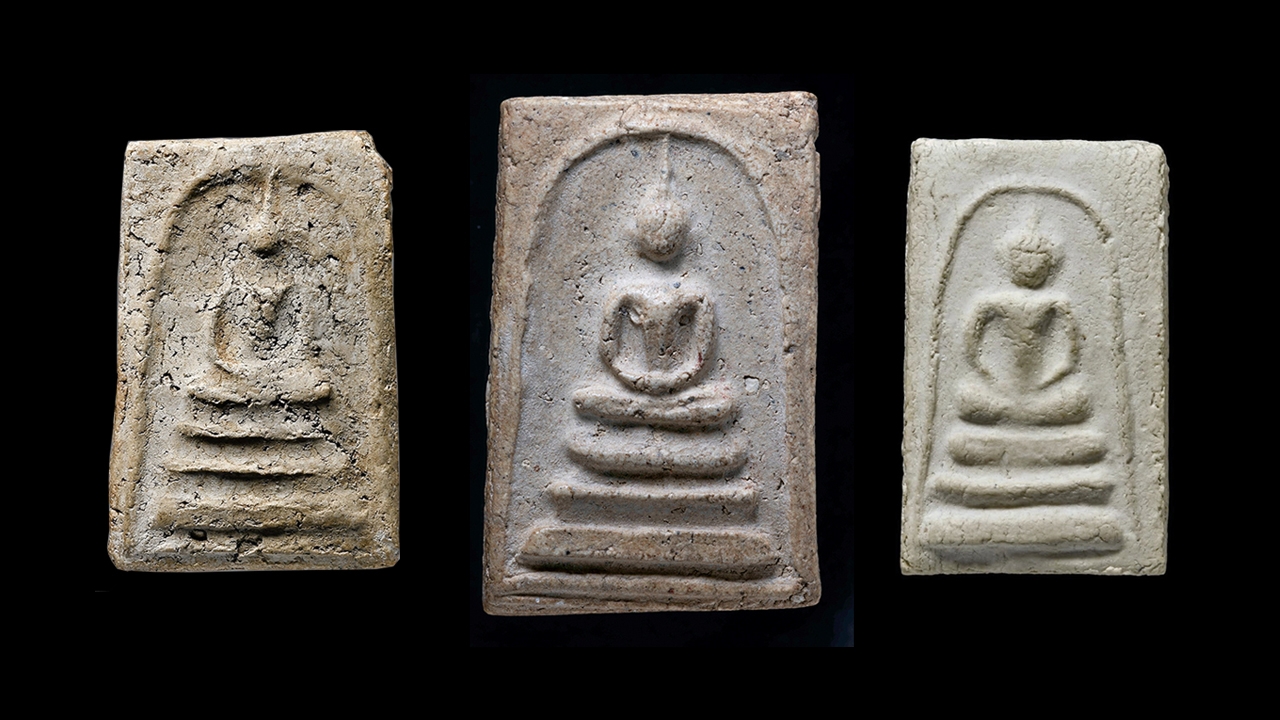
Spotlighting the allure "Phra Somdej Wat Rakang Pagoda print" Je Jaew's Piece A genuine, easily recognized champion-level amulet coveted by collectors, followed by top-tier beauty from "Bang Khun Prom Phra Somdej thread print and large old batch" In dense, smooth condition with soaring values reaching mid-millions, ending with a prized sacred ceremony item, "Bang Khun Prom 2509 Large Garuda Chest print" Sacred materials from the 2500 batch cracked open; at this moment, an original pristine condition like this has hardcore fans competing to rent or own it for low hundreds of thousands.

Following fans' requests to see the allure of Phra Somdej Wat Rakang Pagoda, Pagoda print, "Je Jaew’s piece" again, When the amulet entered the market during the Wat Mahathat era, it passed through a major expert known as P'Li Yai and then went directly to collector Khun Boonyong Nimsombun, mayor of Thonburi City, who owned several famous Phra Somdej amulets in this collection for a long time before it passed to Je Jaew or Je Sukanaya, who boldly fought for its price, making it famous as "Je Jaew’s piece." She was a close associate of Field Marshal Praphas Charusathien, sharing the treasure. Later, Je Jaew's piece went to "Hia Nueng" Preeda Apipunya and has remained there since—many want it but dare not ask the price as it gives them goosebumps each time they inquire.

Must be awarded to Bang Khun Prom Phra Somdej thread print, Wat Mai Amataros, Bangkok, Genuine and easy to recognize, in perfect condition with a dense, smooth fine-textured surface, sharp print, evenly detailed artistic lines, protruding texture along the top edge as a key identifying feature. The back shows light patina and old batch roots indicating its age as an “old batch” amulet. Such pristine pieces are now rare. This one belongs to The Kob-Thikan Supaviratchabuncha, who is currently collecting champion amulets.

This piece is Bang Khun Prom Phra Somdej Large print, old batch, Wat Mai Amataros, Bangkok, Created late in King Rama IV’s era by the registrar (Duang), progenitor of the Thanakoset family, invited by His Holiness Somdet Phra Phuttha Chao (Toh Prommarangsi) of Wat Rakang, Thonburi, as the chief overseer. The amulets were enshrined in a pagoda. When opening the batch, eight print types were discovered:
1.. Principal Buddha print (large)
2.. Lotus bud print
3.. Pagoda shape print
4.. Thread print
5.. Base insert print
6.. Monk’s cloak print
7.. Double base print
8.. Garuda chest print
There are also a few Bodhi leaf and Reclining Buddha prints, very rare. This piece belongs to Hia Joe-Sakorn Chantawanich. It is a genuine large print old batch, easy to identify, in perfect original condition with light patina and batch roots on front and back, with some cracks revealing dense internal material—solid texture. This condition commands a standard price around mid-millions.
This piece is from the later period, Bang Khun Prom Phra Somdej Large Garuda chest print, 2509, Wat Mai Amataros, Produced during the tenure of Phra Khru Amornkanachan (Seng) as abbot, to raise funds for a new ordination hall. Phra Khru Borihan Khunwat (Chom), assistant abbot, led the project. The Buddhist chant ceremony was presided over by Somdet Phra Wanrat of Wat Phra Chetuphon and 84 monks including Luang Pho Nak of Wat Rakang, Luang Pho Ngern of Wat Don Yai Hom, Luang Pho Tae Kong Thong of Wat Sam Ngam, Luang Pho Nor of Wat Klang Tha Ruea, A. Tim of Wat Chang Hai, Phra Ajarn Taem of Wat Phra Loi, among others. The Buddhist consecration ceremony was held at Wat Suthat led by Phra Kru Palat Wisutthiwat.

There are 12 prints: 1. Large print 2. Pagoda print 3. Lotus bud print 4. Monk’s cloak print 5. Thread print 6. Double base print 7. Base insert print 8. Bodhi leaf print 9. Garuda chest print 10. Reclining Buddha print 11. Score print 12. Floating moon print. The amulet materials include damaged pieces, batch soil from the 2500 batch opening, sacred powders from renowned monks nationwide, seashell lime, lotus pollen, Pikun flower, and many other sacred materials, with honey and sesame oil as binders.
Each print required many molds since the mold material was fragile, needing frequent replacement. The large print alone used nearly 30 molds, carved by craftsmen Chaem, Ja Manit Pathapee, and Kasem. A total of 84,000 pieces were produced. Buyers were instructed to enshrine the amulets in pagodas for one baht each or keep them for ten baht each. Sets of 11 prints (with pagoda stamp on the back) were sold, excluding the Reclining Buddha print, which was sold as a set for 100 baht.
Currently, early series prints like large and pagoda prints fetch prices from tens of thousands to hundreds of thousands baht, while popular secondary prints like this one belonging to Sia Tao from Ban Nam Mon, the large Garuda chest print in pristine champion condition, sell from high tens of thousands to low hundreds of thousands baht.
Thanks for the images from the Sanam Phra Viphavadi column by Seeka Ang