

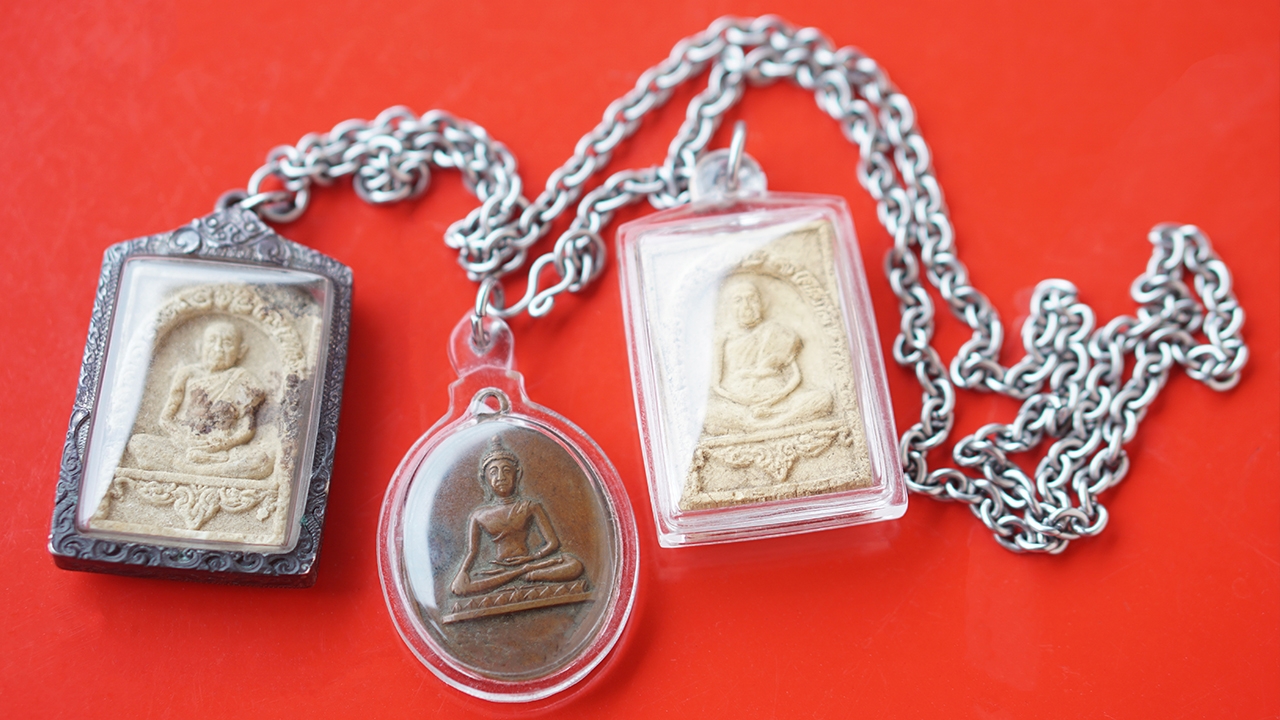
For Thais who hold deep reverence for Buddhism and sacred objects, "amulets" have long been a spiritual anchor in society. Many have strong faith in multiple revered teachers and monks, which often leads to the frequently debated question among collectors and spiritual practitioners whether wearing multiple amulets on the same necklace causes their powers to clash or cancel each other out, and if so, how should one properly wear several at once?
According to beliefs in the amulet community and teachings from renowned monks in the past, "The powers of amulets never clash." This is because the power, or efficacy, of amulets arises from the pure-minded intentions of the venerable monks who created them, intended for protection, safeguarding, and as reminders of the Buddha, Dharma, and Sangha.
The idea that amulets clash often stems from personal concerns, such as mixing amulets for loving-kindness with those for invincibility and fearing their powers will negate each other. In reality, the powers act like positive energy waves that support each other. Wearing multiple amulets does not reduce their auspiciousness.
Although the powers do not conflict, in terms of belief and Thai customs, importance is given to the "hierarchy" and "positioning" of amulets on the necklace to show the utmost respect. The commonly used arrangement principles are as follows:
1. The main position (center)
must be a Buddha image representing the Supreme Buddha, such as Phra Somdej, Phra Phuttha Chinnarat, the Emerald Buddha, or the Buddha posture corresponding to one’s birth day, since the Buddha holds the highest rank in the three worlds.
2. The secondary positions (left and right)
are arranged in descending order of significance: next to the Buddha image are venerable monks or famous masters (e.g., Luang Pu Thuat, Luang Pho Khun), then royal portraits (e.g., King Rama V), with talismans such as takrut or Luang Pho Pan’s tiger often placed at the lowest or back of the neck position.
Arranging left and right sides is counted from the wearer’s chest, with the right side of the chest (left from the observer’s perspective) considered slightly more important according to ancient belief.
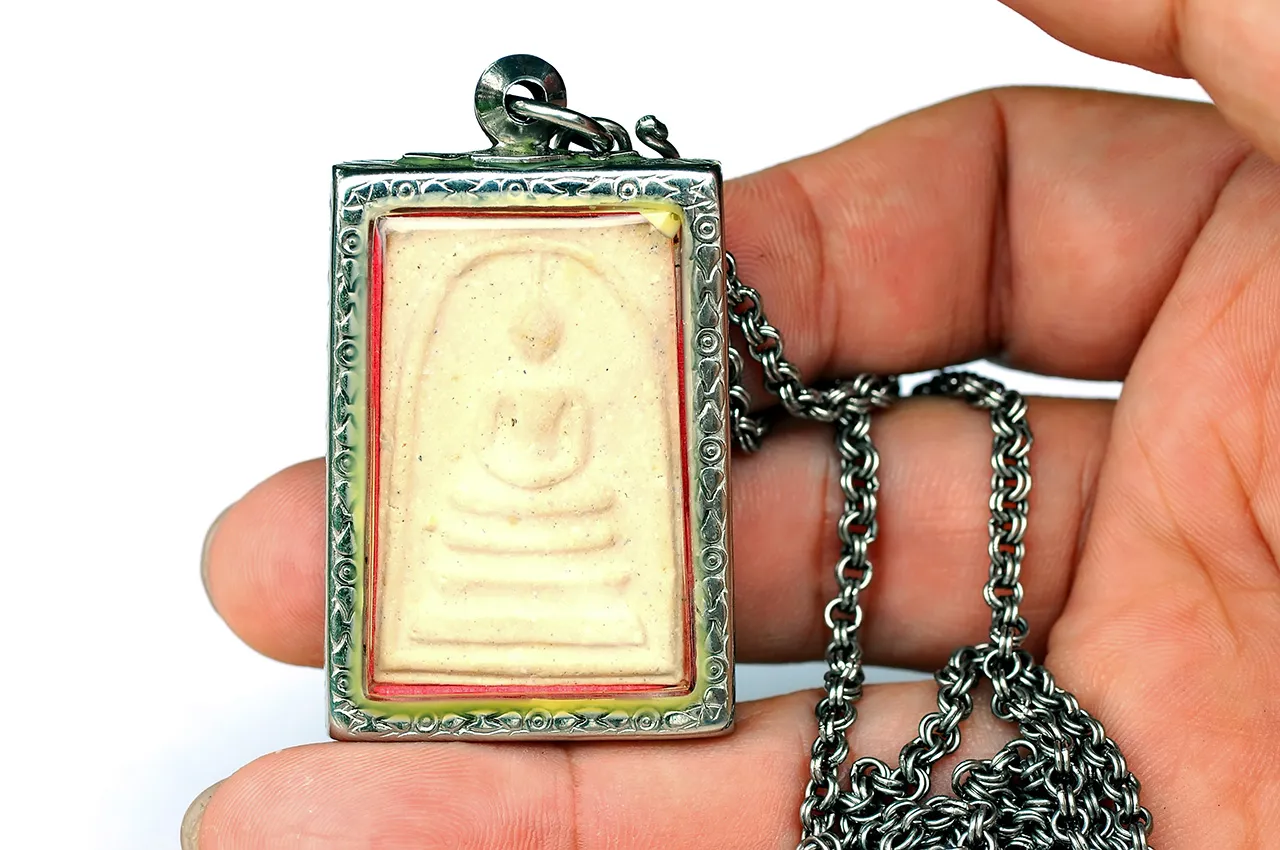
Another common question concerns the number of amulets on the necklace. Traditionally, odd numbers such as 1, 3, 5, or 7 are preferred according to universal beliefs.
Number of amulets | Reasons and arrangement patterns |
| 1 amulet | A single main amulet stands out and is easy to care for. |
| 3 amulets | The main amulet is centered, flanked by revered monks on each side, providing good balance. |
| 5 amulets | One main amulet, two popular revered monks (left and right), and two smaller amulets or talismans. |
Wearing an odd number is practical because it allows one amulet to serve as a "central axis" perfectly centered on the chest, ensuring the necklace stays balanced and does not tilt to one side.
If wearing an even number (such as 2 or 4 amulets), collectors often add a takrut or small amulet at the back of the neck to make the total count odd.
Ultimately, the most important aspect of wearing amulets is not the number or value but living morally, as the amulets’ powers protect those who practice good conduct.