

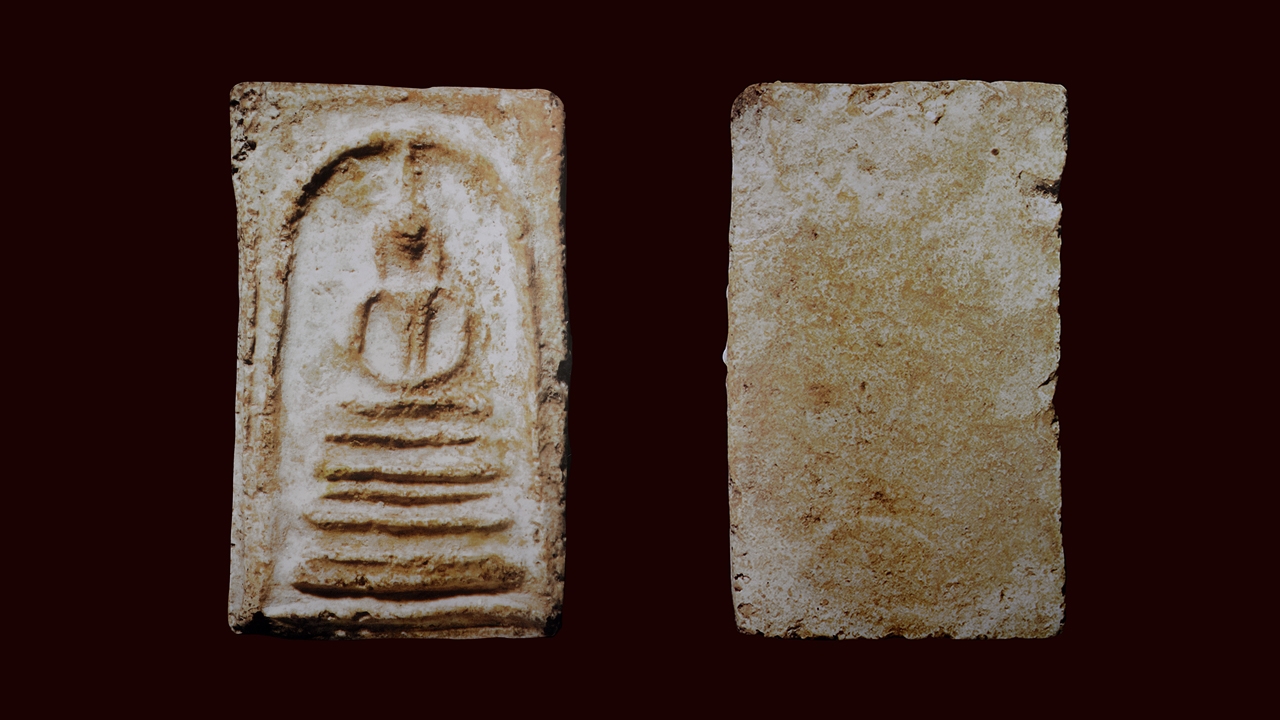
Phra Somdej Base Sam amulets from both Wat Rakang Kositaram and Wat Bang Khun Phrom share overall characteristics that give the print its name: the presence of two Sam lines. The first line is above the middle base tier, and the second is above the top base tier, known as the line under the lap. Among collectors, two additional notable features are known: the amulet often has "a horizontal lap line resembling the number eight" and "a top border wider than the bottom border, tapering downward, with the left frame line at the top often bending outward." The first feature usually carries more weight in authenticating the amulet than the second. This is partly because the "prototype Phra Somdej" or master Base Sam print (from both Wat Rakang and Wat Bang Khun Phrom) typically aligns with the first feature, while the second may or may not appear in master Base Sam prints (but never in other print types). Ajarn Prakit Limskul, also known as Plai Chumphon, of Thairath Newspaper, explained that the flared top border results from the amulet's wide, curved rattan arch at the top, which required the craftsman to widen the top frame line accordingly.
From the forensic science perspective, one could say that the "horizontal lap line resembling the number eight" has a higher "evidential value" than the "top border wider than the bottom," which raises the question: what does "evidential value" mean?
To verify whether an item is genuine or counterfeit by forensic principles, a prototype must be found for comparison. In seeking the original Phra Somdej or master Phra Somdej, which the "science of Phra Somdej" has previously discussed, credible evidence is essential—whether witness testimony, physical evidence, documents, expert opinion, etc.—that can be traced back to confirm the prototype was indeed created by Somdej Toh, also known as having "evidential value." The credibility of the prototype is crucial—like fastening the first button. If the prototype is unreliable, the entire verification process fails from the start, rendering subsequent efforts nearly useless.
After identifying a prototype, the next step is to define the identity (unique traits not found in other prints) of the Phra Somdej. For example, the craftsmanship of the mold-carver for Somdej Toh’s amulets is distinctive and serves as a signature different from other types, aligning with the "Phra Somdej signature theory" discussed previously. Alternatively, the texture density of the Phra Somdej may also serve as an identity. Beyond identity, other common attributes found in prototype Phra Somdej can be considered, such as the two distinctive features found in the Base Sam print mentioned above.
The final step is to verify the identity and distinctive attributes of the Phra Somdej. The "evidential value" of the attributes used for verification is also very important. These attributes must help indicate the authenticity of the amulet to some degree. If the attribute has little or no evidential value, the verification cannot reliably confirm authenticity. Identity attributes generally have high evidential value. For amulets where the identity is not clear, other attributes may be examined, such as the "horizontal lap line resembling the number eight," which has higher evidential value than the "top border wider than bottom," for example.

Some attributes require proper tools and methods for evaluation. For instance, examining the texture density or constituent materials of the Phra Somdej using a low-power magnifying glass—a method used effectively for decades—can aid verification to a certain extent.
However, authenticating amulets by forensic principles does not always require expensive equipment. The key is what is being verified and the evidential value of that element. If the feature has little or no evidential value, even costly tools yield minimal benefit. Conversely, if the feature has some evidential value but inappropriate or nonstandard methods or tools are used, the verification results are also ineffective.
In verifying Phra Somdej by forensic principles, important steps include finding the prototype, defining identity, and conducting verification. The critical point is "evidential value." That is, the evidence or attributes considered must be relevant and carry sufficient weight to help determine whether the Phra Somdej under examination is authentic.
Today, collecting Phra Somdej is widespread and has broad economic effects, both positive and negative. Negative impacts especially affect those lacking academic knowledge about Phra Somdej, making it difficult to distinguish genuine scholarship from fake information. Studying Phra Somdej following forensic academic principles can help beginners learn correct study methods.
The "science of Phra Somdej" closes this discussion by summarizing knowledge on examining the Wat Bang Khun Phrom Phra Somdej Base Sam subtype 2, whose mold has distinctive features unique to Wat Bang Khun Phrom, by Nirunam, for educational purposes, as follows.
1. The upper area of the amulet is wider than the lower area, a key distinctive trait found in Phra Somdej Wat Bang Khun Phrom (Wat Mai Amataros) Base Sam and Phra Somdej Wat Rakang Kositaram Base Sam prints.
2. The mold’s frame lines on all four sides of Wat Bang Khun Phrom Base Sam subtype 2 are more prominently raised than those on subtype 1.
3. The lower base’s right corner is cut at a sharp angle, while the left corner is blunt—an important mold art characteristic.
4. The amulet’s hair is slender and elongated like a chedi spire tip.
5. The face is semi-oval shaped.
6. Both ears are straight down to the shoulders, but the right ear’s upper tip is higher than the left—a very important identity feature.
7. The chest area of subtype 2 is narrower than that of subtype 1.
8. The monk’s robe cord runs in twin lines from the chest down to the hand, resembling a double fold; under close examination or magnification, these lines curl upward, similar to those in Wat Rakang Kositaram Base Sam and Wat Bang Khun Phrom Base Sam subtype 1.
9. The lap line resembles a horizontal figure eight, with a faint overlap of the right foot over the left.
10. The Sam line under the lap is shorter than the knees on both sides and is sharper than that of Wat Rakang Kositaram Base Sam.
11. The Sam line below the first base tier is more prominently raised than in Wat Bang Khun Phrom Base Sam subtype 1.
12. The arch-shaped frame is as thick as that of Wat Bang Khun Phrom Base Sam subtype 1 and thicker than subtype 3.
For further reading, visit the Phra Somdej Science page by Police Lieutenant Colonel Komsan Sanongpong, with thanks to Assistant Professor Rangsarn Tosuwan for providing images. Master Phra Somdej Wat Bang Khun Phrom for educational purposes, and thanks to the current owner. This amulet is a very beautiful Wat Bang Khun Phrom Phra Somdej Base Sam subtype 2 (Nirunam divides Base Sam into three subtypes; this subtype features unique traits of Wat Bang Khun Phrom). The print matches reference texts, with the top border wider than the bottom (a typical tapering feature of this print), clear ear attachment (Wat Bang Khun Phrom amulets generally have clearer ears than Wat Rakang), a light yellow hue with a thick crust of dirt covering the front and back, the robe lines flaring toward both arm gaps, and the lap line resembling a horizontal figure eight (a key feature of Base Sam family). The front border shows a clear curled edge on the left side, common in Wat Bang Khun Phrom amulets. The back is smooth, typical of most Wat Bang Khun Phrom Phra Somdej. This amulet is an excellent prototype for studying Wat Bang Khun Phrom Phra Somdej. More articles are available in the "Science of Phra Somdej" column.
Author Police Lieutenant Colonel Komsan Sanongpong, former forensic police officer
Facebook page –Phra Somdej Science