

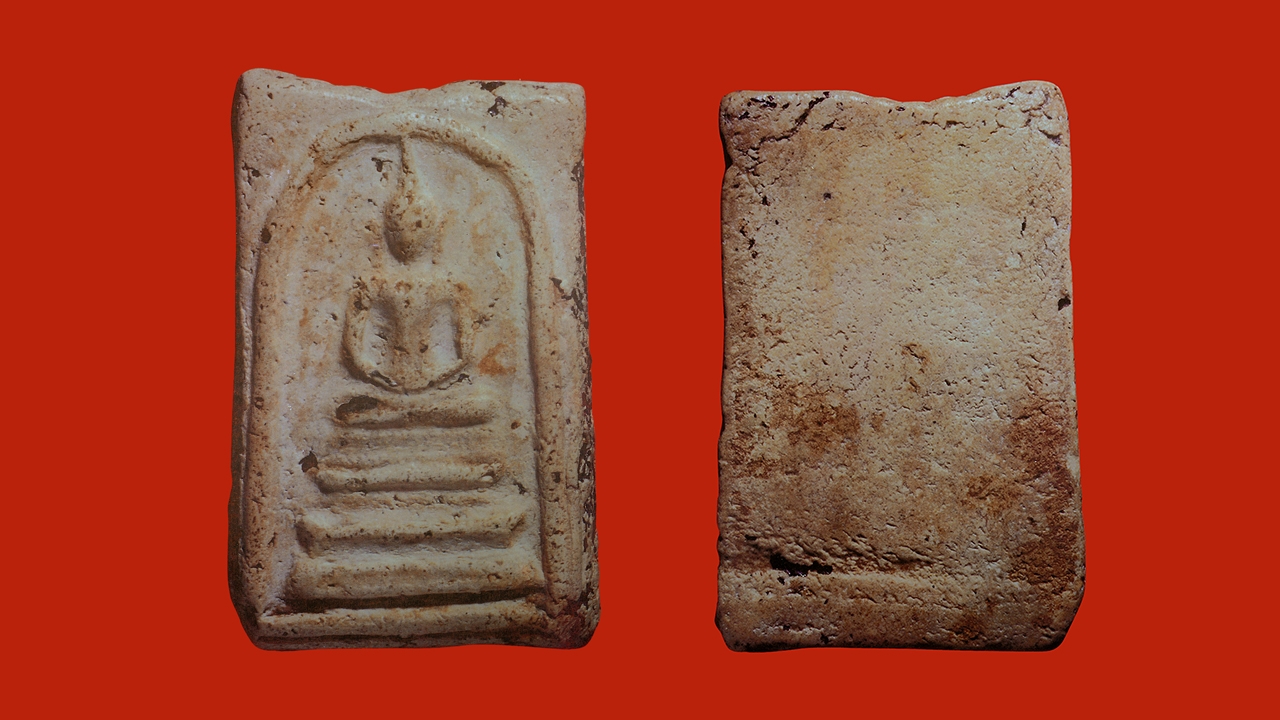
The Wat Rakang Kositaram Somdej amulet with the base insert design is the most commonly found among all standard Wat Rakang Somdej amulet types, with numbers close to the large design. Given this abundance, the number of molds carved must also be considerable. An anonymous writer for Precious magazine categorized this design into four subtypes, with the first subtype bearing a strong resemblance to the Wat Bang Khun Prom Somdej amulet base insert subtype 1, especially those with dense material.
The anonymous writer also noted that this Wat Rakang design often contains many materials (white stone particles or relic granules, red particles resembling parts from the Kamphaeng Samkor shrine, gray lumps, black substances resembling incense ash, wood fragments, etc.). However, examining the mold engraving lines of this amulet type, they are generally not sharp or detailed. Even the boundary lines of the mold are usually shallow and barely visible, almost giving the impression of no defined mold frame. Senior Somdej expert Professor Kitti Thammacharat said, "This is the only Wat Rakang Kositaram mold that has a shallow and ornate mold art, unlike the robust style of other Wat Rakang Somdej molds."
//Overall, the design features a floating appearance, completely different from other Wat Rakang Somdej types, and it is the only standard design showing the diamond meditation posture. In common terms, one might say that the Wat Rakang Somdej base insert design “does not fit in” with other Wat Rakang Somdej types. It is intriguing to investigate the origin of this design and why it has so many distinctive features.

One plausible hypothesis is that the Wat Rakang Somdej base insert design was created at a different time than the other four standard designs: large, chedi, lotus bud, and Bodhi leaf poses. However, examining the mold lines suggests that all were likely made by the same artisan or artisan family. Also, since most base insert amulets contain similar amounts of materials, as the anonymous writer observed, it is likely they were produced in one session with sufficient prepared clay. Using common sense, the presence of abundant materials suggests that the clay mix was ready, so perhaps this design was made before the others, correct?
Supporting the idea that the base insert design was created before other Wat Rakang designs is the floating, elongated Buddha figure, while the other four designs show Buddha figures bearing their weight on the base with stepped compression. This floating style closely resembles the Wat Kes Chaiyo Somdej, including the ear shape called "elongated ears". "Elongated ears" and even the "groove chest" feature. It is possible that when the artisans began designing the standard Wat Rakang Somdej molds, they started with the base insert design influenced by Wat Kes Chaiyo's elongated style and its five- or seven-layer base (evidence suggests Wat Kes Chaiyo Somdej was made before Wat Rakang, as previously discussed in “The Science of Somdej”).
Upon receiving direction from Somdet To to design a three-layer base Somdej, the design evolved from the Wat Kes Chaiyo style into the three-layer elongated Wat Rakang Somdej base design, requiring the addition of the "insert line" or "base insert" above the middle and upper base layers to maintainbalanceand aesthetic harmony. Later, the other four three-layer base designs were created with more intricate and precise craftsmanship. The reason why the base insert design features a diamond meditation posture—associated with important Buddha images such as the Phra Phuttha Sihing—while other Wat Rakang designs show a flat meditation posture, remains an interesting topic for further study.such as the Phra Phuttha Sihingwhile other Wat Rakang standard designs show a flat meditation posture, which is also intriguing to explore further. Nevertheless, Professor Prakit Limsakul, also known as Phlai Chumpol from Thairath Newspaper, shared that Somdet To’s Somdej amulets may also include other designs featuring the diamond meditation posture.
The Wat Rakang Somdej base insert design is considered unique and distinct, or as some say, "does not fit in" with other Wat Rakang Somdej designs. Understanding its origin, which links the design lineage of Somdej amulets from Wat Kes Chaiyo through Wat Rakang and up to Wat Bang Khun Prom, can help better grasp the overall creation of Somdej amulets by Somdet To.
“The Science of Somdej” We conclude this article by compiling knowledge on the Wat Rakang Somdej base insert subtype 1, which closely resembles Wat Bang Khun Prom Somdej base insert subtype 1, as categorized by the anonymous writer, for educational purposes as follows.
1. The Wat Rakang Kositaram Somdej base insert design’s outer arch is thick and large, similar to the large Wat Rakang Somdej (all subtypes).
2. The term "groove chest" actually does not refer to a deep groove; the chest area is "solid." However, if the mold is sharply engraved, a "sangkhati" line appears from the center of the chest down to the navel, resembling a groove at first glance, but on closer inspection, it is a raised line (all subtypes).3. The upper edge of the amulet (usually) is wider than the bottom (all subtypes).4. The Wat Rakang Somdej base insert design may appear to lack defined mold edges on all four sides, unlike other Wat Rakang designs. In reality, the mold edges exist but slope down toward the edge on all sides, differing from Wat Bang Khun Prom base insert designs, which have distinct raised edges on all four sides (all subtypes).
5. The outer surface around the arch is slightly higher than the inner surface.
6. The tip of the Buddha hair is thicker than in other designs.
7. The hands clasped together form a triangle close to the lap.8. A raised "sangkhati" line appears.9. The right side of the first base layer is set away from the arch.
10. Granules of relic particles are visible.
11. Needle-like pores are found throughout the amulet.
12. There are three types of mold back defects for the Wat Rakang Somdej base insert: textured back, smooth back, and plank back, with the plank back being very rare.
For more details, visit the Facebook page "The Science of Somdej" by Police Lieutenant Colonel Komsan Sanongpong. Thanks also to Assistant Professor Rangsarn Tosuwan for kindly providing images of this master Wat Rakang Somdej amulet for educational use. We also thank the current owner of this amulet, a Wat Rakang Somdej base insert subtype 1 (as classified by the anonymous writer), which closely resembles the Wat Bang Khun Prom base insert subtype 1. This beautifully preserved master piece shows moderate wear, barely visible "sangkhati" line, a white-yellow tone, soft texture with visible relic granules and needle pores. Worm trails characteristic of Wat Rakang amulet material appear on its walls. The design features correct mold according to reference, with long ears nearly reaching the shoulders on both sides. The upper edge is wider than the bottom, a distinct feature of this design (found in both Wat Rakang and Wat Bang Khun Prom). The arch is large and split like rattan (typical for Wat Rakang). Lacquer residues appear in general pits on front and back. The edges fit the mold frame exactly, with a unique indentation on the upper edge. The back is smooth mixed with textured areas, showing natural aging signs (typical "ant trails" on Wat Rakang backs). Surface wrinkles appear generally. This exemplar serves as an excellent model for studying Wat Rakang Somdej amulets. More articles are available in the "The Science of Somdej" column.
Author
Police Lieutenant Colonel Komsan Sanongpong, former forensic police officer
Facebook page
–