

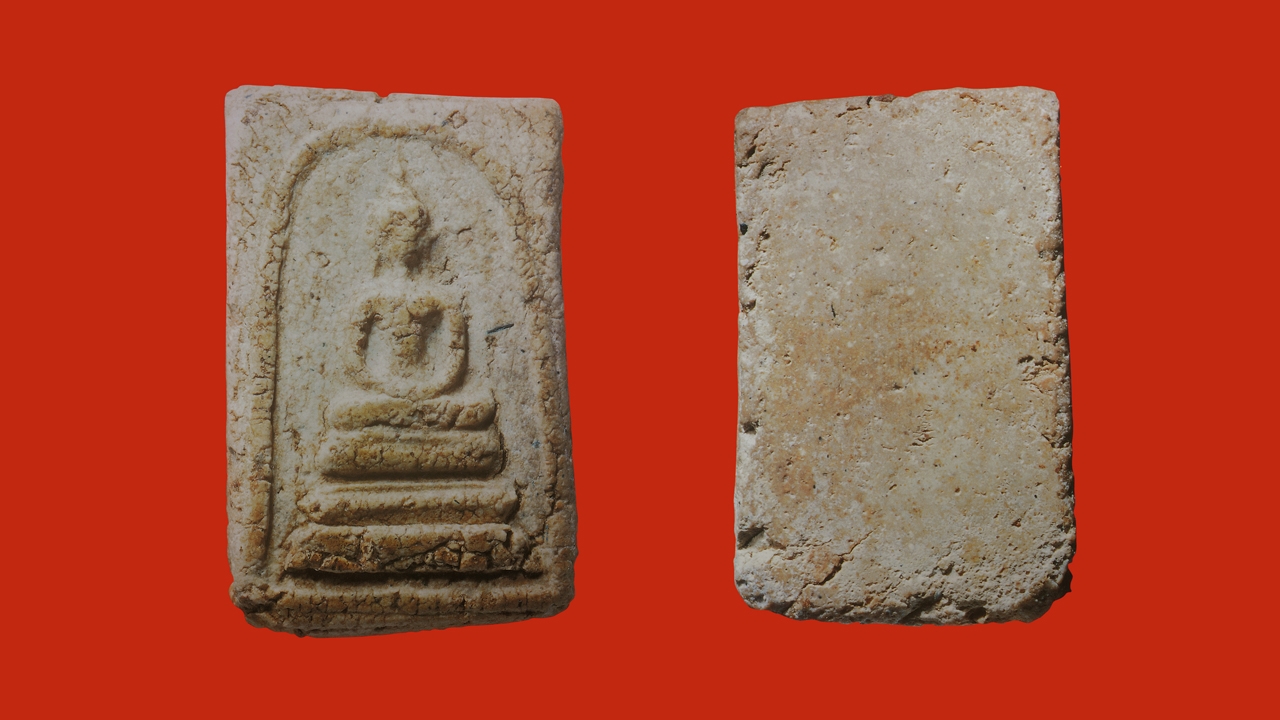
Among the five principal molds of Phra Somdej Wat Rakang Kositaram by Somdej Phra Phutthachan (Toh Prommarangsi), if the base Sam mold is considered the shallowest and most delicate in mold artistry, then conversely, the Wat Rakang Phra Somdej with the deepest and most robust, majestic mold is the Phra Somdej Wat Rakang in the Kesa Buatom mold. From an art perspective, this mold can be seen as a high-relief sculpture (more than half of the Buddha figure rises above the base plane). In contrast, most other Wat Rakang molds tend to be low-relief sculptures. Additionally, among all Wat Rakang Phra Somdej, the sculptor carved the face with relatively clear features in this mold more than others, including carving the Buddha's feet tips. It can be said that this mold exhibits all 32 bodily characteristics. This mold is also one of the rarest, second only to the Prok Pho mold.
The currently accepted standard Wat Rakang Phra Somdej Kesa Buatom molds are divided into two subtypes: the narrow lion base mold and the wide lion base mold. The wide lion base mold was only accepted recently. Originally, collectors believed this mold had only one subtype, the narrow lion base (the most famous example is the Khun Montri piece, reportedly fetching prices up to nine figures in auctions). Prakit Limsakul, also known as Plai Chumphon, from Thairath newspaper, stated that the wide lion base mold was recognized as a standard mold only about twenty years ago, introduced by a senior amulet expert, thus gaining acceptance.
An anonymous source described this mold: "Phra Somdej Wat Rakang Kositaram Kesa Buatom mold has Buddha hair shaped like a lotus bud, a unique trait naming this mold. At the hair base, there are indentations resembling a garland encircling it. The forehead (nalat) slopes upward from the brow to support the hair base. The mold’s art differs from others; the Kesa Buatom mold features deep relief and is less delicate, emphasizing thickness and elegance. All elements appear thick and solid—from the lap down to the lowest base layer. The lap and base lines are thick solid bars, unlike other molds. The arch surrounding the figure is especially thick, resembling split rattan placed on the Buddha’s base."

The anonymous source further added, "The Wat Rakang Kesa Buatom mold has a special characteristic: it contains a high amount of sacred material, and is noticeably thicker than the larger and base Sam molds. Its thickness is comparable to the Chedi mold." Typically, Phra Somdej amulets are thin, as collectors often say, "Somdej thin, Nang thick, as said; Phra Rod soft, firm inside; Suphan powder, filtered soil, captivating eyes; Suem Kor arch, tamarind vein, beautifully striking." It is interesting to consider what these facts reveal.
The "Science of Phra Somdej" has previously presented that among all Wat Rakang Phra Somdej molds, the base Sam mold was likely the first created, evidenced by its elongated shape resembling the older Wat Ketchaiyo Phra Somdej, containing abundant materials, produced in large quantities, and carved with less refinement—likely experimental work by the first generation of royal goldsmith sculptors. Following that, sculptors designed and carved molds more delicately. According to mold development theory, the molds created after the base Sam are probably the Kesa Buatom and Chedi molds, respectively. Notably, both are especially thick, likely made around the same time. The Kesa Buatom mold contains abundant material, suggesting early production. It is the mold with the most elaborate ornamentation, followed by the Chedi mold. The "Science of Phra Somdej" previously noted that the Chedi mold's overall style was likely modeled after the Emerald Buddha’s rainy season attire. After carving the Chedi mold, the larger mold was carved with fewer lines, more schematic, incorporating perspective techniques showing dimension and realistic observation—demonstrating advanced mold development. The Prok Pho mold was probably produced later in a special occasion, as it appears to have Bodhi leaf carvings added onto existing molds.
The Wat Rakang Phra Somdej Kesa Buatom mold is considered the deepest and most robustly elegant among all Wat Rakang Phra Somdej molds. It also features the richest ornamentation—termed the most "ornate" mold. It possesses many unique traits valuable for studying Phra Somdej, enhancing understanding of Somdej Phra Phutthachan (Toh)’s overall amulet creation.
The "Science of Phra Somdej" concludes this installment with the criteria for identifying the Wat Rakang Phra Somdej Kesa Buatom mold, specifically the wide lion base subtype (considered by the anonymous source as the same group as the narrow lion base subtype) for educational purposes, as follows:
1. The Buddha hair resembles a lotus bud.
2. The forehead (nalat) slopes gradually upward from the brow to support the hair base.
3. Both ears are raised ridges forming thick curved lines resembling Bai Sri ceremonial leaves, extending along the shoulders on both sides. The shoulder and underarm areas are notably thicker than other molds.
4. The left knee is rounded, while the right knee is more curved and sloped.
5. On the Buddha’s lap toward the right side, the sole of the foot clearly protrudes beneath the lap.
6. The Sam line starts as a small base ridge before becoming the Sam line, clearly visible above the second base layer.
7. The Sam line’s origin under the lap at the right base corner touches the third base layer's corner.
8. It contains a large amount of sacred material.
9. It is noticeably thicker than the large and base Sam molds, comparable to the Chedi mold.
Further reading is available on the Phra Somdej Science page by Police Lieutenant Colonel Komsan Sanongpong. Thanks to Assistant Professor Rangsarn Torsuwan for kindly providing photos of another master Wat Rakang Phra Somdej mold for educational purposes. Thanks also to the current owner of this beautiful wide lion base Kesa Buatom master mold, which is white in color, perfectly matching reference texts. The middle lion base layer is longer than the upper base, and the material is soft and dense (usually showing no crackle pattern), with visible relic granules and small porous holes called needle pores. Worm trails are visible on the back, which is smooth, with a characteristic chipped edge showing natural aging.. Such features are often found on the backs of Wat Rakang Phra Somdej and serve as excellent study models. More articles can be read in the "Science of Phra Somdej" column.
Author Police Lieutenant Colonel Komsan Sanongpong, former forensic police officer
Facebook page –Phra Somdej Science