

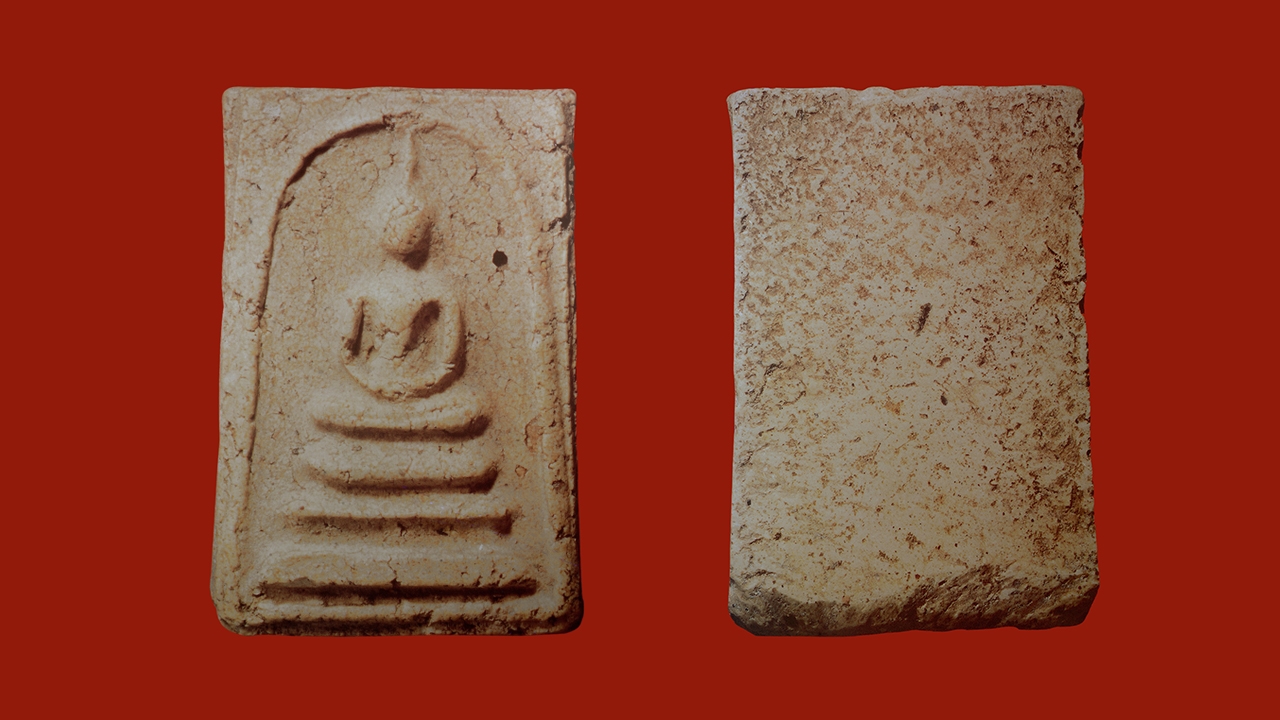
Phra Somdej Wat Rakang Kositaram, along with Phra Somdej Wat Bang Khun Phrom (Wat Mai Amataros) and Phra Somdej Wat Ket Chaiyo by Somdet Phra Phutthachan (Toh Prommarangsi), generally have a thin profile. Ajarn Prakit Limsakul or Plai Chumphon from Thairath newspaper noted an average thickness of about half a centimeter. Due to these distinctive features, they have been grouped with four other famous amulet types in the Benjapakee set: Phra Somdej Nang Phaya, Phra Rod, Phra Pong Suphan, and Phra Kamphaeng Soom Kor, which inspired a poetic verse. “Somdet Bang, Nang thick, as said, Phra Rod soft, sticky inside, like beeswax, Pong Suphan, filtered earth, eye-catching, Soom Kor moving, tamarind luster, beautifully captivating.”
However, according to the knowledge of 'Anonymous' from Precious magazine, there are two Phra Somdej Wat Rakang molds that tend to be especially thick (sometimes more than twice the normal thickness): the Chedi mold and the Bud Bloom mold. This may be because these two molds were the first finely carved molds by royal goldsmiths, following the earlier base Sam mold, which was likely the first mold carved with less refinement, serving as a trial for the Wat Rakang series. A significant amount of material remained, allowing the statues to be pressed fully. These two molds were likely carved around the same time, beginning with the Bud Bloom mold, which had more material than the Chedi mold, as 'Anonymous' observed.
“The Science of Phra Somdej” It was previously presented that the Phra Somdej Wat Rakang Chedi mold was likely carved based on the image of the Emerald Buddha dressed in the rainy season attire. However, the Bud Bloom mold probably also used the Emerald Buddha as a model, especially considering the relatively large size of the head and the decorative ear ornaments of both molds resembling the wearing of a royal hair crown. The chins of both molds are also full and rounded, similar to the Emerald Buddha. Regarding the body build, the Bud Bloom mold appears slightly closer in resemblance to the Emerald Buddha than the Chedi mold. Some Chedi mold variants have a deep body relief similar to the high-relief sculpture style seen in the Bud Bloom mold.
After carving the Bud Bloom and Chedi molds, the next step was carving the large mold, which several experts say was modeled after the smiling principal Buddha image in the ordination hall of Wat Rakang. The large mold is a more simplified form but incorporates the technique of “perspective” or three-dimensional carving according to the Western understanding of visual perspective, representing the highest development in mold carving. The Prok Bodhi leaf mold was likely made for a special occasion after the other molds were completed, created by modifying some existing molds, as also described in Triyampawai’s writings. It is interesting to consider whether the principle of “perspective” was also integrated into the carving of other Phra Somdej Wat Rakang molds.
“The Science of Phra Somdej” previously stated that all Phra Somdej Wat Rakang molds, except the large mold, exhibit symmetrical features. The large mold’s appearance, which seems to lean the Buddha image toward the right, as noted by experts since long ago, is due to the carver’s viewpoint being from the front but slightly to the left of the image.
Phra Somdej Wat Rakang, Chedi mold, considered overall, can also be described as generally symmetrical. However, when examining its distinctive features or possible mold defects, questions arise about why the carver intentionally included these peculiarities, as illustrated below.
The first distinctive or defect characteristic present in every Phra Somdej Wat Rakang Chedi mold is that the uppermost base layer (third from the bottom) has a right-side end that curves upward like a sail.
The second distinctive feature is that the arm circle of this mold tapers inward toward the torso, differing from other molds where the arms spread widely in a meditative cross-legged posture.
The third distinctive feature is that the left armpit below the torso is often slightly higher than the right armpit. Some past teachers explained that the thickness above both armpits is equal, which is true, but upon observation, the shoulder tends to slant downward toward the right side, resulting in this difference. Still, the left armpit is usually slightly higher.

To explain these phenomena, which are like “secrets in the mold” of this Phra Somdej mold, “The Science of Phra Somdej” proposes that when the carver began finely carving the first mold, the Bud Bloom, they used a frontal viewpoint, resulting in a symmetrical image. When carving the next mold, the Chedi, the viewpoint shifted to about 45 degrees from the front toward the left side of the Buddha image. This caused the unique features mentioned above. The sail-like curve is the curved edge of the Emerald Buddha’s base as seen from that angle. The inward-curving arms also result from this perspective, with a greater angle causing more tapering. The left armpit’s higher position is similarly due to this viewpoint. The small bumps sometimes appearing on the head, often slightly right of center, might also be explained this way, though less clearly than the first three features. Nevertheless, the Chedi mold’s carving, while resembling a 45-degree perspective, does not strictly follow the “perspective” principles like the large mold, which likely used a 15–30 degree viewpoint. Some dimensions in the Chedi mold still retain a frontal symmetrical appearance.
Phra Somdej Wat Rakang statues carved by royal goldsmiths, according to “The Science of Phra Somdej,” likely began with the base Sam mold, carved somewhat roughly as a trial. This was followed by the finely detailed Bud Bloom mold with elaborate attire, carved around the same time as the Chedi mold, which incorporated some perspective carving techniques reflecting visual reality. Both Bud Bloom and Chedi molds were probably modeled after the Emerald Buddha. Then the large mold was carved, representing an evolution in mold design, fully integrating Western knowledge of perspective for three-dimensional carving. The Prok Bodhi leaf mold was likely a special variation adapted from existing molds. Understanding the detailed mold characteristics, especially those using perspective principles, helps illuminate the design origins of Phra Somdej Wat Rakang by Somdet To, sometimes considered “secrets in the mold.”
“The Science of Phra Somdej” concludes this installment with knowledge from 'Anonymous' of Precious magazine and Assistant Professor Rangsan Tosuwan, who explained the interesting differences between the large mold (principal image mold) and the Chedi mold of Phra Somdej Wat Rakang (Anonymous divided the Chedi mold into five types) for educational purposes as follows.
1. The left mold edge line of the Chedi mold extends down to the bottom corner of the glass frame, whereas the large mold’s edge line reaches only about mid-statue at the elbow.
2. The hair on the Chedi mold type 2 (known as "Je Jaew" mold) has a jagged line resembling a garland wrapped around the center, absent in the large mold, which tends to lean left.
3. Shoulder thickness from top to underarm on both sides is equal in the Chedi mold, but in the large mold, the right shoulder side is thicker than the left. While the thickness above both armpits is equal, the right shoulder tends to slope downward, and the left armpit is usually slightly higher.
4. The glass frame arch of the Chedi mold is smaller than that of the large mold.
5. The Chedi mold, especially type 2 ("Je Jaew"), has a clear cloth fold line from the shoulder to underarm, which may be faint if the imprint is shallow. The large mold lacks this cloth fold line.
6. The inner right arm of the Chedi mold has excess material buildup, a mold defect in the deepest part. This remains visible even if the mold is worn or pressed lightly.
7. The outer left elbow of the Chedi mold lacks the robe’s draping line that runs from the left elbow to the knee, present in the large mold.
8. The Chedi mold’s proportions are smaller than the large mold’s.
9. The back of the Chedi mold is flat (smooth back).
For further reading, visit the Phra Somdej Science page by Police Lieutenant Colonel Komsan Sanongpong. Thanks to Assistant Professor Rangsan Tosuwan for providing images of an exemplary Phra Somdej Wat Rakang Chedi mold statue for educational purposes, and to the current owner of this beautiful master Chedi mold piece (Anonymous classified the Chedi mold into five types; this is type 2, the famous “Je Jaew” type). The left mold edge line extends fully to the bottom, characteristic of this sub-mold type. The statue shows signs of use, with faint cloth fold lines, a white-brown hue, dense texture, visible crackling on the front (typical of dense texture with lacquer), presence of sacred particles, pinhole pores, and characteristic worm trails on the surface, confirming authenticity per reference texts. The arm circles taper toward the body, the head is large, and the right upper base edge curves upward like a sail—distinctive features of this mold. The mold edge fits precisely within the frame. The back is flat, with minor cracking edges indicating natural aging (cracking edges commonly appear on Phra Somdej Wat Rakang). This specimen serves as an excellent reference for studying Phra Somdej Wat Rakang. More articles are available in the Science of Phra Somdej column.
Author Police Lieutenant Colonel Komsan Sanongpong, former forensic police officer
Facebook Page –Phra Somdej Science