

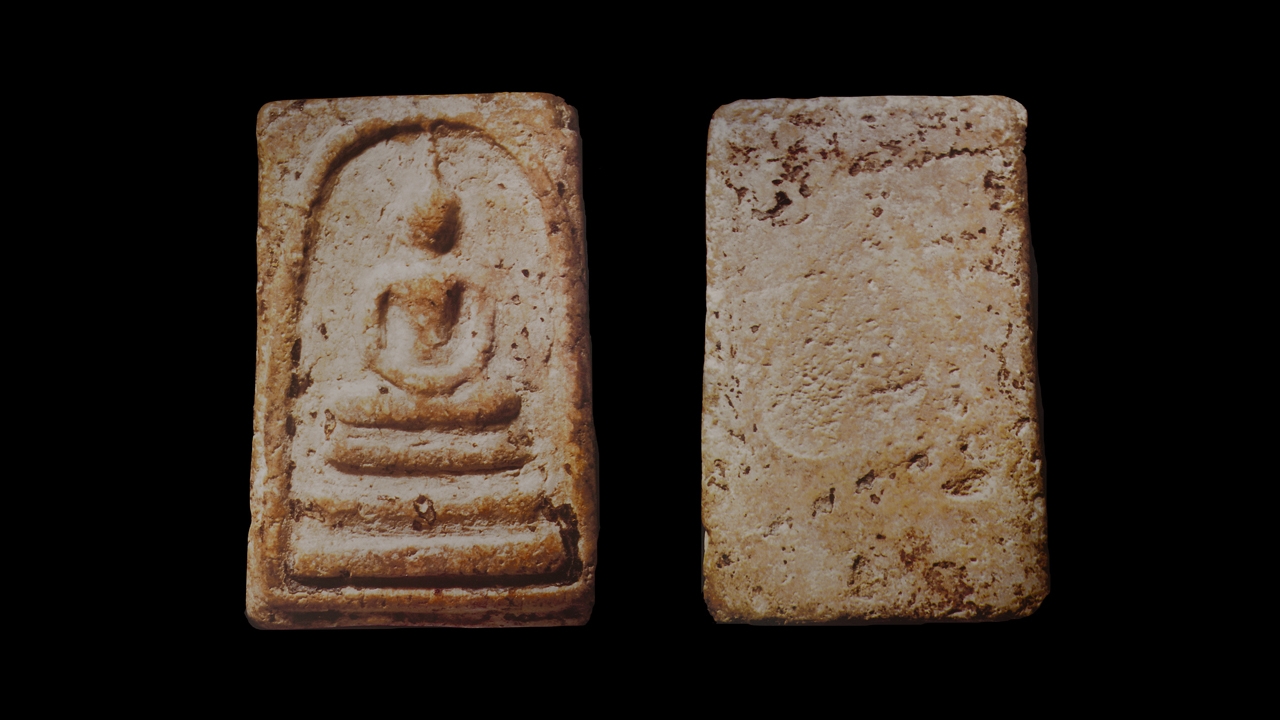
The large-format Phra Somdej Wat Rakang Kositaram amulet by Somdej Phra Buddhacharn (Toh Prommarangsi) is considered the most popular among all his Phra Somdej amulet types. The auction value of well-preserved examples reportedly reaches eight figures or more, with some even hitting nine figures. This mold type holds the highest value compared to all amulets currently available in the market. Among all the normally sought-after Phra Somdej types, this mold is regarded as the ultimate desire of collectors.
Several factors contribute to its top popularity, but the most evident is that this Phra Somdej mold has the most beautifully balanced design. It is interesting to explore the historical background before this Phra Somdej mold was created.
"The Science of Phra Somdej" has previously presented theories about "the evolution of mold designs" of Phra Somdej, suggesting that the standard mold group of Phra Somdej Wat Rakang, carved by the royal goldsmith, likely began with the base Sam mold group. This was probably the first mold group carved. It used a significant Buddha image, the Phra Phuttha Sihing, as a model, observable from the diamond meditation posture (the original image is enshrined at Wat Phra Singh in Chiang Mai and at the Phra Phuttha Sihing Hall in Nakhon Si Thammarat), depicted in the Mara Vichai posture. The diamond meditation posture. Meanwhile, the Buddha image at the Phuttha Thaisawan Throne Hall,National Museum,Bangkok, is in the meditation posture with legs crossed flat. The design was also influenced by the Phra Somdej Wat Ket Chaiyo, which has a floating style (it is understood that the choice of the diamond meditation posture over the flat-crossed legs was because the diamond posture better suited the slender, floating-style base). These two distinctive features clearly differentiate this Phra Somdej mold from others, making it "not grouped" with other molds. This mold type often appears shallow and loosely carved, resembling early experimental molds carved by the royal goldsmith. It often contains abundant materials and is the most commonly found among all Phra Somdej Wat Rakang amulets. An anonymous contributor to Precious magazine divided this mold type into four subtypes.
Following that were molds of the lotus bud hair group, then the chedi (stupa) group. Both these molds were carved with great precision, likely using the Emerald Buddha as the design model. The amulet figures are robust like the Emerald Buddha and resemble the rainy season attire style. The mold shows a compact form, with the amulet’s weight balanced evenly on its base. The lotus bud hair mold is more ornate and symmetrical, while the chedi mold exhibits more relaxed molding and incorporates perspective design techniques, adding realistic dimensionality in certain areas. These two mold types tend to be thicker than others, with the lotus bud hair mold containing more materials than the chedi mold. The anonymous author divided the lotus bud hair mold into two subtypes and the chedi mold into five subtypes (the most famous being subtype 2 known as "Je Jaew"). The lotus bud hair mold is quite rare, second only to the Bodhi leaf mold.
The evolution of mold designs continued, leading to the large-format Phra Somdej mold, which was likely the next official mold carved. It is the final standard official mold design of Wat Rakang. (Excluding the Bodhi leaf mold, which is believed to be a special design possibly adapted from the base Sam and lotus bud hair molds.) This mold represents the highest development stage, a perfect convergence between ancient Buddhist art design knowledge and contemporary knowledge at that time, beginning with Lanna Buddhist art (Chiang Saen Singha style) of the Phra Phuttha Sihing, which was the model for the base Sam mold, continuing to late Lanna Buddhist art (or the pre-Chiang Saen to Chiang Saen artistic lineage) of the Emerald Buddha, which modeled the lotus bud hair and chedi molds, and culminating in Sukhothai and U-Thong Buddhist art of the smiling principal Buddha at Wat Rakang Kositaram, which was the model for the large-format Phra Somdej molds (some subtypes of the large-format mold show a blend of U-Thong and Sukhothai art styles).
This blend formed a perfect junction with the contemporary knowledge of the royal goldsmith, who integrated Western techniques such as "perspective" into the full design of the large-format Phra Somdej. This gave the amulet an asymmetrical quality—the figure appears slightly tilted to the right, the left border line runs down to meet the arch line near the Buddha’s elbow, and so forth, as "The Science of Phra Somdej" has previously noted. This harmony with the era produced the most beautiful and popular Phra Somdej Wat Rakang mold in the amulet community. If the Phra Somdej amulets are considered emperors of amulets, then the large-format Phra Somdej Wat Rakang is rightfully the "Great Emperor of Amulets." .

The anonymous author divided the large-format Phra Somdej Wat Rakang into four types: principal Buddha, chest V-shape, barrel chest, and lotus bud piercing the archway. These classifications have long been accepted as standards for examining this mold type in the amulet community. Professor Prakit Limsakul, also known as Plai Chumphon, from Thairath newspaper, divided them into six subtypes: large, open, slender, stout, stocky, and small, following Triyamphawai's methodology with interesting explanations. Some teachers say that the large-format Phra Somdej Wat Rakang alone can be subdivided into more than ten subtypes, all based on extensive knowledge and experience in mold study. However, "The Science of Phra Somdej" suggests that this large-format mold is quite distinct from others, or it can be called a masterful artwork of the highest level, exquisitely crafted by the royal goldsmith, who aimed for maximum beauty while embedding many subtle techniques. Surprisingly, despite producing many mold blocks, the royal goldsmith maintained strict adherence to the mold design (known today as the "drawing") across all blocks. While some minor details differ, such as certain subtypes having the head piercing the arch or clearly carved lines under the lap, overall, "The Science of Phra Somdej" proposes that the large-format Phra Somdej Wat Rakang molds, across all blocks, were carved following a single mold design or "drawing" pattern.
The large-format Phra Somdej Wat Rakang amulet is a masterful artwork, finely crafted, blending ancient Buddhist art knowledge and a sequential evolution of mold designs untilultimately,it perfectly integrates ancient knowledge with contemporary techniques of its time, fitting the era, resulting in the most beautiful and popular amulet, arguably the "Great Emperor of Amulets." "The Science of Phra Somdej" also believes that as a masterful ancient Thai artwork with unique identity and limited quantity, Somdej Phra Buddhacharn To's Phra Somdej, especially the Wat Rakang type, will not only be sought after by Thais or nearby regions but will surely ascend to become a "rare, highly valuable global treasure" in the future.
"The Science of Phra Somdej" closes this chapter by presenting the long-accepted criteria for examining the large-format Phra Somdej Wat Rakang, as summarized by the anonymous author in Precious Special magazine by Professor Rangsarn Tosuwan, published in 1996, as follows: Key flaw 1 The four outer edges of the amulet have raised lines; specifically, the left edge line descends between the Buddha’s elbow and then merges with the arch line.
Key flaw 2 The mold frame’s right side (the Buddha’s side) has a raised line running continuously adjacent to the bottom arch line.
Key flaw 3 The arch (glass pavilion) line is thick and raised, resembling a split rattan; inside the arch is a vertical line from the base. The amulet’s surface outside the arch slopes slightly.
Key flaw 4 The Buddha’s face resembles a matu fruit (a small, roundish fruit).
Key flaw 5 Both ears are present, though sometimes faintly attached.
Key flaw 6 At the curved area where the upper arm meets the shoulder, the right shoulder is bulkier than the left.
Key flaw 7 The left knee protrudes higher than the first tier of the base.
Key flaw 8 The right knee protrudes lower than the first tier of the base.
Key flaw 9 The Buddha figure slightly tilts to its right, while the three-tiered base tilts to the left, alternating opposite the figure’s lean.
Key flaw 10 The walls between the three base tiers are uneven: between the first and second tiers, the wall is level with the surface; between the Buddha’s shaft and first tier, and between the second and third tiers, the wall is higher than the amulet surface.
Key flaw 11 The area outside the arch is slightly higher than inside, making the line almost invisible unless the amulet is tilted to reveal it.
For further reading, visit the page Phra Somdej Science
by Police Lieutenant Colonel Komsan Sanongpong, with thanks to Associate Professor Rangsarn Tosuwan for kindly providing images of a master-class Phra Somdej Wat Rakang amulet to share knowledge. Gratitude is also extended to the current owner of this amulet, which is a large-format Phra Somdej Wat Rakang, well-preserved with natural wear resulting in a rich surface. The texture is resilient yet soft, showing crack patterns and brown coloration, with traces of ruby resin on both front and back surfaces. The tight frame reveals the left mold frame faintly. The amulet exhibits all three authentic characteristics: granular relics, worm trails, and needle-like pores. The mold shape is textbook accurate, with a smooth back showing wrinkles and slight indentations. The side edges show some wear, possibly from trimming, and the back shows signs of framing, resembling a Bodhi leaf shape. This amulet serves as an excellent study model for Phra Somdej Wat Rakang. More articles can be found in the "Science of Phra Somdej" column. Author Police Lieutenant Colonel Komsan Sanongpong, former forensic police officer.
Facebook page –
Phra Somdej Science Read the columnScience of Phra Somdej