

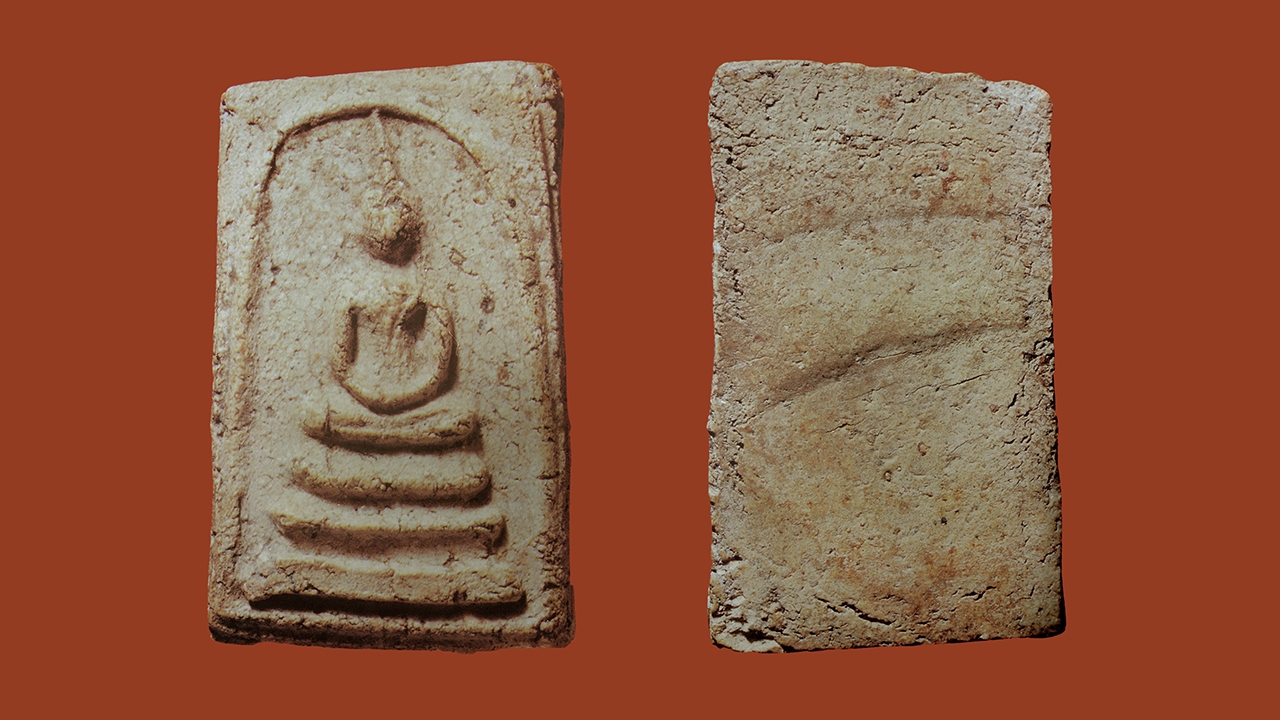
Unraveling the mystery of the "Phra Somdej Wat Rakang in the small chedi style"—why does the Buddha image lean to the right? This article delves into three key defects and reveals the history of the legendary amulet "Je Jaew," a highly valued piece throughout history.
The Phra Somdej Wat Rakang Kositaram in the chedi style shows considerable variety. Triyampawai classified it into four subtypes: large print, slender print, medium print, and a smaller subtype. Meanwhile, Nirnam from Precious magazine divided it into five subtypes, with the second subtype being the famous "Je Jaew". Among all known chedi-style Phra Somdej Wat Rakang amulets, the "Je Jaew" is considered one of the most valuable ever. According to Ajarn Prakam U-Arun, a senior expert, around 1962 (B.E. 2505), this amulet entered the market, first bought by the top collector “Kasem” for 5,000 baht, then sold to the second collector “Li Yai” for 80,000 baht, followed by “Boonyong,” and finally reaching “Je Jaew” as the fourth collector. It has passed through the hands of legendary collectors and now belongs to a major amulet owner today.
It is noteworthy that regardless of how many subtypes the chedi-style Phra Somdej Wat Rakang is divided into—depending on which expert’s classification is followed—the main characteristic or "primary defect" remains consistent. This is due to the design mold used for all these subtypes. The "Science of Phra Somdej" has previously reported that three main mold defects are typically found in every subtype.
When quickly examining a Phra Somdej Wat Rakang amulet, if it matches the three mold defects described above, it is typically identified as a chedi style. Further classification into subtypes then considers additional features.
Nirnam also noted that among the five subtypes, the second subtype (the "Je Jaew" print) is the most popular, possibly because it has been found the most frequently. Next in popularity is the fifth subtype, or the "small print," which is also commonly found. The first, third, and fourth subtypes of the chedi style are rarely seen.

Interestingly, the fifth subtype or "small print" of the Phra Somdej Wat Rakang chedi style, while sharing the overall characteristics and the three main mold defects with the other four subtypes, also has unique features found only in this subtype. Notably, the entire Buddha image distinctly leans to the right, especially visible in the split rattan arch’s upper half, the left frame line on the upper Buddha image, the upper half of the Buddha’s torso, and the hair leaning sharply to the right. In contrast, the large print Phra Somdej Wat Rakang has a master amulet known as "the hair swaying Buddha," but its hair sways to the left. The rightward hair sway appears unique to the small chedi print. This rightward lean (some collectors call it the "small chedi lean-right print") likely results from the craftsman’s handedness during mold removal.
Ajarn Prakit Limsakul, also known as Phlay Chumphon, of Thairath Newspaper. He explained that the rightward lean of this small chedi print arises because the same person molded these amulets, consistently using their dominant hand to lift the amulet off the mold in the same direction. The amulet mixture—a paste made of plaster mixed with tung oil—was still soft and sticky when pressed firmly into the mold and the back was smoothed and trimmed. When lifting the amulet, the craftsman would choose which corner to lift first, consistently lifting in the same manner. Other experts agree, suggesting that the mold carving was done following the craftsman’s handedness, carving multiple blocks but always with a rightward tilt, creating a signature style. To date, no examples of this subtype lean left.
Another distinctive feature of the small chedi print is its typically greater thickness. While thicker amulets are common in the chedi style overall, the small print often shows thickness up to twice that of other subtypes.
The Phra Somdej Wat Rakang chedi-style amulet has several subtypes. Nirnam from Precious magazine classified them into five, with the second subtype (Je Jaew) being the most popular, followed by the fifth subtype or "small print." The other three subtypes are rarely seen. The small print has distinctive features, especially the overall rightward lean and its unusual thickness, making it unlike other Phra Somdej amulets made by Somdej Toh. The design traces left by ancient craftsmen may lead to new discoveries about the Phra Somdej amulets.
"Science of Phra Somdej". To conclude, here is Nirnam’s compiled guide to identifying mold defects of the Phra Somdej Wat Rakang small chedi print for educational purposes.
1. The raised mold edge lines on both sides run from the top down to the base of the covering arch.
2. The covering arch tends to tilt toward the right side of the Buddha image.
3. The Buddha’s hair extends closely alongside the covering arch.
4. The right ear is attached closely to the Buddha’s cheek.
5. Both upper arms are tall and deeply recessed.
6. This small print has a slightly flared waist.
7. The lap is more rounded and thicker than other chedi prints, with clearly visible overlapping feet.
8. The third base layer is thicker than the second, third, and fourth chedi subtypes.
9. The small chedi print is generally thicker than other chedi prints, sometimes nearly twice as thick.
10. The side cut marks on the small chedi print are more pronounced than on other chedi prints.
11. The back print of the small chedi print resembles the large "Sangkaya back" print of the Phra Somdej Wat Rakang.
12. Clear 'ant trail' marks (tiny cracks along the back edges) are visible, a hallmark of Phra Somdej Wat Rakang.
13. Distinctive chipping marks from edge cutting appear, reflecting the natural aging and shrinkage of the amulet edges, which are important identifying features.
For more information, follow the Facebook page "Phra Somdej Science" by Police Lieutenant Colonel Komsan Sanongpong. Thanks to Assistant Professor Rangsarn Tosuwan for kindly providing images of another master Phra Somdej Wat Rakang amulet for educational purposes. Thanks also to the current owner of this master small chedi print amulet, which is beautifully preserved, smaller than all other chedi prints, with brown coloration, dense texture, crackled surface typical of lacquer-coated amulets, containing relic granules and wormhole patterns. The design is correct per references, with an overall rightward lean, smooth back (typically small prints have a Sangkaya-style back), and characteristic scraping marks and edge cracks reflecting natural aging. The amulet was likely cut when the material was still moist, making it an excellent study model.
Author. Police Lieutenant Colonel Komsan Sanongpong, former forensic police officer.
Facebook page. –Phra Somdej Science.