

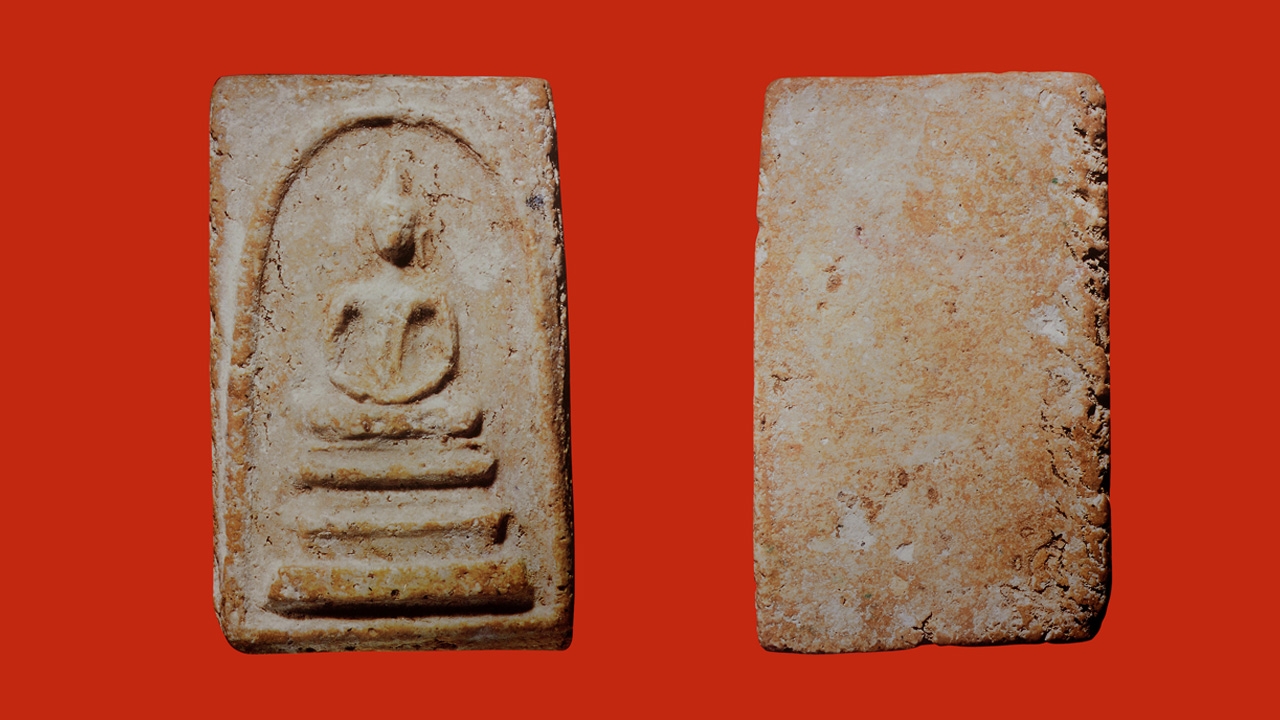
The Wat Rakang Somdej Buddha image with the standard Bud Bloom Hairprint, highly sought after and commanding very high prices today, is traded mainly in two subtypes: Narrow Lion Base and Wide Lion Base. Among all Wat Rakang Somdej Bud Bloom Hairprint images, the most renowned and recognized master piece or “champion” from past to present is the one known by the nickname “Khun Montri” Indeed, this particular image is of the Narrow Lion Base subtype.
Regarding the origin of the term “Khun Montri” it was written by Professor Prakit Limsakul, or Plai Chumphon, in Thairath Newspaper in the column “Miracle from the Buddha Shelf” that...
...around 1977, Khun Sompong Jarusen, the top Somdej Buddha restorer at Ban Pan Thom Market, told me while repairing a Buddha image for a client, “My son-in-law sold one Somdej image and could live off it for a whole year.”
The “son-in-law” named Apichat Kulonornphan had married Sompong’s daughter. Another expert named “Chat Sompong” was considered a top Somdej connoisseur. It is said that Chat asked the price of a Bud Bloom Hairprint Somdej from “Chalee,” known as the source of beautiful Somdej images famous in the circle.
“For you, I’ll take five hundred thousand,” Chalee replied. Chat said nothing, took out the money, and paid. On that same day, “Khun Niyom Asunee,” owner of “Tanjit Tour” from Nakhon Sawan, bought it for “one million.”
At that time, million-baht Wat Rakang Somdej images were often discussed, and this Bud Bloom Hairprint was one of them.
The profit margin Chat Sompong made that day was considerable. Remember, at that time, gold prices had just risen from 400 baht to 1,200-2,000 baht, and journalists’ salaries were only around 2,000 baht. So when Sompong said “live off it for a year,” it was true.
Thirty years later, this Bud Bloom Hairprint image remained with Khun Niyom, with rumors of it changing hands to Khun Montri, the new owner, for 50 million baht. The exact price is unconfirmed.
It is said to have been a “cash lump sum supplemented by some previously purchased Buddha images.”
Later, this Somdej image was acquired by one of the largest national Buddha image collections today.

Originally, among Wat Rakang Somdej Bud Bloom Hairprint collectors, only the Narrow Lion Base subtype was traded, considered the rarest among the five main Wat Rakang Somdej types: Large Print, Chedi Print, Bud Bloom Hairprint, San Base Print, and Chedi Print (later a Wide Lion Base subtype was accepted). It is interesting to consider how the Somdej community has classified subtypes of each main type.
When examining subtype classifications of Somdej images, past masters have tried to categorize Somdej images by the venerable Somdej Phra Phutthachan (Toh Prommarangsi) into subtypes to facilitate recognizing defects and summarizing evaluation criteria, making it easier and faster to understand.
“The Science of Somdej Buddha Images” may present that the subtype classification approach can be divided mainly into two: the approach of “Triyampawai” which can be called “academic knowledge” (based on theory and academic study)and the approach of“Niranam” which may be described as “practical knowledge” (based on extensive trading and ownership experience). The two classification approaches for Wat Rakang Somdej are as follows. Large Print - “Triyampawai”
divides into six subtypes: Large, Open, Slender, Stout, Compact, and Small, while “Niranam” divides it into four subtypes, namely Principal Buddha, V-shaped Chest, Cylindrical Chest, and Hair Piercing Archway, all equally popular with many master pieces in this group.Chedi Print - “Triyampawai”divides into four subtypes: Large, Slender, Compact, and Small, whereas “Niranam” divides into five subtypes. The second subtype corresponds to the famous “Je Jaew” piece, the most popular and numerous. The third and fourth subtypes are quite similar to the second. The first subtype features a particularly robust Buddha figure and is rather rare. The fifth subtype is called “Small Chedi” or “Tilted Small Chedi,” popular second only to subtype two.
Bud Bloom Hairprint - “Triyampawai” divides into five subtypes: Large (flat neck), Open (diamond neck), Compact (diamond neck), Small (flat neck), and Slim Bud Hair (diamond neck). “Niranam” mentioned in “Precious” magazine that “there is only one subtype” (likely meaning both Narrow and Wide Lion Bases are grouped together). Personally, Niranam likely accepts both as Wat Rakang Somdej images, whereas old circles only recognized the Narrow Lion Base subtype before later accepting the Wide Lion Base.San Base Print - “Triyampawai”divides into six subtypes: Large, Open, Slender, Stout, Compact, and Small. “Niranam” divides this type into four subtypes, with subtype one resembling the Bang Khun Phrom San Base Print (some divide it further into Large Chest and Small Chest subtypes).
Bodhi Leaf Print - “Triyampawai” divides into two subtypes: Bodhi Leaf San Base and Bodhi Leaf Sangkhati. However,
“Niranam” noted in “Precious” magazine, “Wat Rakang Bodhi Leaf Print is the most debated type in the Buddha image community. Some consider it a Wat Rakang print created by Somdej Phra Phutthachan To, but others reject this due to lack of proof and absence of key Wat Rakang Somdej characteristics like those seen in Large Print, Chedi Print, San Base, and Bud Bloom Hairprint. Examples include the sacred material mass, trimming on all four sides, material shrinkage revealing grain textures, pinhole porosity, wormhole marks, crab-like edge flaking, and other details. Therefore, the Thai Buddha image community does not accept Bodhi Leaf Print as a standard Wat Rakang Somdej created by Somdej Phra Phutthachan To.” Nonetheless, Niranam concluded, “The Wat Rakang Bodhi Leaf Print gained fame when the Bang Khun Phrom Somdej (New Amulet Temple) cache was opened in 1957, revealing Bang Khun Phrom Somdej Bodhi Leaf Prints, causing excitement that there might be Wat Rakang Bodhi Leaf Prints as well.” Conclusion
There are several approaches to subdividing the five main Wat Rakang Somdej types. The two main approaches presented by “The Science of Somdej” are those of “Triyampawai,” representing “academic knowledge,” and “Niranam” from “Precious” magazine, representing “practical knowledge.” Both have validity depending on perspectives, knowledge, and experience of each master, all aiming to make Somdej studies understandable without excessive difficulty. “The Science of Somdej” has previously shown that certain types, like Large Print, once subdivided into many subtypes, might actually originate from a single mold design when considering principles like “perspective” or three-dimensional mold design based on how the human eye sees, a fundamental mold design basis in modern craftsmanship. Thus, these are considered to have only one subtype. “The Science of Somdej” closes this article with the key identification points for the Wat Rakang Somdej Bud Bloom Hairprint Narrow Lion Base subtype, as defined by Niranam, for educational purposes as follows:1. The hair resembles a lotus bud.2. The forehead (nalad area) slopes gently from the eyebrow upwards to support the hair base.3. Both ears have thick curved ridges resembling ceremonial Bai Sri ears, extending down to the shoulders on both sides. The flesh on both shoulders to the armpits is especially thick, differing from other subtypes.4. The left knee is rounded, while the right knee is more curved and slanted. 5. On the chest’s right side, the sole of the foot clearly protrudes beneath the chest.
7. The “sam” line’s beginning under the chest at the base’s right side touches the third tier’s base.8. The material mass is substantial.9. It is noticeably thicker than Large Print and San Base subtypes, comparable to the Chedi type. Further reading is available on the Facebook page “Somdej Science” by Police Major Komson Sanongpong. Thanks to Assistant Professor Rangsarn Tosuwan for kindly providing photos of another beautiful master Wat Rakang Somdej Bud Bloom Hairprint Narrow Lion Base example, currently owned by a collector. This piece shows correct features per reference, with a white-brown patina, smooth material (usually without crackling patterns), visible grain texture, small pinhole porosity, wormhole marks, a smooth back with edge flaking indicating natural aging, commonly found on Wat Rakang Somdej backs. This excellent model serves as a valuable study reference.
. . . For more articles, see the “Science of Somdej” column.
Author
Police Major Komson Sanongpong, former forensic police officer.
Facebook page
–
Somdej Science
Read more in the
Science of Somdej
column.