

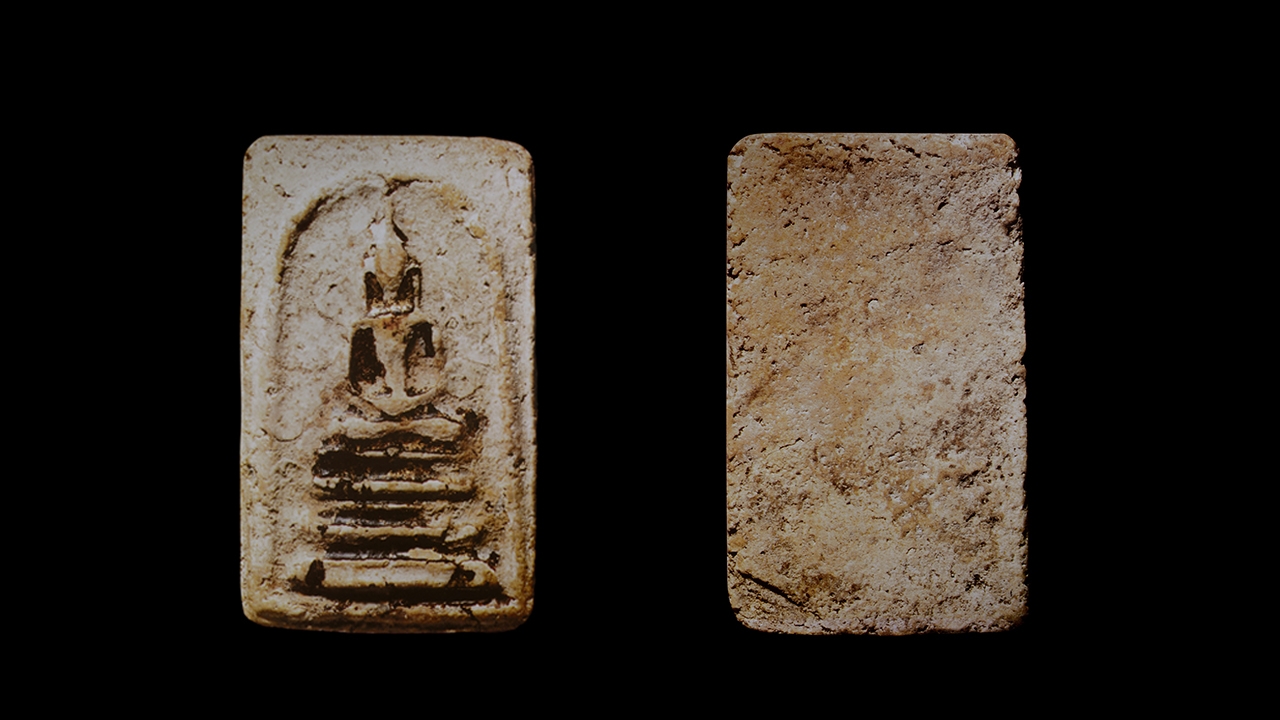
The Phra Somdej of Somdet Phra Phutthachan (Toh Prommarangsee) was originally intended, according to some ancient texts, to be lacquered and gilded on every piece. This practice partly stems from an old custom where people applied gold leaf onto Buddha images and sacred objects they revered for good fortune—a tradition that continues today. Lacquer application, whether gilded or not, also helps preserve the material, especially for Phra Somdej made of powdery substances that are prone to wear through use. Historically, some wore the amulet in their mouths during certain occasions, as evidenced by residual betel stains in the crevices of some master Phra Somdej. Some old amulets incorporated lacquer mixed with resin in the powder to enhance durability, known as powder mixed with lacquer. A famous example of such lacquered powder amulets is Luang Pho Kaew's Phra Pidta from Wat Kruawan in Chonburi, which are rarer and highly sought after by collectors, believed to have been made around the same time as Somdet Phra Phutthachan’s Phra Somdej.Somdet Phra ToSimilarly
Although not every Phra Somdej of Somdet Phra To was gilded due to a shortage of gold at the time, ancient texts suggest that nearly every piece was lacquered. Ajarn Prakit Limsakul, or Phlai Chumphon from Thairath Newspaper, explained that nearly every Phra Somdej Wat Rakang by Somdet Phra To was lacquered, but over time, the lacquer residue often wears away, making it hard to see. To identify genuine Phra Somdej that have been lacquered, known as the lacquer mist theory, one can dip the amulet in warm water and observe red lacquer residue appearing; as the water dries, the red mist fades but some traces remain visible.
Triyampawai explained the characteristics of Phra Somdej Wat Rakang that have been lacquered and gilded as follows: "Old lacquer and gold were applied shortly after creation. When the thin lacquer layer on the amulet’s surface flakes off, if the material is soft, it absorbs the lacquer’s color beneath the surface, darkening the amulet. Some old lacquer and gold fragments remain in small crevices, enhancing the amulet’s appearance greatly. If the material is hard and dense, the lacquer penetrates the cracks of the crackle pattern throughout. This is called the lacquer engraving groove (amulets with hard material dipped in lacquer usually have crackle patterns only on the front; softer ones do not crackle), resulting in alternating clear and dark tones and maroon-red lacquer groove patterns—forming a net-like design...”
Regarding gilding in the red grooves, Triyampawai said, "The gilding of red grooves resembles the old lacquer and gold application, but the flaking of the old red lacquer is less than that of old lacquer, and the old red lacquer applied is usually thicker. If the material is very soft, it does not crackle. (For example, the Prok Pho mold which often has soft material.) However, where the red lacquer flakes off, the material absorbs the red hue similarly...”

Lacquer and gold application is considered a high art form in Thailand, part of the "Ten Craftsmen" category known as "lacquer craftsmen," using lacquer resin sourced from lacquer trees. This technique can be divided into several types.
Smooth lacquer and gold coating also called "opaque gilding," where craftsmen apply lacquer to create a glossy surface, then apply genuine gold leaf on top. This method is common for metal Buddha statues. Wood carvings or wet plaster sculptures, like the lacquer and gold coating on Phra Somdej by Somdet Phra Phutthachan (Toh Prommarangsee), mostly fall into this category.
Gilding with red grooves involves applying lacquer and gold on raised parts of sculptures or carvings, while recessed areas receive red lacquer, hence the terms "red grooves" or "lacquered grooves." Historically, if red lacquer was found on Phra Somdej, the community would often label it as a forgery. Ajarn Prakit Limsakul explained, "It is a belief in the community, following teacher Triyampawai, that 99% of Phra Somdej Wat Rakang with red grooves are fake. In his commentary on Phra Somdej amulets, the teacher mentioned that he had seen only one Prok Pho Base Sam mold with red lacquer and lacquer applied to a wooden board. Collectors would saw the board to the amulet's edge and file down the wood to reach the amulet material." Later, genuine Phra Somdej with red lacquer were more widely accepted. Recently, a large Phra Somdej Wat Rakang with red lacquer applied on all four sides—unlike the traditional groove application—was reportedly sold privately for 60 million baht. This particular amulet changed hands from a major expert to an anonymous buyer for as much as 60 million baht.
Gilding with glass grooves resembles gilding with red grooves but includes embedding colored glass on the background where lacquer and gold are not applied, creating a sparkling effect. This technique has not been observed on standard Phra Somdej molds by Somdet Phra To.
Stencil lacquer and gold application uses paper or goat leather punched and cut into patterns,then appliedto surfaces where lacquer or glue is printed before applying gold leaf on top. This is common in areas with limited workspace, such as temple ceilings or viharns.
Ajarn Prajam U-Arun, a senior Phra Somdej expert, once shared with "The Science of Phra Somdej" that most lacquer used to preserve amulet surfaces comes from China. Initially black, it was mixed with expensive imported red stone powder from China, yielding a ruby-like color. Lacquer craftsmen know this stone powder well. Good lacquer dries slowly; before gilding, they apply a thick black lacquer base and let it dry, then a clear lacquer coat. Clear lacquer is usually used as a primer before gilding. Black lacquer is thick and dense; if gold is applied on top of thick black lacquer, the gold sinks into the lacquer layer. Regarding gilding, at Wat Bang Khun Prom, gilding covers only the Buddha image down to the base, not the arch or the background, and is done before enshrinement—rarely found. At Wat Rakang, gilding is applied later after acquisition, called "gold leaf application."
Information from various teachers generally agrees that nearly every Phra Somdej by Somdet Phra To was lacquered. However, regarding gilding, there are differences: Triyampawai noted that those gilded shortly after creation still retain some old lacquer and gold fragments in crevices, enhancing beauty. Interestingly, Ajarn Prajam U-Arun, a senior expert with over 60-70 years of experience and deep practical knowledge, concluded that Phra Somdej Wat Rakang were not gilded at the temple but gilded later, whereas Phra Somdej Wat Bang Khun Prom were gilded at the temple only on the Buddha image down to the base, leaving the arch and walls ungilded, and this was done before enshrinement in very limited numbers. "The Science of Phra Somdej" suggests that gilding on Phra Somdej Wat Bang Khun Prom may serve as a production marker, such as marking every thousand pieces with one gilded amulet.When a thousand amulets were completed,one would be gilded. Current red lacquer applications on Phra Somdej are mostly surface coatings, not the "red grooves" described in ancient texts.
"The Science of Phra Somdej" concludes this section by compiling knowledge on examining Phra Somdej Wat Bang Khun Prom, Base Sam mold, subtype 3, by an anonymous expert from Precious magazine. This particular mold features a clearly grooved sangkhata line,unlike molds 1 and 2, where the sangkhata line protrudes from the Buddha image. It has the longest ears compared to molds 1 and 2 and resembles Phra Somdej Wat Bang Khun Prom, Double Base mold (which is divided into three subtypes by the anonymous expert, with subtype 1 resembling Phra Somdej Wat Rakang, and subtype 2 unique to Wat Bang Khun Prom). For educational purposes, the following points are detailed.1. The upper cutting edge of the Buddha image is wider than the lower edge.
2. The mold edges on all four sides are more prominently raised than those of Wat Bang Khun Prom (New Amataros Temple) Base Sam mold molds 1 and 2.
3. The glass arch cover is narrower than that of Wat Bang Khun Prom Base Sam molds 1 and 2.4. The Buddha's hair is slender and long, reaching the glass arch cover like the tip of a pagoda spire.5. The face is shaped like a half-oval.
6. The right ear is a straight line, positioned higher than the left ear and longer than those of Wat Bang Khun Prom Base Sam molds 1 and 2.
7. The left ear is also a straight line and longer than those of molds 1 and 2.
8. The area between the face and chest is longer than in all Wat Bang Khun Prom Base Sam molds and has thin lines resembling neck art.
9. The robe lines are deep grooves, called "grooved chest," similar to the double base mold.
10. The chest line spreads out, connecting to both arms.
11. The front of the Buddha image is shaped like a horizontal figure eight (subtype 3 may be less distinct than subtypes 1 and 2).
12. The right foot overlaps the left.
13. The second groove line under the lap is roughly the same size as the third base layer.
14. The first groove line is nearly the size of the second base layer.15. The cut on the right side of the first base layer is blunt.16. The cut on the left side of the first base layer is slanted and sharply pointed downward.
For more information, visit the Facebook page Phra Somdej Science by Police Lieutenant Colonel Khomsan Sanongpong, who thanks Assistant Professor Rangsarn Tosuwan for providing images of the master Phra Somdej Wat Bang Khun Prom, and also thanks the current owner. This amulet is a beautifully preserved Phra Somdej Wat Bang Khun Prom, Base Sam mold, subtype 3 (as the anonymous expert divides into three subtypes, this one most resembles the double base mold). The mold is accurate according to texts, with a slightly less blunt upper edge (both Wat Bang Khun Prom Base Sam molds usually have a blunt upper edge and a tapered lower edge), featuring the distinctive gilding covering the Buddha image down to the base but not the arch or walls, done before enshrinement. It has sharp detail, brownish color, and a patina covering both front and back. The robe lines spread towards both arm crevices (in contrast, the double base mold’s robe lines run straight to the chest, with a smaller overall head and body size). The lap line resembles a horizontal figure eight (the double base mold’s is straight). The front shows a slight lip on the Buddha image’s left edge, typical for Wat Bang Khun Prom, with a smooth back. This serves as a prime example for studying Phra Somdej Wat Bang Khun Prom. Additional articles are available in the "Science of Phra Somdej" column.
Author
Police Lieutenant Colonel Khomsan Sanongpong, former forensic police officer,
Facebook page
–
Phra Somdej ScienceRead the columnScience of Phra Somdej