

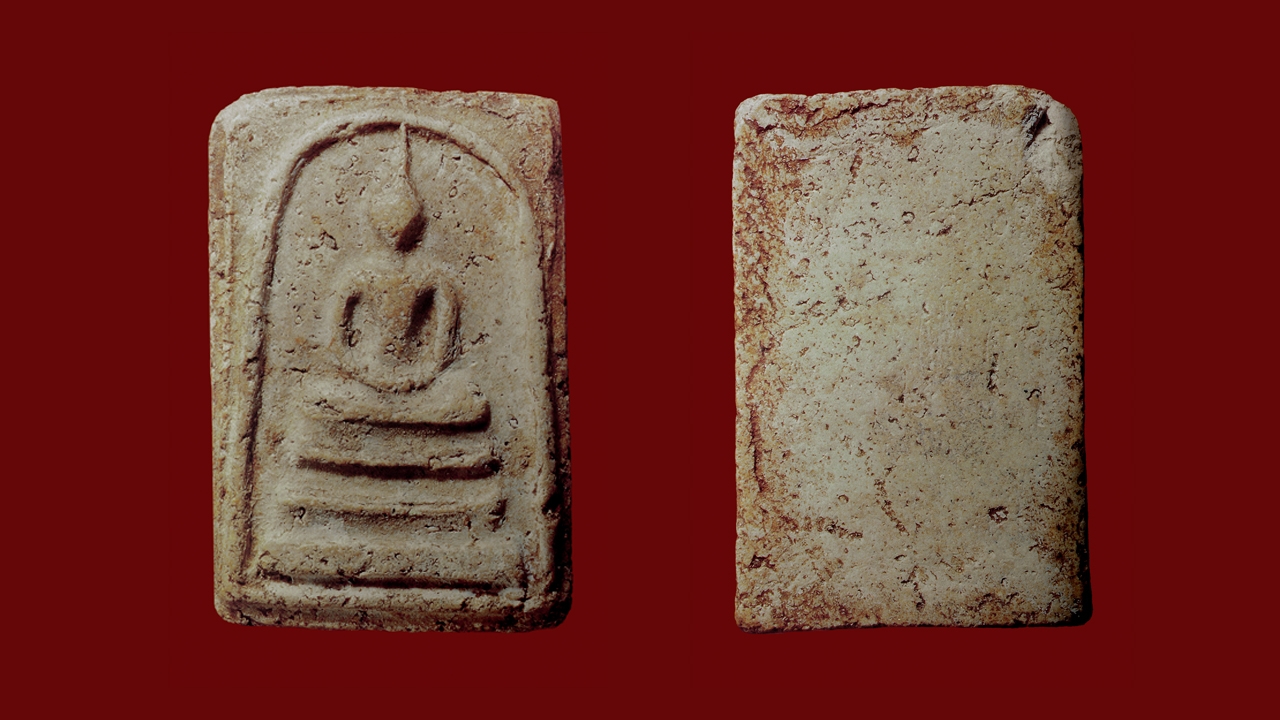
The Wat Rakang Kositaram Somdej amulet, large mold, is regarded as the ultimate masterpiece.It is the desireof all amulet collectors.According to the textby the anonymous author from Precious magazine, the large mold is divided into four types: the Principal Buddha mold (with a line beneath the lap), the V-shaped chest mold, the cylindrical chest mold, and the hair piercing the arch mold. Each shares common features identifying them as large molds but also has subtle distinct traits that give rise to their subtype names for easy recognition. This classification by the anonymous author has been widely accepted from the past to present. However, other masters may classify differently; for example, Triyamphawai divides them into six types: broad, clear, slender, stout, sturdy, and small molds. Teacher Prakit Limsakul or Plai Chumphon of Thairath newspaper often explains these classifications. Regardless of the method, all are possible depending on each collector’s experience and perspective.
The Wat Rakang Somdej large mold group is considered to contain master pieces or original prototype amulets highly respected, all exhibiting beauty and commanding very high auction values, especially those famous or star amulets. Among these, two stand out and are especially renowned: “Khun Sri” and “Uncle Phut”. Master Rangsan Tosuwan related the history of these two Somdej amulets as follows:
“Back in approximately 1967–1977, the most famous Wat Rakang large molds considered master pieces were two: the second mold, known in the community as “Khun Sri”, and the fourth mold, known as “Uncle Phut.”
Originally, both belonged to Khun Chai Lee. Later, Khun Chat, son-in-law of Sompong, received a share and gave it to Khun Krit Rattanarak. Not long after, Khun Niyom Asunee Na Ayutthaya from Nakhon Sawan province requested to possess it for over ten years.
Around 2000–2001, Khun Montri Pongpanich, former Deputy Prime Minister, also requested to enshrine the Khun Sri amulet at a very high price that caused a sensation in the amulet world.Untilafter his passing, the Khun Sri Somdej amulet went into the possession of Khun Vichai Srivaddhanaprabha, former chairman of King Power Group, at a record-breaking price.
As for the Uncle Phut Wat Rakang Somdej, it is well known that Khun Chai That Techapaiboon has enshrined it since 1977 and continues to possess it. Uncle Phut is among the most famous amulets in the amulet community, nicknamed “Uncle Phut.” Regarding its estimated auction value, it is said that each amulet reaches around 100 million baht, plus or minus, as of today.
The “Uncle Phut” is the Wat Rakang Somdej large mold, fourth type, distinguished by the special feature of hair piercing the arch. The other three large molds do not have hair piercing the arch. The “Science of Somdej” once presented that although the Wat Rakang Somdej large mold has many subtypes—some dividing into over ten sub-molds—all these sub-mold blocks likelyoriginated froma single mold shape or what modern craftsmen call “drawing.” When carving molds, sometimes the hair may be carved too long or lines beneath the lap are faint, thus not visible in some mold blocks.
The Wat Rakang Somdej large mold group and other standard molds are believed, based on evidence, to have been carved by royal goldsmiths who integrated Western artistic knowledge introduced into Thailand during the reigns of Rama IV to Rama V as part of modernization efforts to counter Western colonialism. These royal goldsmiths and the ten craftsmen likely received knowledge transfers from Western artists at that time. Western sculpture practices typically require “drawings” as templates before carving, especially when carving Wat Rakang Somdej molds using “perspective” principles to create realistic three-dimensional effects, blended with traditional Thai art knowledge of “carvers” from the ten craftsmen lineage passed down through generations.
In the mold carving process, the craftsmen would sketch designs on a sufficiently large soapstone slab to carve multiple amulets in reverse (mirror image) on a single slab. According to academic documents on soapstone mold carving by the Thai Arts and Crafts Center, Department of Fine Arts, published in 2011, the carving process began with freehand sketching:
“... When freehand sketching on the soapstone slab, the craftsman starts by drawing vertical and horizontal axis lines using a sharp metal tip or chisel tip on the stone’s surface. The outermost lines form the outline, followed by detailed sketches in sequence ... Then, the craftsman uses the chisel tip to scratch grooves along the sketched lines, after which the pattern background is scraped, starting from edges, gradually achieving the desired depth. The chisel must be held level with the surface as much as possible and scraped in thin layers...”

During the mold carving process, for the standard Wat Rakang Somdej mold, interpreted through the ten craftsmen’s methods, the carver first scratches the mold’s frame lines (glass frame lines) vertically and horizontally. Then, they carve small inner border lines of the split rattan arch forming a circle. For the large mold, the inner wall of the split rattan arch is the original flat surface of the soapstone slab. Next, they carve the base layer starting from the lower right corner of the base (some molds may start from the left corner), leaving a “bird’s beak” mark. Sometimes, the craftsman starts carving from both sides of the base in the same mold. The chisel strokes run straight from left to right or vice versa. Examining the base edge lines should reveal marks matching these chisel strokes. The carver then proceeds to carve the rest of the amulet from the base upward to the torso, head, and hair, before carving the split rattan arch lines. Observing the Wat Rakang Somdej large mold with hair piercing the arch clearly shows the hair is carved before the split rattan arch. During carving, the craftsman presses wax on the mold and periodically removes it to check carving completeness. Then, the craftsman smooths the surfaces, for example, the exterior surface of the split rattan arch is slightly sloped toward the edges to facilitate amulet removal from the mold, followed by final detail refinement before using the mold to cast more Somdej amulets.
It is evident that carving the hair before the split rattan arch sometimes causes the hair to unintentionally extend, resulting in the hair piercing the arch feature. . Is it possible thatthe craftsman followed the “drawing” template using the ten craftsmen’s method, carving the amulet from base upward to the top before carving the split rattan arch? If the arch lines were carved first, the chance of hair piercing the arch would be minimal, as the chisel edge would be blocked by the arch groove lines.
Although the Wat Rakang Somdej large mold is divided into many subtypes based on various masters’ experience—with some dividing into over ten sub-molds—modern knowledge combined with examining differences such as hair piercing the split rattan arch suggests that all sub-mold blockslikelyoriginated froma single mold shape or “drawing,” carved by royal goldsmith craftsmen with distinctive signature strokes.
The “Science of Somdej” concludes this section by presenting the widely accepted Wat Rakang Somdej large mold inspection guidelines by the anonymous author, summarizing 11 key defects and 6 additional defects for the fourth mold, hair piercing the arch subtype, as published in the Precious Special magazine by Master Rangsan Tosuwan in 1996 as follows:
Defect 1 The outer frame of the amulet on all four sides is a raised line. The left frame line extends down to between the amulet’s elbow and then fades into the arch line.
Defect 2 The right mold frame line (on the amulet) is a continuous raised line running closely along the bottom arch line.
Defect 3 The glass house arch line is relatively large and raised, resembling a split rattan. Inside the arch line is a vertical line from the base. The amulet's surface outside the arch slopes slightly.
Defect 4 The face resembles a bael fruit.
Defect 5 Both ears are present but sometimes faint.
Defect 6 At the curved shoulder-arm junction, the right shoulder is thicker than the left.
Defect 7 The left knee protrudes higher than the first base layer.
Defect 8 The right knee protrudes lower than the first base layer.
Defect 9 The amulet leans slightly to its right, while the first, second, and third base layers lean to the left, alternating with the amulet’s tilt.
Defect 10 The wall surface between the three bases: the wall between the first and second base layers is level with the base floor, while the walls between the shaft and first base, and second and third bases are higher than the amulet’s surface.
Defect 11 The outer surface outside the arch is slightly higher than inside the arch, almost invisible unless the amulet is tilted to see a line.
For more details, visit the page Science of Somdej by Police Lieutenant Colonel Komsan Sanongpong, with thanks to Assistant Professor Rangsan Tosuwan for kindly providing images of another master Wat Rakang Somdej amulet for educational purposes, and thanks to the current owner of this amulet.
Additional defects for the fourth mold, hair piercing the arch subtype:
Defect 14 Hair piercing the arch.
Defect 15 The torso forms a V shape but flares at the bottom near the arms.
Defect 16 The robe hem runs sharply down to the knees.
Defect 17 The right knee is rounded and slopes toward the arms.
Defect 18 The left lion base corner bends inward.
Defect 19 The right lion base corner forms a straight line downward.
For more information, visit the page Science of Somdej by Police Lieutenant Colonel Komsan Sanongpong and thanks to Assistant Professor Rangsan Tosuwan for kindly providing images of another master Wat Rakang Somdej amulet for educational purposes, and thanks to the current owner. This is a Wat Rakang Somdej large mold, fourth or hair piercing the arch type, beautifully preserved with moderate use causing a rich patina. The amulet body is soft with no crackling (which is common in dense amulets with lacquer). It has a brownish hue, with relatively wide margins showing clear frame lines on all four sides, typical of this subtype. It exhibits all three authentic Somdej elements: granules, worm trails, and porous needle holes. The mold shape is correct per text, with a smooth back showing wrinkles and separated lines. The crab-like edge peeling marks are faint, likely due to edge sanding. This serves as an excellent prototype for studying Wat Rakang Somdej amulets. For more articles, see the Science of Somdej column.
Author Police Lieutenant Colonel Komsan Sanongpong, former forensic police officer,
Facebook page –Science of Somdej