

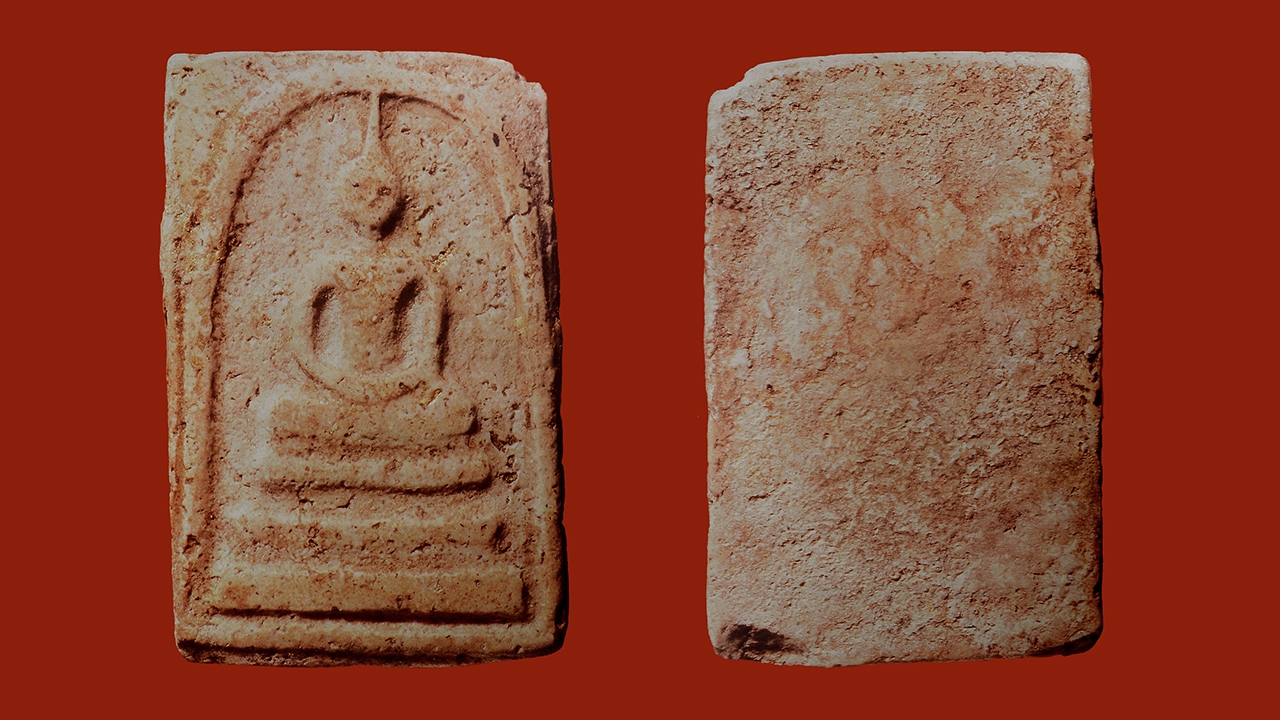
The Phra Somdej Wat Rakang Kositaram created by Somdej Phra Phutthachan (Toh Prommarangsi) features a carved control frame line or "mirror frame line" on every mold type. In some forms, such as the Large-Print, this frame line has a distinctive special character. Past collectors regarded this as a crucial identifying flaw when deciding to buy or sell Phra Somdej Wat Rakang amulets, calling it the “million-dollar line.”
It is intriguing to ask about the origin of this “mirror frame line”: why did the artisans design all Phra Somdej Wat Rakang molds to include this “million-dollar line,” and why does the Large-Print mold show a different characteristic from others?
According to the 2011 academic publication by the Center for Thai Art and Craft, Fine Arts Department, explaining the carving process of soapstone molds, the procedure starts with sketching the design directly on the stone surface:
“...when sketching on the soapstone slab, the artisan begins by drawing vertical and horizontal axis lines using a sharp metal point or chisel tip on the surface. Starting from the outermost line as an outline, they then proceed to sketch details sequentially... afterwards, they carve grooves along the sketched lines with a sharp chisel tip...”
The control frame lines likely originated from these vertical and horizontal axis lines drawn to frame the mold before the artisan carved the split-arc arch line, then the Buddha figure and its three-tiered base, before beginning to carve surface details. The carving starts from the lower corner of the split-arc arch, sweeping diagonally upward to connect with the lower edge of the offering table base (lowest tier). This appears as a “bird’s beak” shaped groove. This base edge point is the starting point of carving the Phra Somdej Wat Rakang mold. One piece of evidence supporting this theory is that in the Garuda-Head mold—unique for lacking a base arch line—there are visible small grooves linking the lower end of the split-arc arch to the base corners, showing clear start marks. Some experts treat this mark as a critical flaw for authenticating this specific mold as well.
Phra Somdej Wat Rakang The five standard mold types include Large-Print, Chedi-Print, Bud Lotus Bud-Print, Base Cross-Print, and Bodhi Leaf-Print. These are sculptures created from meticulously carved molds, believed to have been carved by royal goldsmith artisans highly skilled in small-scale carving. The carving technique aligns with traditional Thai art knowledge passed down by the Silpa Sip Mu craftsmen guild. For each mold carving, the control frame line or mirror frame line must be engraved on every mold and every block. This frame line defines the carving area and may vary among mold types. For example, the Base Cross mold's frame line is barely visible on some pieces, resembling the faint vein lines often seen on the figure’s body—shallow and delicate. This was likely a trial mold made by the royal goldsmith artisans, as the first mold type carved, with subsequent molds having clearer frame lines. This fits the evolutionary theory of mold development previously discussed in the “Science of Phra Somdej” series.
Interestingly, the mirror frame line of Phra Somdej Wat Rakang in all mold types generally shares similar traits: a low-relief rectangular frame—tall and narrow (the Base Cross mold may appear trapezoidal, with the upper left side flaring out and the lower side tapering in)—overlapping all sides of the split-arc arch line. The distance from the arch line varies per artisan design. The inner and outer walls of the control frame line usually differ in height, with the outer side lower than the inner side. (Professor Prakit Limsakul or Plai Chumphon explained in the “Miracles from the Amulet Shelf” column that when two control frame lines appear, it often indicates a reused mold.) However, the Large-Print mold differs from others in that the frame line on the left side of the figure does not run as a raised line from top to bottom close to the arch line like other molds. Instead, it runs down only to the figure’s elbow level, then disappears into the arch line. This distinctive trait is considered by many Phra Somdej experts to be a key identifying flaw of the Large-Print Wat Rakang amulet, appearing in all subtypes, and is commonly called the “million-dollar line.” It is intriguing why the artisans carved the control frame line in this manner on the Large-Print mold.
The “Science of Phra Somdej” series explained that this design reflects the mold maker’s integration of Western artistic knowledge called “perspective,” introducing dimensionality as perceived by the human eye into the Large-Print design. The designer imagined viewing the principal Buddha image from the ordination hall floor, slightly from the front-left side. Notably, the top frame line slopes gently upward to the figure’s left, while the bottom frame line slopes downward. These upper and lower lines converge gradually toward an imaginary vanishing point far to the figure’s right, consistent with perspective principles.

In the case of Phra Somdej Wat Rakang with a designed frame line on the mold, the “Science of Phra Somdej” noted that the frame line also helps the amulet’s front surface press tightly against the mold. The pressing force starts by pressing the mixture mass onto the mold, possibly with a pressing tool such as a wooden board, exerting vertical pressure. Once the amulet material flows into the mold block, pressure comes from all directions due to the mold’s basin-like sloped design and resistance from the frame line. This creates an especially smooth and dense front surface, enhancing the sharpness and detail of the lines on the Phra Somdej Wat Rakang amulet.
Some Phra Somdej experts also say that the mirror frame line serves as a guideline for trimming the amulet’s edges. In some pieces trimmed very close to the split-arc arch line, the control frame line may be cut away and thus invisible. This raises the question of whether trimming is done front-to-back or back-to-front. If trimmed from back to front, the frame line would be hidden. Senior expert Prajam U-Arun said trimming can be either way: back-to-front while the amulet is still in the mold—though this may cause uneven trimming as the amulet is unseen—or front-to-back after removal from the mold. It’s possible the mold had cutting guide lines.
The Phra Somdej Wat Rakang amulets by Somdej Toh in the five standard molds typically show the control frame line or mirror frame line on all mold types. This appears as a rectangular frame surrounding the split-arc arch line. The Large-Print mold’s frame line differs by running down only to the figure’s elbow level, then disappearing into the arch line. This design incorporates perspective principles, creating dimensional depth as seen by the eye. Past collectors called this line the “million-dollar line,” considering it a key identifying flaw or “payment point” when authenticating Large-Print Phra Somdej Wat Rakang amulets. However, some older Large-Print amulets lacking this line have also circulated. It will be interesting to see how the Phra Somdej community standardizes authentication for Large-Print molds going forward.
The “Science of Phra Somdej” closes this discussion by presenting the long-accepted evaluation criteria of Large-Print Phra Somdej Wat Rakang by the anonymous expert “Niranam,” summarizing eleven major flaws for all subtypes and three additional flaws for the third mold type, Barrel-Chest Print. (Niranam divides into four subtypes: Principal Buddha Print, V-shaped Chest Print, Barrel-Chest Print, and Lotus Bud Through Arch Print) as follows:
Flaw 1 The outer frame on all four sides is a raised line, but only the left frame line runs down to the figure’s elbow before disappearing into the arch line.
Flaw 2 The right frame line (figure’s side) is raised and runs down continuously, close to the bottom arch line.
Flaw 3 The split-arc arch line is quite thick and raised, resembling a split rattan stalk; inside the arch is a vertical line from the base. The outer base surface outside the arch slopes slightly.
Flaw 4 The face resembles a bael fruit shape.
Flaw 5 Both ears are present but sometimes faintly attached.
Flaw 6 The curved arm attaches to the shoulder, with the right shoulder thicker than the left.
Flaw 7 The figure’s left knee protrudes higher than the first base tier.
Flaw 8 The right knee protrudes lower than the first base tier.
Flaw 9 The figure leans slightly to the figure’s right, while base tiers 1, 2, and 3 lean to the figure’s left, alternating with the figure’s tilt.
Flaw 10 The walls between the three base tiers vary in height: between tier 1 and 2 is level with the surface; between the shaft and tier 1 and between tiers 2 and 3, the walls are higher than the figure’s surface.
Flaw 11 The outer surface outside the arch is slightly higher than inside, almost invisible unless the amulet is tilted.
Additional flaws for the third mold, Barrel-Chest Print:
Flaw 12 The torso is cylindrical (not V-shaped like other molds).
Flaw 13 The second base tier (lion base) line is thinner and more raised than other molds.
Flaw 14 The torso lines, arm circles, and base lines are thinner and sharper than in other molds.
For further reading, visit the page Phra Somdej Science by Police Lieutenant Colonel Komsan Sanongpong. Thanks to Assistant Professor Rangsarn Tosuwan for kindly providing photos of a masterpiece Phra Somdej Wat Rakang amulet for educational purposes, and thanks to the current owner. This amulet is a Large-Print, third mold type or Barrel-Chest Print (Niranam’s classification divides into four subtypes; types 1 and 3 are very rare, type 2 is most common, type 4 is moderate). It is beautiful, well-used, with a soft texture and no crack patterns (which often appear in harder amulets with lacquer), brownish tone, edges trimmed near the control frame line, showing all three authentic Phra Somdej characteristics: granules of relics, worm trails, and needle-like pores. The mold shape is correct per references, torso cylindrical, with the left-side mirror frame line or “million-dollar line.” Notice faint seam lines under the lap. The back is smooth with wrinkles, minor flaking at edges, and slight oil residue. This piece serves as an excellent study model for Phra Somdej Wat Rakang. More articles are available in the “Science of Phra Somdej” column.
Written by Police Lieutenant Colonel Komsan Sanongpong, former forensic police officer.
Facebook page –Phra Somdej Science