

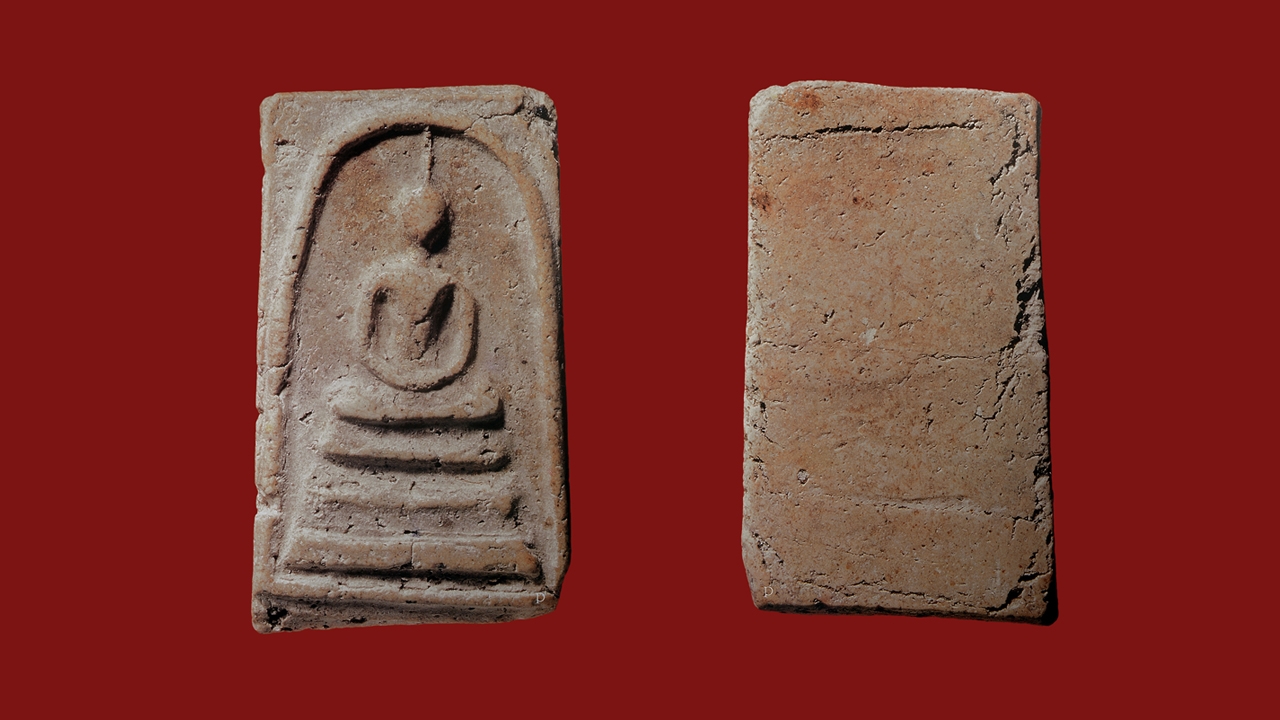
The Wat Rakang Somdej Buddha statue created by Somdet Phra Phutthachan (Toh Prommarangsi) is considered a small stucco sculpture representing the Buddha in a meditation posture. Evidence confirming which important temple’s principal Buddha image Somdet Toh instructed the mold carvers to use as the “model” for designing the Wat Rakang Somdej molds is scarce.Such evidence is rare.The clearest existing evidence is the Wat Rakang Somdej Buddha statue itself.It serves as the key artifact.This artifact leads to conclusions on the matter.
“The Science of Somdej Buddha” has previously presented that the Wat Rakang Somdej Buddha in the bud-shaped hair mold and the chedi mold likely drewinspiration for their design from the Phra Phuttha Maha Mani Rattana Patimakorn, or the Emerald Buddha, enshrined at Wat Phra Sri Rattana Satsadaram in the Grand Palace. The Somdej Buddha statueshave a robust form similar to the Emerald Buddha,with several features in the mold resembling the Emerald Buddha’s rainy season royal attire. The base Sam mold is thought to have been inspired bya blend of Buddha art styles fromvarious Phra Phuttha Sihing statues.for example,based on the diamond meditation posture sitting style (the originals enshrined at Wat Phra Singh in Chiang Mai and the Phra Phuttha Sihing Hall in Nakhon Si Thammarat are in the “Victory over Mara, diamond meditation posture” style, while the one at the National Museum Bangkok is in the “meditation posture, flat cross-legged” style). The Bodhi tree covering mold islikely a modification of the moldsfrom the base Sam and bud-shaped hair molds. Regarding the large mold, many past masters have opined it likely drew inspiration from the “Smiling to the Sky” principal Buddha image in the ordination hall of Wat Rakang, which displays the U Thong style Buddhist art (some minor details differ, likely as a mark of respect), closely resembling the Wat Rakang Somdej Buddha.The large moldspecifically the first sub-mold or the robust principal Buddha mold,
has its history described in the “Book for the Royal Cremation Ceremony of Phra Thammathirat Rajamahamuni (Thien Akkathamma Maha Thera), former advisor of the 11th ecclesiastical district and abbot of Wat Rakang Kositaram, Sunday, 13 February 2022 CE,” which states...
“The older principal Buddha image was originally smaller, made of stucco with a small stone pillar core, not as large as the current one, and had deteriorated greatly. Somdet Phra Phutthachan (M.R. Charoen Isarangkun), when he was still Phra Thamtrai Lokachan and abbot of Wat Rakang Kositaram, had several local sculptors and casters,one of whom was identified asMr. Chamroen Phatthanangkul, collaborate to sculpt the principal Buddha image over the old one,making it much larger,so large that it seemed unbelievable that the umbrella canopy could be offered over it.

As for the current principal Buddha image, its origin is unknown; only told by Phra Kru Methangorn (Thong) that Somdet Phra Phutthachan (M.R. Charoen Isarangkun) said, when he held a high ecclesiastical rank,he asked an elderly monk about the principal Buddha image.This elderly monk,called by both temple and villagers as“Sae Tho Sa” because he lived in the library tower above the pond. Though not nobility, he was called “Luang Pi” by Mom Chao Phra Phutthabat Pilan (M.C. Thad Seniyawong), former abbot of Wat Rakang Kositaram, which made him feel respected and assume a noble status. He was wise and would only speak if addressed as “Sae Tho,” refusing otherwise.This elderly monkinformed Somdet Phra Phutthachan thatwhen he was a child, he saw Buddha images being transported in sectionson boats arriving at Ton Sok pier (beside the embankment in front of Wat Rakang Kositaram near a large Ton Sok tree, now gone), then carried into the ordination hall. He only knew this much, thus Somdet Phra Phutthachan understood that the principal Buddha in Wat Rakang’s ordination hallwas a cast Buddha image, not stucco...”Referring to this information, Mom Chao Phra Phutthabat Pilan (M.C. Thad Seniyawong) was born in 1822 CE, and Somdet Phra Phutthachan (M.R. Charoen Isarangkun) was promoted to high ecclesiastical rank in 1896 CE. The current principal Buddha imagewas therefore likely enshrined in Wat Rakang Kositaram's ordination hallbefore the standardized Wat Rakang Somdej molds were created,which probably began around 1866 CE.It is said that when King Chulalongkorn visited to offer robes during the Kathin ceremony at Wat Rakang Kositaram, he remarked, “Visiting other temples is not like coming to Wat Rakang; as soon as you enter the ordination hall, the principal Buddha smiles to the sky.” The U Thong style Buddha art is characterized by elegance,with a somewhat square, ancient face, wide lips slightly parted, hence the name “Smiling to the Sky.”Professor Dr. Chatri Prakitnonthakarn, architecture faculty, Silpakorn University, stated in the book “Politics in Architecture during King Rama I’s Reign” (Matichon Publishing) that the meditation posture Buddha imagewas the royal preferred posture of King Rama I of Rattanakosin, replacing the previously popular “Victory over Mara” posture. Professor Chatri also noted that among 12 temples established or renovated by King Rama I,eight had principal Buddha images in the meditation posture, including Wat Phra Sri Rattana Satsadaram with the Phra Phuttha Maha Mani Rattana Patimakorn (Emerald Buddha), Wat Pho with Phra Phuttha Thewa Patimakorn transferred from Wat Sala Si Nae (Wat Khuha Sawan). Wat Rakang Kositaram is one of these eight temples, and Professor Chatri suggested its “Smiling to the Sky” principal Buddha was likely created during King Rama I’s reign as well.
“The Science of Somdej Buddha”previously presented a perspective based on Triyampawai’s information that among the four sub-molds of the Wat Rakang Somdej large mold,the first mold, the principal Buddha mold, was influenced by the U Thong style Buddhist art, while the other three molds—V-shaped chest, cylindrical chest, and hair piercing the arch molds—likely drew from the more delicate and graceful Sukhothai style. It is intriguing that besides the “Smiling to the Sky” principal Buddha that likely inspired the large mold’s principal Buddha style,one wonders which important Buddha images inspired the other three sub-molds.“The Science of Somdej Buddha” noted that the large mold design
generally follows the principles of “perspective” or three-dimensional viewpoints as seen in reality,combined with balancing mass weight,or adjusting the amount of material to give proportions that appear dimensional and harmonious according to low-relief sculptural principles. Every line on the rectangular base follows this principle.Notably, the large mold design likely incorporated an additional feature:the principal Buddha used as the model leans back slightly,a trait also observed in some principal Buddha statues in certain ordination halls.This slight backward lean of the model causes the Wat Rakang Somdej large mold statues to tilt slightly left from the torso up to the hair tip.(Though some past masters have also noted a slight tilt to the right.) Alternatively, the carvers may have imagined the model leaning back slightly to give the Somdej Buddha mold more balanced beauty.“The Science of Somdej Buddha” suggested that when viewed slightly from the right side, the statue returns to balanced proportions.It is understood that the left upper arm compressing inward helps achieve this balance from that angle.
Considering the Wat Rakang Somdej large mold statues alongside other evidence might improve understanding of their design origins. Could another “model” for the large mold design bea certain important meditation posture Buddha imagethat King Rama I or another monarch commissioned or brought to be enshrined in a major temple in Rattanakosin before the Wat Rakang Somdej was created?ConclusionSomdet Phra Phutthachan (Toh)’s Wat Rakang Somdej Buddha statues of various molds
are believed to have drawn inspiration for their designs from important principal Buddha images in ordination halls of various temples.For example, the bud-shaped hair and chedi molds likely drew inspiration from the Phra Phuttha Maha Mani Rattana Patimakorn (Emerald Buddha) at Wat Phra Sri Rattana Satsadaram.The base Sam mold likely combines Buddha art styles from various Phra Phuttha Sihing statues enshrined in different locations, including both the Victory over Mara diamond meditation and flat cross-legged meditation postures.The large mold partly draws inspiration from the “Smiling to the Sky” principal Buddha in Wat Rakang’s ordination hall, but likely also from principal Buddha images in other places.Understanding the Buddhist art styles, mold designs, and the key distinctive marks on the Somdej statues might help clarify their design origins or “models.” “The Science of Somdej Buddha” ends this segment by compiling accepted criteria from the community for examining the Wat Rakang Somdej large mold, known as Nirunam’s criteria, listing 11 key distinctive marks common to all sub-molds and 4 additional marks for the V-shaped chest mold, as follows: Mark 1: The outer frame of the statue on all four sides is a raised line; only the left side frame line extends down between the statue’s elbow and then fades into the arch line. Mark 2: The mold frame line on the statue’s right side is a raised line running continuously, closely adjacent to the bottom arch line.Mark 3: The arching frame is a fairly large raised line resembling a split rattan line; inside the arch is a vertical line from the base. The statue’s base outside the arch slopes slightly.Mark 4: The face resembles a bud of the matum fruit. Mark 5: Both ears are present, though sometimes faintly attached. Mark 6: At the curved shoulder-arm junction, the right shoulder has thicker material than the left. Mark 7: The statue’s left knee protrudes higher than the first base tier. Mark 8: The right knee protrudes lower than the first base tier.Mark 9: The statue tilts slightly to its right side, while the base tiers 1, 2, and 3 tilt slightly left, alternating with the statue’s tilt.Mark 10: The wall between the three base tiers—between tiers 1 and 2 is flush with the base floor; walls between the shaft and tier 1 and between tiers 2 and 3 are elevated compared to the statue’s base floor.Mark 11: The area outside the arch is slightly higher than inside, almost imperceptible unless tilting the statue to see a faint line.Additional marks for the V-shaped chest mold (Mark 2):Mark 12: Between the shaft (lap) and arms is a raised area clearly showing the shaft, especially from the knee up to the arm ring (the torso forms a “V” shape).Mark 13: Both arms spread wider than in Mark 1 (close to Mark 3 and Mark 4).Mark 14: The hair is longer than in Mark 1 (close to Mark 3).Mark 15: The top base tier is longer than in Mark 1.For more details, visit the Facebook page“Somdej Buddha Science”by Pol. Lt. Col. Komsan Sanongpong, with gratitude to Assistant Professor Rangsarn Tosuwan for kindly providing images of master Wat Rakang Somdej statues for knowledge sharing, and thanks to the current statue owner.This statue is a large Wat Rakang Somdej, V-shaped chest mold (Nirunam divides into four sub-molds: mold 1—principal Buddha, mold 3—cylindrical chest (rare), mold 2—V-shaped chest (most common), and mold 4—hair piercing the arch (moderate quantity). It is very beautiful, well preserved, with firm, soft texture mixed with hardness, white-brown coloration, tight mold edges, and authentic Somdej Buddha features visible: granule patterns, worm trails, and needle hole pores. The mold is accurate per references. The statue tilts slightly left from torso to hair tip, a distinctive mold trait. The back is smooth with wrinkles and cracking marks visible, along with peeling marks on edges and oil-like stains. It is an excellent prototype for studying Wat Rakang Somdej Buddha statues. For more, read the “Science of Somdej Buddha” column.Author: Pol. Lt. Col. Komsan Sanongpong, former forensic police officer.Facebook page:
Somdej Buddha ScienceRead more in theScience of Somdej Buddhacolumn.