

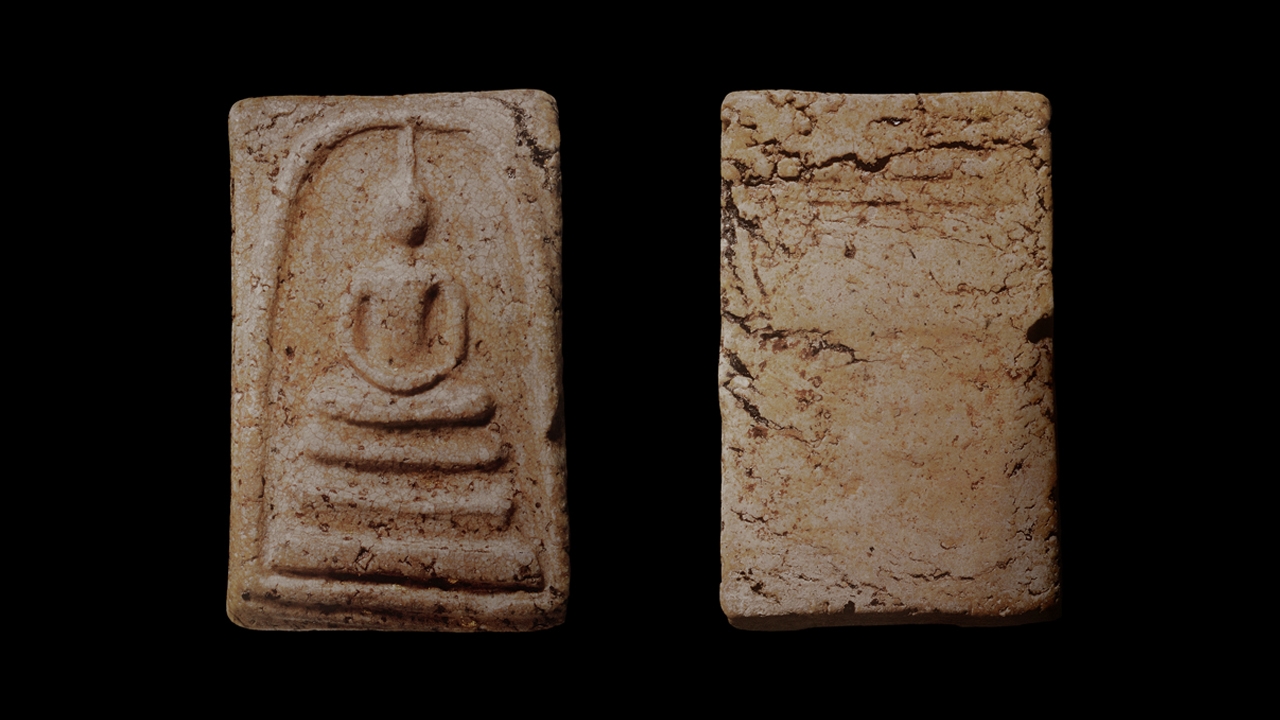
The large mold Phra Somdej Wat Rakang Khositaram is considered the most developed and distinguished form of Phra Somdej, highly valued and commanding the highest market prices among those of Somdej Phra Puttajarn (Toh Prommarangsi). This mold also has unique characteristics not found in other Wat Rakang molds. Many past masters have summarized various distinguishing flaws of this mold to aid understanding of its features. Currently, "The Science of Phra Somdej" invites readers to decode the secret flaws in the base of the large mold Phra Somdej Wat Rakang, which will help genuinely identify authentic Phra Somdej statues.
"The Science of Phra Somdej" has previously explained that the large mold Phra Somdej Wat Rakang was designed by a royal goldsmith who integrated ancient Thai art with Western art theories introduced to Thailand at that time, particularly the bas-relief sculpture technique called “perspective” or dimensionality as seen by the eye. This approach reflects the viewpoint of the mold carver seated slightly to the left front of the principal Buddha statue in the ordination hall, resulting in the statue appearing to lean slightly to its right. All components of this mold follow this perspective view, producing asymmetrical lines—such as the split rattan arch line, which in other Wat Rakang molds is symmetrical but here curves inward on the right side of the statue, clearly visible from just below the shoulder upward. This feature is an important identifying mark noted by past masters. "The Science of Phra Somdej" suggests that the reason for this asymmetry is the use of perspective. To verify, one can draw a symmetrical split rattan arch on paper and tilt the paper 15–30 degrees from the horizontal, mimicking the goldsmith's viewpoint; the arch will then appear just as it does on the large mold Wat Rakang statue when viewed straight on. This principle guided the carving of all lines and proportions on the mold block, with further integration of bas-relief sculpture techniques by adding raised or recessed areas to give the statue dimensionality and aesthetic appeal. A clear example is the carving of the three-layered base (seat), which hides multiple secret flaws, as detailed below.
Triyampawai discussed the three-layered base of the large mold Phra Somdej Wat Rakang in the first volume of his explanatory book as follows...
"...The top layer of the base functions as the upper board, with a convex molding and a well-defined soffit thicker than the middle base, but narrower in width. Some examples are very close to the edge of the Buddha's body, others set further back. The base corners on both sides are usually rounded, with a few showing chamfered cuts angling toward the Buddha's body to create a cone shape. Most base corners are worn or blurred.
The middle baseis the lion base, considered the most beautiful layer. Its thickness and relief are less than other layers, often somewhat blurred or indistinct. Both corners resemble lion paws curling down to meet the lower base, with the corner edges slightly raised, similar to the top base's elevated corners but sharper. The central area forms a ridge like a chicken's chest or axe blade, slightly sharp and gracefully sloping down to meet the lower base, known as the “axe blade of the lion base.”

The bottom base is the lower board, featuring the thickest and widest relief. It is a smooth section with relatively even surface, lacking anti-counterfeit lines (raised edges along the top of the base may be scratch marks or original edges with central depressions—however, many master examples show traces of anti-counterfeit lines). The left base corner is chamfered toward the middle base to maintain the cone shape more than the right corner, which is cut square or sometimes partially chamfered. The upper and lower edges are not perfectly aligned but have subtle natural curves typical of plaster materials or originally liquid forms..."
These details offer much to consider. Firstly, Triyampawai’s mention of chamfered corners on the top base as a minor feature aligns with observations in several statues shown in "Sam Somdej" by Ajarn Prachum Kanjanawat. High-value master large molds typically have rounded base corners. Secondly, the lion base appears in all Wat Rakang molds, while Wat Bangkhunprom molds rarely show it. For ambiguous pieces lacking lion base traces, they should be classified as Wat Bangkhunprom.Thirdly,Triyampawai's note that the bottom base’s left corner angles toward the middle base while the right corner is cut square or chamfered reflects perspective carving. Particularly, the left corner (the statue’s right side) slopes upward, and the right corner (statue’s left side) often also inclines slightly, though less so, in many master large molds. Finally, Triyampawai also described the overall statue and base as having a"cone shape,"which merits explanation. A cone-shaped Phra Somdej means that lines drawn from the base corners to the statue’s crown form a symmetrical triangle. The three base layers and the statue fit neatly within this triangular frame, typical of principal Buddha statues (the lotus bud and chedi molds are similarly cone-shaped). However, the large mold Wat Rakang shows a variation—a half-cone shape. Many masters say that a line drawn from the statue’s left bottom base corner up through each base layer, shoulder, and crown tip is straight, but on the right side, the base and statue protrude beyond this line due to perspective mold design, causing asymmetry. Examining the right side base layers shows uneven spacing: the bottom base corner is farther from the middle base corner than the middle base is from the top base corner, and the top base corner is farther from the shoulder than from the middle base corner. On the left side, spacing is more even. Interestingly, measuring the distance from the split rattan arch to the base corners and statue’s shoulder usually shows the left side distances are greater than the right side. All these follow perspective principles. Anonymous
from Precious magazine made an insightful observation about the three-layer base of the large mold Wat Rakang: “The statue leans slightly to its right, while the three base layers lean to the left, alternating with the statue’s tilt.” This matches sculptural theory, where the statue tilts right while the base layers tilt oppositely to balance the relief mass, preventing the statue from appearing unbalanced. This gives a stable, dimensional, and skillfully crafted appearance. Closing remarks The large mold Phra Somdej Wat Rakang shows the greatest mold development and is highly sought by collectors. It has unique features not found in other Wat Rakang molds. Many past masters have summarized its distinguishing flaws, which help in authenticating these statues. One notable feature is the unique three-layer base. "The Science of Phra Somdej" presents that these mold flaws and the base's design derive from the carver’s use of perspective in mold carving. Studying these flaws with understanding of their origins and forensic methods deepens insight into the large mold Wat Rakang, allowing genuine Somdej statues of Somdej Toh to be truly recognized.
"The Science of Phra Somdej" concludes this installment by presenting widely accepted criteria by Anonymous within the amulet community, summarizing11 key flawscommon to all sub-molds and
for the third mold type,the cylindrical chest mold (Anonymous divides into 4 sub-molds:principal Buddha, V-shaped chest, cylindrical chest,and hair extending beyond the arch), as follows:Flaw 1
The outer frame on all four sides is a raised line; only the left side frame extends down to between the statue’s elbows before blending into the arch line. Flaw 2 The mold frame on the statue’s right side is a raised line running along and close to the lowest arch line. Flaw 3 The arch of the crystal palace is a relatively large raised line, resembling a split rattan line. Inside the arch are vertical lines from the base; the outer statue surface slopes slightly. Flaw 4 The face resembles a bud-shaped fruit. Flaw 5 Both ears are present but sometimes faint.
Flaw 6 At the arm-shoulder curve, the right shoulder is thicker than the left.
Flaw 7 The statue’s left knee protrudes above the first base layer.
Flaw 8 The right knee protrudes less than the first base layer.
Flaw 9 The statue leans slightly to its right, while the three base layers tilt to its left, alternating with the statue’s tilt.
Flaw 10 The wall surfaces between the base layers: between the first and second base layers is level with the floor; between the statue’s body and first base, and between the second and third base layers are higher than the statue’s floor.
Flaw 11 The outer floor beyond the arch is slightly higher than the inner floor, barely visible except when tilting the statue to see a line. Additional flaws for the third mold, cylindrical chest:
Flaw 12 The torso is cylindrical (unlike the V-shaped torsos of other molds).
Flaw 13 The second base layer (lion base) has thinner raised lines than other molds.
Flaw 14 The torso, arm lines, and base lines are thinner and sharper than other molds.
For further reading, visit the Phra Somdej Science page by Pol. Lt. Col. Komsan Sanongphong. Thanks to Associate Professor Rangsarn Tosuwan for generously providing images of another master large mold Phra Somdej Wat Rakang for educational purposes, and thanks to the current owner. This statue is a large mold Wat Rakang, close to the third mold or cylindrical chest type (Anonymous divides into 4 sub-molds; mold 1 and 3 are rare, mold 2 is most common, mold 4 less so). It is beautifully preserved with signs of use, dense material, visible crackle patterns (often found in dense material with lacquer), brown color, closely trimmed edges, and shows all three authentic features: relic grains, worm-like traces, and needle-like pores. The mold matches academic references, with a cylindrical torso and visible line traces under the lap. The middle base is the lion base; the back is smooth with wrinkles and cracks visible, along with edge flaking and residue resembling soy sauce stains. This serves as an excellent study model for learning about Phra Somdej Wat Rakang. More articles can be found in the "Science of Phra Somdej" column. Author
Pol. Lt. Col. Komsan Sanongphong, former forensic police officer Facebook page
–
Phra Somdej Science Read the column
The Science of Phra Somdej for more