;
Thairath Online
Thairath Online

Unraveling the Mystery of the Head and Hair of the Large-Format Phra Somdej Wat Rakang: Why It Differs from Other Types

Amulet28 Oct 2026 10:02 GMT+7

Share

Unraveling the Mystery of the Head and Hair of the Large-Format Phra Somdej Wat Rakang: Why It Differs from Other Types

The Large-Format Phra Somdej Wat Rakang Kositaram of Somdej Phra Buddhacharn (Toh Prommarangsi) is regarded as the "Emperor of Amulets" due to its supreme value and highest auction prices among all amulets.,This style also has many unique mold characteristics, or what are called mold defects, that differ from other Phra Somdej Wat Rakang types, presenting a puzzle about its design. Understandingtheorigins of these mold defects, which were previously recognized only through memorization, could enable a more reasoned evaluation of Somdej Wat Rakang by Somdej Toh and accelerate learning about various mold defects. At this point, "The Science of Phra Somdej" invites readers to help unravel the mystery of the "head and hair" of the Large-Format Phra Somdej Wat Rakang and why it differs from other types.

The first volume of the Amulet Commentary by Triyampawai divides the main type of Phra Somdej Wat Rakang (equivalent to what is popularly called Large-Format today) into six subtypes based on distinctive features: Khueng type, Throng type, Chalud type, Pom type, Santat type, and Yom type. , (Two other types mentioned—Leuan and Khueng Sen Dai—are said by Triyampawai to exist only for Phra Somdej Wat Bang Khun Prom.) Triyampawai also classifies the shape of the head (Phra Si-ra or crown) and face into four types:Matum fruit shape, oval shape, sharp shape, and stout shape.,andthe hair (Phra Khet—meaning the uppermost part of the head symbolizing enlightenment) into three types by shape: thespike type, the slender type, and the arch-penetrating type."The Science of Phra Somdej" respectfully summarizes this for study guidance on Somdej Wat Rakang of Somdej Toh as follows... Matum fruit shape is characterized by a well-proportioned round shape resembling a matang fruit, slightly broad. This is considered the most beautiful and distinct type. Truly sharp specimens show eye groove details: on the left side, a small rounded bump resembling an ivory grain with a surrounding groove, positioned lower than the right eye and angled sharply to the left; on the right side, a truncated diamond shape without a protruding eyeball bump. This Matum fruit type is very rare.

  • It appears in the Khueng subtype. Triyampawai notes that in truly clear specimens, the eyes, nose, and mouth are faintly visible. Most Khueng types have spike-type hair. Oval shape resembles the Matum fruit shape but with a slightly tapered chin and more pronounced convex curves. Variations include slightly slender or stout forms. This is the second most beautiful type after Matum fruit shape.It commonly appears in the Yom and Throng subtypes.In the Yom subtype, most hair types are spike and slender; in the Throng subtype, hair is mostly slender and arch-penetrating.
  • Sharp shape is a truncated diamond shape with rounded corners. The crown edge slopes upward matching the base of the hair. The chin is pointed and rounded, and the cheeks flare outward with soft angles. This face type often has spike-type hair and is the most common in this mold. It appears frequently in the Santat subtype and also occurs in Throng and Chalud types, especially the Chalud type which Triyampawai describes as high relief resembling a grasshopper. The Chalud subtype features spike-type hair, while Santat shows all hair types. Stout shapeis nearly round with prominent convex curves but relatively short. It is found in the Khueng and Pom subtypes.The Pom subtype's hair includes both arch-penetrating and slender types."The Science of Phra Somdej"
  • has previously presented that the Large-Format Phra Somdej Wat Rakang design applies principles of perspective and three-dimensionality as seen by the eye, combined with balance in bas-relief sculpture. All lines and proportions on the rectangular surface of the mold follow these principles. Additionally, it has been observed that... "The design of the Large-Format Phra Somdej Wat Rakang likely adds detail from a model Buddha image that leans slightly backward. Such a posture is also found in some Buddha statues in ordination halls. Because the model Buddha leans slightly back, the Large-Format Phra Somdej Wat Rakang from the torso up to the hairtip inclines slightly to the left side of the figure,(while also tilting slightly to the right, as many previous masters have noted)..."When viewed tilted from the right side, the figure returns to balance(and approaches symmetry, unlike when viewed frontally where it is asymmetrical though balanced to some extent). It is understood that the left forearm is slightly compressed to maintain balance from this viewpoint as well...”Applying these principles to the “hair,” referencing Triyampawai's data and observations of many master specimens of Large-Format Phra Somdej Wat Rakang reveals some evidence supporting this principle. Triyampawai states that the slender and arch-penetrating hair types mostly tilt to the left, consistent with observations in many master specimens and the perspective principle. Triyampawai also notes that the spike type has a slightly curved tip; the slender type’s middle or tip is often curved; and the arch-penetrating type’s tip bends back to the right. "The Science of Phra Somdej" respectfully suggests that the wavy or serrated blade-like hair lines in many master specimens are likely accidental results from mold carving or mold removal causing some pulling of hair lines, rather than intentional serration,though some pieces may have been purposely carved that way.Regarding the head (crown)of master Large-Format specimens, significant traces include heads tilted left at the same angle as the torso, with the chin tip slightly shifted to the right side of the figure, while the top center of the head (crown) is offset to the left. This crown center is where hair lines begin, tilting slightly to the left as well. Simply put, an imaginary line from the center of the abdomen through the slightly convex neck, face center, to the hairtip aligns nearly straight, meaning all parts tilt at the same angle consistent with perspective principles described earlier. As for the four head shapes carved as classified by Triyampawai for clarity, "The Science of Phra Somdej" suggests these differences may result from the carver’s intentional carving or variations in carving tools or chisels used for different molds originally intended for a standard face shape. Some masters note that besides the torso tilting right, many master specimens also have heads and faces tilted right, causing the right face area to slope down toward the mold’s back wall, which explains why the right ear is often hard to see as it is recessed, as previously presented by "The Science of Phra Somdej."Conclusion
  • The Large-Format Phra Somdej Wat Rakang is a unique mold with many distinct mold defects unlike other types, such as in the "head and hair" area—a puzzle for those unaware of its background. Understanding the underlying design principles, such as the combination of perspective and bas-relief sculpture, should enable a reasoned evaluation of Somdej Wat Rakang by Somdej Toh and facilitate quicker recognition of mold defects, replacing rote memorization and allowing genuine Somdej amulets to be truly appreciated. "The Science of Phra Somdej" concludes this section by presenting the long-accepted evaluation guidelines of an anonymous expert in the amulet field, summarizing 11 major defects common to all subtypes and 3 additional defects specific to the third subtype, the tubular chest type. The anonymous expert divides the Large-Format into four subtypes: principal Buddha image type, V-shaped chest type, tubular chest type, and arch-penetrating hair type, as follows. Defect 1The outer frame on all four sides is a raised line, with the left frame line running down to between the Buddha's elbows before disappearing into the arch line.Defect 2

The right mold frame (figure side) is a raised line running continuously close to the lowest arch line. Defect 3

The arch of the glass house is a rather large raised line resembling a split rattan. Inside the arch line are vertical lines from the base. The mold surface outside the arch slopes slightly. Defect 4 The face resembles a matang fruit shape. Defect 5 Both ears are present but sometimes faintly attached.

Defect 6 At the curve where the arm joins the shoulder, the right shoulder is thicker than the left. Defect 7The Buddha's left knee protrudes higher than the first base layer.Defect 8The right knee protrudes lower than the first base layer.Defect 9

The figure tilts slightly to the right, while the first, second, and third base layers tilt left alternately with the figure's tilt. Defect 10 The wall surfaces between the three base layers vary in height: between the first and second bases they are level with the mold surface, but between the Buddha's legs and first base, and between the second and third bases, the wall surfaces are higher than the mold surface.Defect 11The outer surface outside the arch is slightly higher than inside, almost invisible unless the amulet is tilted to reveal a line.

Additional defects for the third subtype, tubular chest type,

Defect 12

The torso is cylindrical (unlike the V shape in other types). Defect 13 The second base (lion base) line is a thinner raised line than all other types. Defect 14

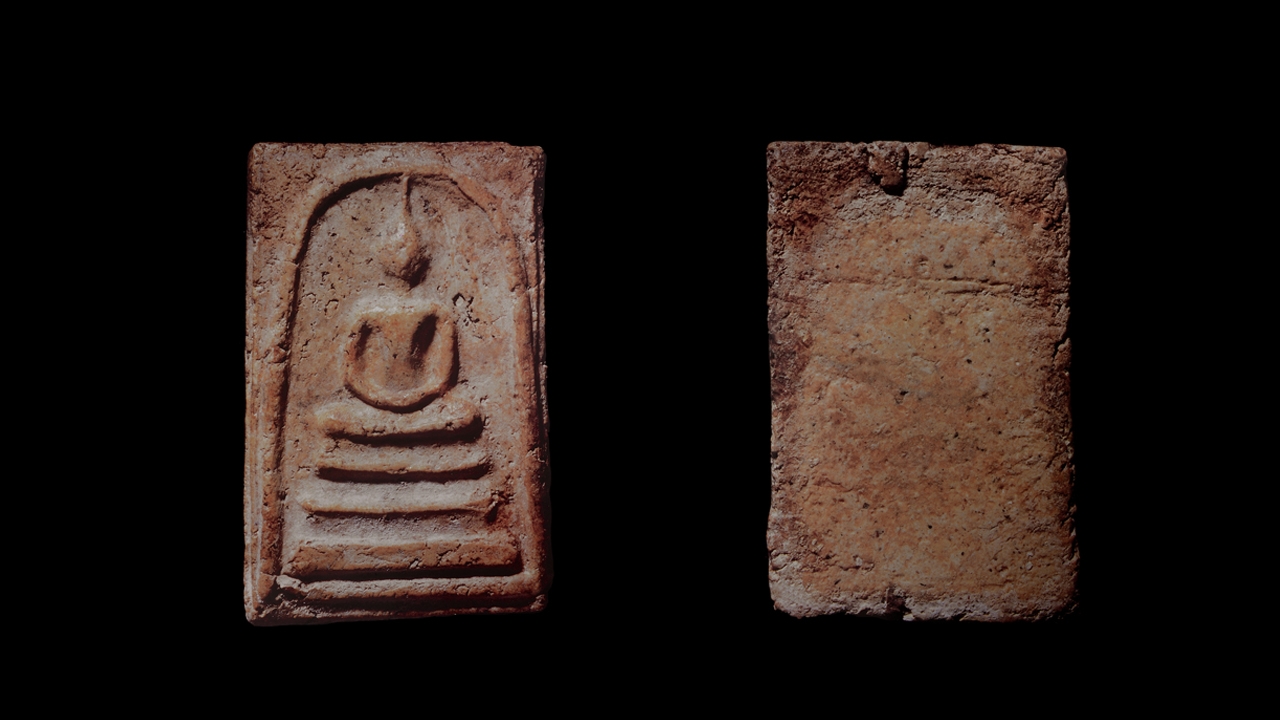
The torso lines, arm lines, and base lines are thinner and sharper than all other types. For more reading, visit the Phra Somdej Science page by Police Major Komsan Sanongpong. Thanks to Assistant Professor Rangsarn Tosuwan for kindly providing images of another master Large-Format Phra Somdej Wat Rakang specimen for educational purposes. Also thanks to the current owner of this beautiful and well-preserved Large-Format, third subtype, tubular chest Phra Somdej Wat Rakang (the anonymous expert divides into four subtypes: principal Buddha image, V-chest, tubular chest, and arch-penetrating hair; subtypes 1 and 3 are rare, subtype 2 is most common, and subtype 4 is moderately common). This specimen is sharply and deeply pressed, soft in texture, without cracks commonly found in hard amulets with lacquer coating, with a white-brown hue and slightly separated mold frame edges. All three authentic Phra Somdej features are present: bud grains, worm trails, and needle hole porosity. The mold shape matches the treatise: cylindrical torso slightly flaring at the bottom, deep arm pits, and a consistent tilt from torso to neck, head, and hair to the left side—a hallmark of the Large-Format. The back combines smooth, condensed, and betel-nut sheath styles, with wrinkles, peeling marks on all four edges, and oil-like stains visible front and back. This specimen serves as an excellent model for studying Phra Somdej Wat Rakang.

Follow other articles in the "Science of Phra Somdej" column. Author

Police Major Komsan Sanongpong, former forensic police officer. Facebook page

– Phra Somdej Science

Read more in the "Science of Phra Somdej" column.