

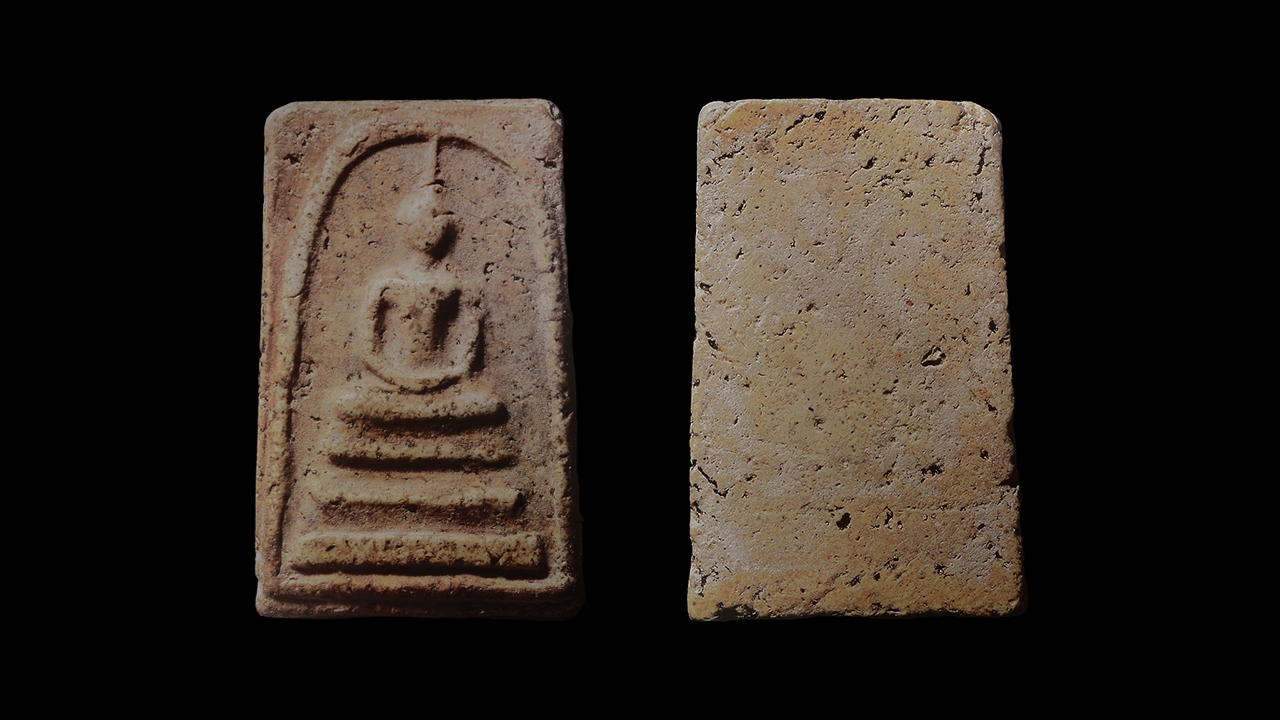
The large mold Wat Rakang Somdej Buddha image, created by the revered Somdej Phra Phutthachan (Toh Prommarangsi), features a design rich with intricate details.In its design,it perfectly blends ancient Thai art with Western art influences that had reached Thailand at that time, embedding subtle relief sculpture details within the design. Now, “The Science of Somdej” invites readers to explore the Triyampawai text to unravel the secrets of the “niche wall” and “frame edge area,” referencing the first volume of the Triyampawai explanatory text as follows...
Triyampawai states that the “niche wall area” is the space inside the arch frame between the Buddha image and the throne, and the arch halo line (the rattan-split arch). The niche wall is fairly smooth but not uniformly so like a drum surface; it shows natural wrinkles from plaster shrinkage.Minor irregularities appear, but nota rough, bumpy surface like an orange peel or wave ridges, which are features of some fakes. When adjusted to align with the Buddha image, one can observe the niche wall surface gently sloping inward from the arch line edgesonall sides, converging toward the Buddha and throne. This slope is nearly level, and the inner arch line edges blend into the niche wall, not forming a harsh boundarylike awall base on concrete, which sharply separates the niche wall from the arch line. Such strict separation characterizes arches that have beendeeply carved with clear definition....
Meanwhile, the “frame edge area” refers to the space between the arch line and the mold frame (Triyampawai likely means the mold's casting boundary, which may be trimmed closely and thus absent on some sides). Generally, space remains at the upper frame corners due to the arch's curve and the top frame cut, which usually doesn't cut right at the arch peak—contrary to the side and base frame cuts, which often do. The frame edge surface level should match or closely approximate the niche wall level. If higher, it indicates that the wall was carved to deepen the mold. The joint between the outer arch line and the frame edge should be smooth, not abruptly cut like the inner arch line to niche wall junction described earlier.
Triyampawai also classifies frames into two types: a plain, smooth frame and a “glass frame” type, whichfeatures small raised parallel linesalong the frame edges, parallel to the top and sides. These raised lines appear mostly at the upper part, as the lower part usually lacks them due to tight frame cuts at the arch edges. The slender raised lines are called “glass frames,” consideredthe most beautiful frame style.For the glass frame type, the frame edge surface at both upper corners is slightly higher than the niche wall surface. The mold thickness is minimal, and the back often shows betel nut sheath marks or algae wrinkles.”
“The Science of Somdej” draws on the above Triyampawai data to elaborate, combined with observations from the accepted standard master Somdej Buddha large mold, as follows...
Regarding the niche wall area or the inner wall inside the arch line, it generally has a smooth surface (similar to the “frame edge area” outside the arch line) but is not as perfectly flat as a mirror or drum surface, as Triyampawai metaphorically describes. Initially, the surface may have resembled a mirror, but over time it changes, showing the “wrinkles of time.” It is not bumpy or wavy (excluding wear from use or unsuitable environments). This is a key, easy-to-check feature for all Wat Rakang Somdej molds, not just the large mold. It can be compared with the master mold, and when contrasted with other surfaces on the Wat Rakang Somdej image—the back and sides—the niche wall surface is the most compact. “The Science of Somdej” has previously explained that this smoothness results from the manufacturing method: pressing a plaster mass formed into a lump sized for one image onto a soapstone mold (sometimes with added material for thickness). This was done as a fairly large flat sheet containing several carved molds. Evidence from soapstone molds used to create ornate Buddha statues during the reigns of King Rama IV and V—contemporaneous with Somdej Toh's Wat Rakang images—supports this. Likely, artisans pressed the mass into the mold by hand, then used wood or similar material to press and tap the back to finalize the form. Empirical evidence supporting this includes the “grooved back” type on the large mold Wat Rakang Somdej, showing marks resembling 2–3 wooden plank edges (anonymously cited in the “Precious” magazine: four back types: smooth back, custard back, betel sheath back, and grooved back). Conversely, pressing a mold onto the mass would not produce a compact front surface. Moreover, the mold type matters: a large soapstone mold would be inconvenient to press onto the mass, or if cut into smaller blocks, pressing onto the mass is easier and more precise—more suitable for detailed works.Such as Wat Rakang Somdej Buddha images..
Pressing the mold onto the mass is likely the method for Wat Bang Khun Prom Somdej, where wooden molds, cut into single blocks for each mold, were pressed onto the mass. This method allows rapid production of many images, suitable for less detailed works.For example,the Wat Bang Khun Prom Somdej, which also shows a key flaw called “flared edges” caused specifically by this pressing method, absent in Wat Rakang Somdej images.

Regarding the “frame edge area,” located between the rattan-split arch and the mold's casting boundary, Triyampawai states that “the frame edge surface level should match or be close to the niche wall surface level; if higher, it indicates carving to deepen the mold.” It also notes, “In the glass frame mold type, the frame edge surface at both upper corners is slightly higher than the niche wall surface.” Observing current large mold Wat Rakang Somdej master images suggests that all have glass frames. Those lacking them likely had the glass frame lines cut off by trimming close to the arch lines or suffered erosion making them invisible.
“The Science of Somdej” further infers that originally the frame edge surface, niche wall surface, and outer surface beyond the glass frame (visible on images trimmed away from the glass frame line, such as the master mold nicknamed “Wide Wings”) were on the same plane—the original soapstone mold surface, which was the highest flat surface when first carved. “The Science of Somdej” has explained this follows the carving method of the artisan guild. The artisan first drew the glass frame or casting boundary lines as a rectangular frame, then shaved the surface inside this frame. The frame edges were scraped into raised ridges representing the casting boundary or glass frame lines. Next, the artisan carved details inside the glass frame, drawing the rattan-split arch line, then scraping the bird’s beak shape from the lower right arch corner upward to the lower right corner of the base’s bottom tier. The base was then carved continuously from bottom to top, then the Buddha image from the torso upward to the hair tip. The rattan-split arch line was carved slightly overlapping the casting boundary line on the left side, a feature “The Science of Somdej” explains is based on perspective principles. Afterwards, the artisan smoothed the surface inside the arch line or niche wall again on some images,resulting in a gradual increase in carving depth from bottom to top to enhance dimensionality and beauty, causing the upper part of the niche wall to be slightly lower than the frame edge outside the arch, and the surface slants inward toward the Buddha image, as Triyampawai observed.. Closing remarks
“frame edge area” contain subtle details akin to secrets within the mold. Understanding these aspects aids in grasping the design background of this Wat Rakang Somdej mold and helps in recognizing the authentic master Somdej Buddha image created by Somdej Toh. “The Science of Somdej”
concludes this installment by compiling the widely accepted evaluation criteria for the large mold Wat Rakang Somdej from the anonymous expert of “Precious” magazine, summarizing 11 key identifying flaws across all sub-molds and 4 additional flaws specific to the second mold, the “V” chest type, as followsFlaw 1
The outer frame lines on all four sides are raised lines. Only the left frame line runs down between the Buddha's elbow and fades into the arch line. Flaw 2
The mold frame line on the Buddha's right side is a raised line running continuously close to the lowest arch line. Flaw 3
The glass house arch line is relatively large and raised, resembling a split rattan line. Inside the arch line is a vertical line from the base, and the Buddha's surface outside the arch slopes slightly. Flaw 4
The face resembles a bael fruit. Flaw 5
Both ears are present, though sometimes faint. Flaw 6
The curved arm attaches to the shoulder; the right shoulder is thicker than the left. Flaw 7
The Buddha's left knee protrudes higher than the first base tier. Flaw 8
The right knee protrudes lower than the first base tier. Flaw 9
The Buddha leans slightly to the right, while the first, second, and third base tiers lean to the left, alternating with the Buddha's tilt. Flaw 10
The wall surface between the three base tiers: between the first and second tiers is level with the base; between the torso and first base, and between the second and third base tiers, the wall surface is higher than the Buddha's surface. Flaw 11
The outer surface outside the arch is slightly higher than the inner surface, barely visible unless the Buddha is tilted. Additional flaws
For the second mold, the “V” chest type, Flaw 12
Between the torso (lap) and arm circles, there is a clear raised area representing the torso, especially prominent from the knees up to the arm circles (the body forms a “V” shape). Flaw 13
Both arms spread wider than in the first mold (similar to the third and fourth molds). Flaw 14
The hair is longer than in the first mold (similar to the third mold). Flaw 15
The top base tier is longer than in the first mold. Further reading is available on the page “Somdej Science” by Police Lieutenant Colonel Komsan Sanongphong, with thanks to Associate Professor Rangsarn Tosuwan for kindly providing images of another master Wat Rakang Somdej Buddha image for educational purposes. Thanks also to the current owner of this beautifully preserved large mold Wat Rakang Somdej, second mold or “V” chest type (anonymously divided into four sub-molds: first mold, main Buddha mold; third mold, cylindrical chest; less common; mostly second mold; and fourth mold, hair piercing arch, somewhat common but less so than second mold). This piece features thick, soft texture with pale yellow-white tone, trimmed close to the casting boundary line. The upper frame line is often slightly separated from the arch line; the left side is usually trimmed tight to the arch line. It exhibits the three authentic Somdej features: grainy relic spots, worm tracks, and needle pore holes. The mold shape matches the reference, with the Buddha tilting slightly leftward extending to the hair tip. The niche wall surface is generally smooth with visible aging wrinkles. The inner arch line edges are perpendicular to the wall, indicating age. The back is smooth with shrinkage wrinkles, cracks, chipping marks along edges, and stains resembling soy sauce residue. It serves as an excellent study model for Wat Rakang Somdej Buddha images. Additional articles can be found in the column
“The Science of Somdej”. Author:
Police Lieutenant Colonel Komsan Sanongphong, former forensic police officer. Facebook page:
– Somdej ScienceRead more in the column