

When discussing ancient Chinese calligraphy brushwork, it is said that the first straight stroke in some characters (such as the number one “—" pronounced “yi”) serves as an indicator of the artist’s mental calmness andtechnicaldynamicsof the master-levelartist who created that artwork.
These statements are accurate, considering that in art, achieving perfection requires extensive practice. Drawing a straight line is one of the most difficult skills to master because the human body is naturally designed to move in arcs due to wrist, elbow, and shoulder joints. Drawing a straight line is thus against this natural motion. The more one tries to draw perfectly straight, the more muscles tense, making direction control harder. Eyes continuously monitor, and the brain commands hand corrections, which can cause small tremors or irregularities.minor irregularitiesThrough rigorous physical and mental training leading to mastery, brush lines become more natural and closer to perfect straightness, progressing to other strokes such as curves. When the artist flicks the brush tip onto canvas, it is like releasing energy under a focused mind through muscles trained millions of times, enabling precise control of every movement. The resulting work exudes artistic beauty, technical uniqueness, and the artist’s spirit. The lines display clarity, firmness, and power.
The story of this ancient Chinese brushwork art closely parallels that of the "printed lines" formed by carving the molds of the Phra Somdej Wat Rakang amulet. The "art of Phra Somdej" deduces from credible evidence that the lines on the soapstone mold come from a highly skilled royal artisan, blending Thai and Western art forms. The mold carving methods align with those of the Ten Craftsmen, as described in theTriyampawaimanual, which states that the mold carver was a royal goldsmith, also called Luang Wijarn Chianai. The "art of Phra Somdej" argues that debates over whether Luang Wijarn Chianai actually existed are less important than the fact that the standard mold Phra Somdej Wat Rakang amulets do exist. They are exquisite sculptures created by master royal artisans or goldsmiths skilled in small-scale carving. Some scholars note that around the reigns of Kings Rama IV to V, several "divine craftsmen" produced mold carvings nearly superhuman in quality. Later mold carvers never matched this level, possibly due to the strict and rigorous training systems of certain agencies at that time.
Regarding claims that royal artisans were officially assigned to assist with Phra Somdej Wat Rakang mold creation and that there were disputes among palace agencies then, there is little supporting evidence. The Triyampawai text notes, "...Somdet Krom Phra Bamrapporapak and a member of the Rear Palace, who served in the Ten Craftsmen department, also assisted with the square mold designs..." Somdet To was a highly respected senior monk across all classes. The amulet creation also had support from several royal family members, especially Somdet Chao Fa Krom Khun Bamrapporapak, who served in the royal palace during King Rama IV's reign and held important positions during King Rama V’s reign. He chaired the royal family and was respected by powerful high-ranking officials then. Thus, it is credible and plausible that royal or goldsmith artisans helped create the Phra Somdej molds. Furthermore, the mold carvers’ knowledge of Western art—such as perspective techniques introduced to the Thai court at the time and incorporated into the amulet design—would logically be learned first by royal artisans.Royal or goldsmith artisans who carved the Phra Somdej Wat Rakang molds were master craftsmen with high-level carving skills, reflected in the printed lines on the amulets. This parallels the confidence and decisiveness seen in Chinese calligraphers’ brush strokes.Every printed line on Phra Somdej Wat Rakang amulets shows the carver’s assuredness when pressing the sharp blade or chisel into the soapstone. A slip could mean discarding the mold and starting anew, similar to a calligrapher who must restart if a stroke is too light or heavy. Each carver has a unique style, like a signature. Those trained in the same workshop likely have similar signatures. The "Phra Somdej signature" theory from the "Art of Phra Somdej" aligns with observations from many teachers who note that the standard mold Phra Somdej Wat Rakang amulets were created by the same artisan or workshop.Observing the "Phra Somdej signature" is difficult, akin to signature verification in forensic work requiring experts and academic theories. Senior expert Ajarn Prakam U-Arun said, "Authentic Phra Somdej amulets are examined like signatures; one can tell by the naked eye if it’s genuine or not. Each piece resembles others but is not identical. Magnifying glasses are used only to check completeness." This follows the same principles as forensic signature verification.

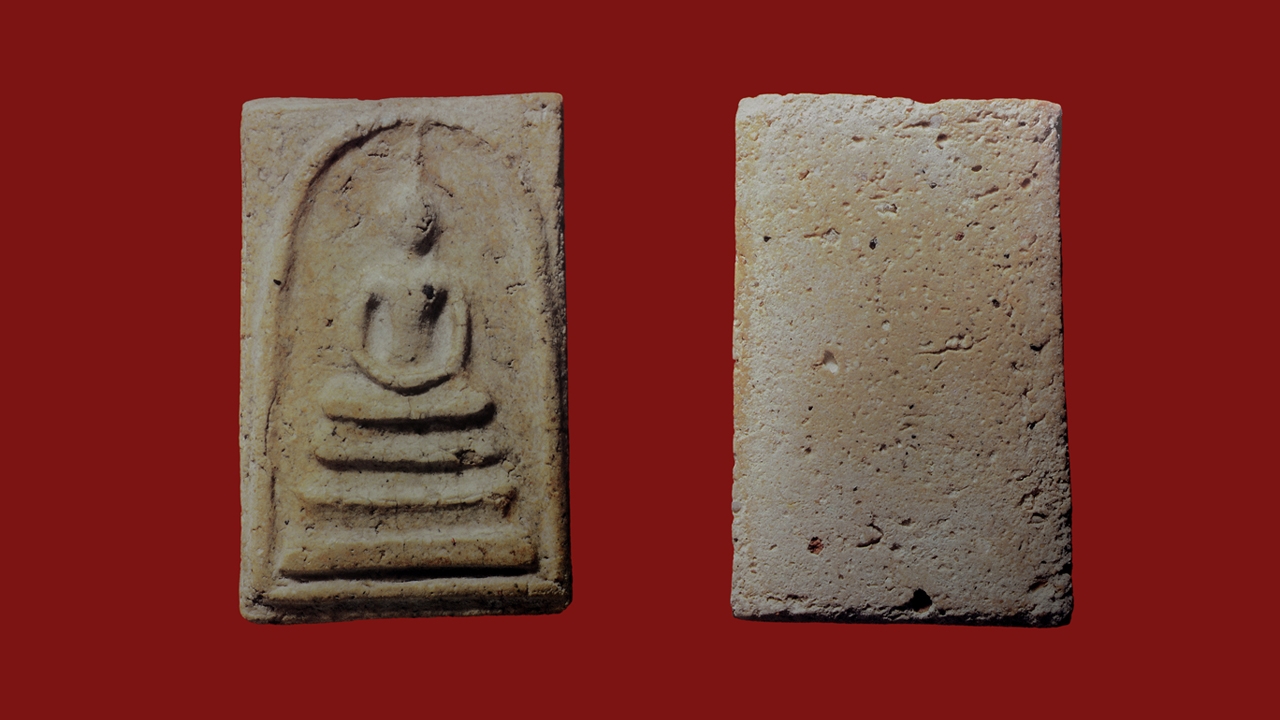
Examining mold defects involves verifying if the amulet’s structure matches the "mold design" (modern artisans call this the "drawing") created by the designer. Though Somdet To created many designs, the five standard molds of Wat Rakang amulets all conform to clearly defined mold designs. For example, the large mold design follows the "perspective" principle. Variations in physical form among amulets of the same mold may result from different mold blocks, carving adjustments, pressing depth differences, removal from molds causing warping, natural shrinkage or wear, or use. However, the "mold defects" referenced by "Art of Phra Somdej" and knowledge from "Niranam" are generally present. Absence often means erosion. "Mold block defects" differ—they are accidental features on the mold block, common in coin-type amulets, like cracks from repeated stamping causing defects in later amulets. Such defects are generally not considered in Phra Somdej studies.The "Art of Phra Somdej" proposes that examining "mold defects" is a foundational step toward understanding Phra Somdej amulets, but truly grasping the "Phra Somdej signature" (and material content) increases the chance of owning a genuine standard mold amulet by Somdet To.The "printed lines" on the soapstone blocks comprise three main parts: the "split rattan arch" lines, the "three-tiered base," and the "Buddha image."A key point isthat according to the aforementioned art theory, the seemingly simplest yet actually most difficult task is carving the split rattan arch lines. Artisans must carefully carve a straight, continuous line transitioning into a curve, maintaining consistent width of the split rattan throughout. Creating a two-dimensional straight line is already difficult, but carving the three-dimensional split rattan arch is much harder. Though carving the "three-tiered base" and "Buddha image" is also challenging, the pressure is less than for the split rattan arch. Variations in line size may go unnoticed by most, but the split rattan arch distinctly reveals the carver’s "mental calmness and technical dynamics." In well-preserved master amulets, this part shows exquisite detail: straight sections resembling flowing water, smooth curves like mountain ridges—impossible for less skilled carvers lacking royal goldsmith-level expertise.
Conclusion
The "printed lines" on the square soapstone mold of Phra Somdej Wat Rakang amulets represent the artistic creations of master royal craftsmen or goldsmiths at the royal court. Each line carved onto the mold embodies the artisan’s technical identity and spirit, visible to devotees of Somdet Phra Phutthachan (Toh Prommarangsi). The printed lines consist of three main parts: the "split rattan arch," the "three-tiered base," and the "Buddha image." According to art creation theory, the area demanding the greatest carving effort is the "split rattan arch," which clearly expresses the artisan’s "mental calmness and technical dynamics." This part is among the hardest to replicate on Phra Somdej amulets. Applying this principle can also assist in evaluating other printed lines on Phra Somdej amulets.
The "Art of Phra Somdej" closes this section by summarizing the evaluation approach for the large mold Phra Somdej Wat Rakang amulet from Niranam of Precious magazine, widely accepted in the amulet community. It lists 11 major defects common to all sub-molds, plus 4 additional defects specific to the second mold, the Agkawi mold.
Defect 1 The outer frame around the Buddha image has raised lines on all four sides; specifically, the left frame line extends downward between the Buddha’s elbow and then fades into the arch line.
Defect 2 The mold’s right frame (Buddha side) has a raised line running continuously close to the lowest arch line.Defect 3The arch line of the glass house is relatively thick and raised, resembling a split rattan line. Inside the arch, a vertical line rises from the base. The base outside the arch slopes slightly. Defect 4 The Buddha’s face resembles a bael fruit (a round shape). Defect 5
Defect 6The curved part of the arm attached to the shoulder shows the right shoulder thicker than the left.Defect 7
The left knee protrudes higher than the first base tier. Defect 8 The right knee protrudes lower than the first base tier. Defect 9
The Buddha figure tilts slightly to the right, while the three base tiers tilt to the left, opposite the Buddha’s tilt. Defect 10
The walls between the three base tiers: the wall between tiers 1 and 2 is level with the base; walls between the Buddha’s pedestal and tier 1, and between tiers 2 and 3, are higher than the base wall. Defect 11
The outer base surface is slightly higher than the inner arch base, barely visible unless the amulet is tilted. Additional defects for the second mold, Agkawi mold
Defect 12 Between the pedestal (lap) and arm rings, there is a prominent raised area representing the pedestal, especially clear from the knee running up to the arm ring, forming a V shape of the torso.
Defect 13 Both arms spread wider than in the first mold, similar to molds 3 and 4.
Defect 14 The Buddha’s hair is longer than in the first mold, resembling molds 3.
Defect 15 The top base tier is longer than in the first mold.
Read more on the Facebook page Phra Somdej Artistry
by Police Lieutenant Colonel Komsan Sanongpong. Thanks to Assistant Professor Rangsarn Tosuwan for kindly providing images of another master Phra Somdej Wat Rakang amulet to share knowledge, and thanks to the current owner of the amulet, a large mold second type or Agkawi mold (Niranam divides into four subtypes: type 1, main Buddha mold; type 3, narrow chest mold—rare; mostly type 2; and type 4, hair piercing arch mold—less common but more than type 2). This beautifully preserved amulet has a thick, soft texture with white tone, trimmed closely near the frame line and close to the split rattan arch on the upper left side (usually trimmed near the arch on the Buddha’s left). It displays all three genuine Phra Somdej features: stupa-like granules, worm tracks, and needle pores. The mold form is correct per references. The Buddha figure tilts slightly leftward, extending to the hair tip. The inner arch wall surface is generally smooth but shows aging marks. The split rattan arch is well preserved, characteristic of all molds, and is key to distinguishing artisan styles. Some wear and erosion, especially on the upper left curve, occur (many large mold amulets share this). The upper right curve narrows slightly, a distinctive feature of large mold Wat Rakang amulets. The arch is generally larger than those of Phra Somdej Wat Bang Khun Prom. Some inner arch edges are perpendicular or slightly indented, indicating age. The back is smooth with wrinkles and fine cracks, showing some chipping on edges. This amulet is an excellent study model for Phra Somdej Wat Rakang. More articles are available in the "Art of Phra Somdej" column. Author
Police Lieutenant Colonel Komsan Sanongpong, former forensic police officer. Facebook page
– Phra Somdej Artistry
Read more columns in
Art of Phra Somdej