

Column: “The Science of Somdej Amulets”, We extend our deepest condolences on the passing of Khun Ying Praneet Sin Watcharaphon, Chairperson of Watcharaphon Co., Ltd., Chairperson of the Thairath Foundation, and Chairperson of the Thairath Group. She was a revered figure in Thailand's mass media industry. Along with her husband, Director Kamphon Watcharaphon, founder of Thairath newspaper, they made countless contributions to society and the nation. One of their most impressive legacies is the ongoing support and development of the Thairath Wittaya school network, with 111 schools nationwide, under their leadership. Thairath has grown through challenging times to become the country's fourth highest-ranked newspaper, steadfastly standing as a beacon of freedom for the people, shining even in the darkest days from past to present.
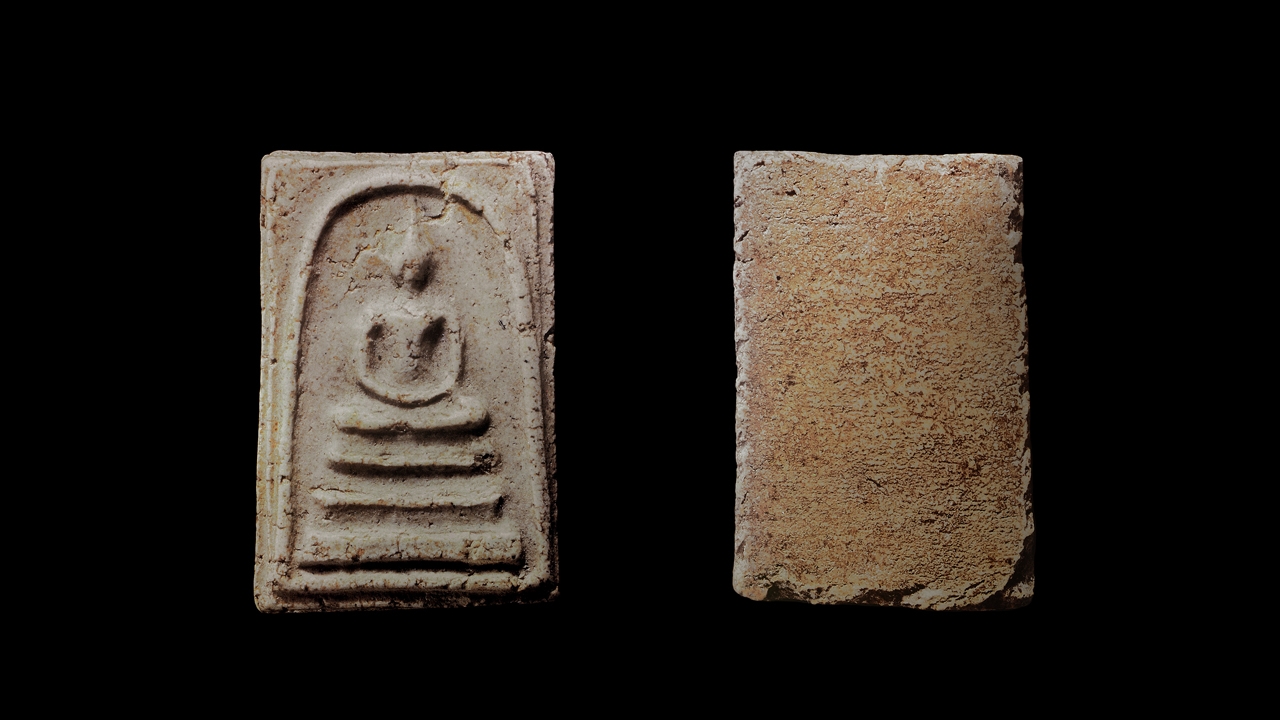
At this time, “The Science of Somdej Amulets” invites readers to consider another important unique feature of Wat Rakang Somdej amulets: the “back print,” or the characteristics of the amulet’s back surface, especially certain traits that could be considered secret defects.
The texture of the back surface of Somdej amulets by Somdej Toh is another very important aspect when evaluating standard print group Somdej amulets. Senior Somdej amulet expert Ajarn Prakam U-Arun once said, “Those highly skilled can identify authenticity and print type just by looking at the back.” Many experts concur that the back of Wat Rakang Somdej amulets is “impossible to forge.”
Triyampawai explained in the book "Priotthathabian Haeng Phra Kherng," Volume 1, that there are eight natural texture characteristics on the back of Somdej amulets:
1. Pin-tip pores, These are tiny holes about the size of a needle tip, commonly found on the back surface in varying amounts and clarity.
2. Crab track marks, These are marks caused by external force on the surface, larger than pin-tip pores. They appear as pairs of holes running side by side, often extending diagonally from one edge to the other, either slanting upward or downward. (The exact meaning of “crab track” varies among Somdej amulet experts; for example, Nirnam includes parallel cracks along the back edge as part of this category.)
3. Worm trails, These resemble crab tracks but are single lines, slightly wider and deeper than crab tracks, with a natural flowing pattern. Some trails curve naturally. These marks form while the material is still soft. (Some teachers say worm trails represent organic material peeling off the surface, commonly seen on Wat Rakang Somdej amulets.)
4. Algae wrinkle or sponge bubble marks, Wrinkles across the back surface, sometimes partial, making it uneven. The texture resembles fine algae wrinkles (not caused by soaking the amulet). Some areas show small round patches with pin-tip pores in the center, called “sponge bubbles.”
5. Betel nut sheath marks, Similar to algae wrinkles but with thicker, deeper ridges and grooves, resembling betel nut sheaths. These appear both vertically and horizontally.

6. Sangkaya marks, Usually appearing in the central back area, these are overlapping wrinkle patterns spreading in concentric circles like ripples on water. The edge of each wrinkle ring may include fine crack lines, algae wrinkle marks, and pin-tip pores, or sometimes just a single ring.
7. Fingerprint marks, Impressions of the thumbprint of the amulet maker, similar to marks on other ancient amulets like Suphan powder amulets and Nang Phaya. Some ancient texts note that the Somdej amulet with Garuda headprint shows paired fingerprint marks more frequently than others. Such amulets have been found in recent times as well.
8. Crack lines, Triyampawai notes these are quite abundant, appearing as fine cracks like dry paddy field cracks in summer (different from a herringbone pattern). These lines are irregular and winding naturally with varying thickness.
Nirnam also discussed this in “Precious” magazine by Assistant Professor Rangsarn Tosuwan, stating: “The final point to check is the back, considered the master teacher… No forger can replicate it because the back shows natural shrinkage and contraction over the amulet’s age.” Nirnam classified Somdej amulet back prints into four types based on visible features: “Smooth back (flat back),” “Board back,” “Sangkaya back,” and “Betel nut sheath back.” Nirnam explained that Wat Rakang Somdej large print amulets have all four back types. The pagoda print usually has a smooth back (except the small pagoda print, which often has a Sangkaya back). The bud lotus print found at the time had smooth and betel nut sheath backs. The base print appeared with smooth, Sangkaya, and board backs. The Bodhi leaf print currently mostly has smooth backs. However, “The Science of Somdej Amulets” believes a single amulet may show mixed back textures, containing more than one type.
Nirnam also noted that many large print Wat Rakang Somdej amulets tend to have a slight concave curve resembling a small elephant belly, with the back surface forming a shallow hollow. Wat Bang Khun Prom Somdej amulets also often curve but in the opposite direction.
“The Science of Somdej Amulets” infers that this shape results from the amulet-making process. For Wat Rakang Somdej amulets, the material is pressed into the mold’s cavity, possibly initially pushed by fingers (some amulets show fingerprint traces on the back). Then a wooden board is tapped to firmly compact the material into every mold corner, forming the diverse back patterns. This method produces sharp detail, though some amulets show slight line shifts or indentations, likely caused by hand movement when removing the amulet from the mold. Removing the amulet probably involves using a blade or similar tool, which may cause the concave shape (whether trimming the amulet edge on the mold from back to front or trimming outside the mold from front to back). Pulling the amulet out before trimming outside the mold likely causes more concavity. Some thicker amulets may not curve at all.into the mold's cavity,where the amulet material is pressed down.
Nowadays, some Wat Rakang Somdej amulets display significant line distortions making their shape appear distorted, though these are rare (excluding fakes). This likely stems from early mold carving trials where the craftsman did not intend to produce a functional mold. Considering the heavy distortion lines, the mold was likely deliberately carved that way rather than distorted during amulet removal. These distorted amulets do not show flared edges (which usually occur when pressing the mold onto the material). “The Science of Somdej Amulets” leans toward the idea that these distorted amulets were made with the Wat Rakang method—pressing the material into the mold—rather than pressing the mold onto the material, which is likely the method used for Wat Bang Khun Prom Somdej amulets.
Nirnam also highlighted another important secret defect on the back of Wat Rakang Somdej amulets, especially large prints: the edges on all four sides, even with crab track and chipping marks, are distinctly raised, and the amulet center is also raised, with a lowered slope between the center and edges. This unique feature appears on every large print Wat Rakang Somdej amulet.
“The Science of Somdej Amulets” infers this phenomenon arises because the center of the amulet is thicker, where the craftsman carved the amulet and its three-tiered base. When the material contracts, the thicker center contracts less than the thinner edges. Moisture such as water and oils evaporate through the outer layer more easily and quickly, causing the edges to contract first. The thick center retains moisture longer and its outer surface hardens, maintaining shape and resisting contraction like the edges. The slight raised ridges along the four edges result from cutting or trimming the amulet edges with chisels or blades, causing those distinctive marks when the tool is pulled back.Tang Yiwu(Note: This is a name or term that appears isolated; no further context provided.) This distinctive back texture of large print Wat Rakang Somdej amulets can be summarized as a dimensional pattern of “raised-sunken-raised.”
The back print or back characteristics of Wat Rakang Somdej amulets are key indicators in authenticating genuine Somdej amulets by Somdej Phra Phutthachan (Toh Prommarangsi). Various teachers have presented methods for evaluating the back’s texture. Triyampawai identified eight types, while Nirnam divided them into four main types. Additionally, Nirnam explained a unique feature of large print Wat Rakang Somdej backs is the “raised-sunken-raised” dimensional pattern found in every amulet.
Considering the shape and production process, it is clear that the back print or back surface of Somdej amulets “cannot be forged.” Studying the back prints of Wat Rakang Somdej amulets helps in identifying genuine amulets.
“The Science of Somdej Amulets” concludes this article by compiling Nirnam’s widely accepted guidelines for examining large print Wat Rakang Somdej amulets, listing 11 key defects common to all subtypes and 4 additional defects specific to the 2nd print, the A-Kawi print, as follows:
Defect 1 The outer frame on all four sides of the amulet forms a raised line; notably, the left frame line runs down to the space between the amulet’s elbow joints and then disappears into the arch line.
Defect 2 The right frame line (of the amulet) is a raised line running continuously adjacent to the bottom edge of the arch line.
Defect 3 The arch line (Kaeo pavilion) is a relatively large raised line resembling a split rattan vine. Inside the arch line is a vertical line extending from the base. The amulet surface outside the arch slopes slightly.
Defect 4 The face resembles a bael fruit.
Defect 5 Both ears are present but may be indistinct on some amulets.
Defect 6 At the arm curve joining the shoulder, the right shoulder is thicker than the left.
Defect 7 The left knee protrudes higher than the first tier of the base.
Defect 8 The right knee protrudes lower than the first tier of the base.
Defect 9 The amulet leans slightly to its right, while the three base tiers lean to the left, alternating with the amulet’s tilt.
Defect 10 The walls between the three base tiers: the wall between the 1st and 2nd tiers is level with the base surface, but the walls between the pedestal and 1st tier and between the 2nd and 3rd tiers are higher than the amulet surface.
Defect 11 The outer surface outside the arch is slightly higher than the inner surface, barely visible except when tilting the amulet.
Additional defectsForthe 2nd print, the A-Kawi print,
Defect 12 Between the pedestal (lap area) and the arm ring, a raised material clearly shows the pedestal, especially from the knee extending to the arm ring, forming a “V” shape.
Defect 13 Both arms spread wider than in the 1st print (closer to the 3rd and 4th prints).
Defect 14 The topknot (kesa) is longer than in the 1st print (close to the 3rd print).
Defect 15 The top tier of the base is longer than in the 1st print.
Read more at the page Somdej Amulet Science by Police Lieutenant Colonel Komsan Sanongphong, and thanks to Assistant Professor Rangsarn Tosuwan for kindly providing images of a renowned master Wat Rakang Somdej amulet for educational purposes. Thanks also to the current owner of this amulet, a large print, 2nd print or A-Kawi print (Nirnam divides into 4 subtypes: 1st print - main Buddha, 3rd print - barrel chest, rare; mostly 2nd print; 4th print - kesa protruding beyond arch, moderate in number). This amulet is very beautiful, well-preserved, with soft texture and white sheen, trimmed away from the print frame, showing clear frame lines on all four sides. It displays all three authentic Somdej features: stupa particles, worm trails, and pin-tip pores. The print matches the reference. The arch interior wall is mostly smooth but shows worm trail textures. The split rattan arch line is intact, characteristic of all Wat Rakang prints, with slight erosion especially on the upper left curve (common in large prints). The upper right curve slightly recedes, a distinct feature of large prints. Some inner arch edges are perpendicular or slightly inset, indicating age. The back is of the betel nut sheath type with “raised-sunken-raised” dimension, a hallmark of large prints, showing wrinkles and crack lines, with crab track marks (chipping). This amulet serves as an excellent study model for Wat Rakang Somdej amulets. Read more articles in the column “The Science of Somdej Amulets.”
Author Police Lieutenant Colonel Komsan Sanongphong, former forensic police officer
Facebook page –Somdej Amulet Science