

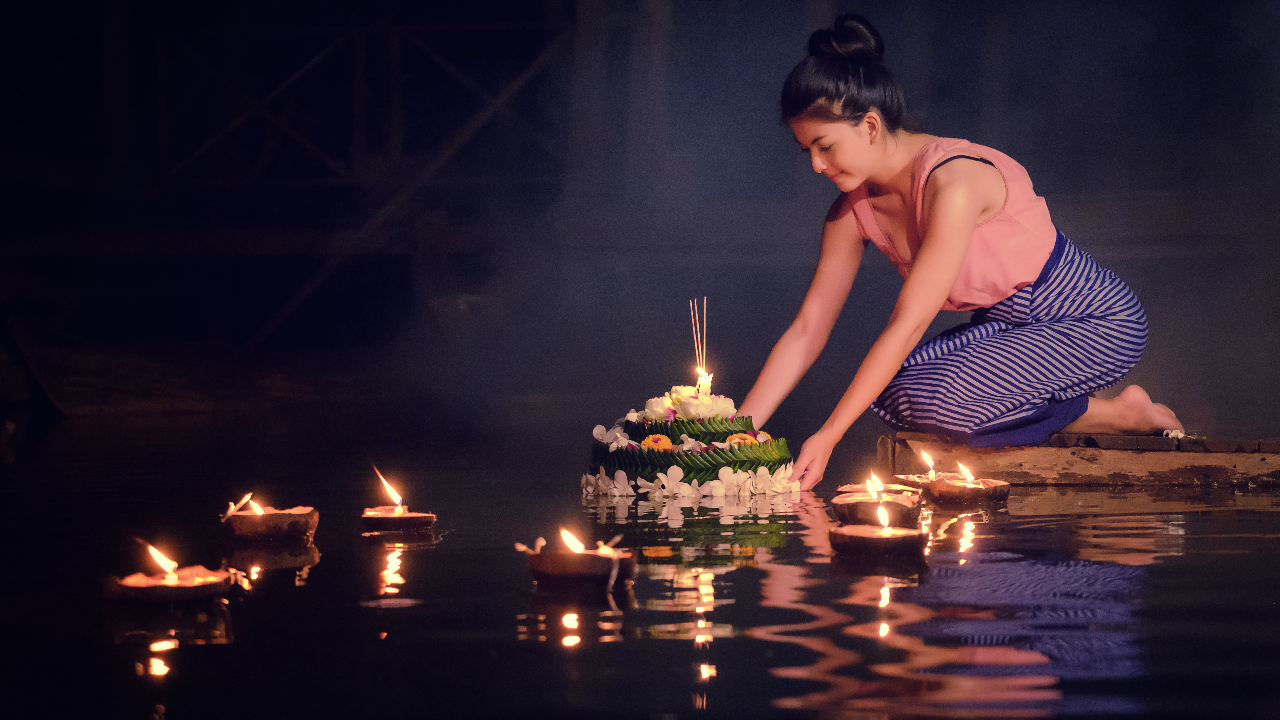
When is Loy Krathong Day 2026? This year, Loy Krathong Day falls on Tuesday, 24 November 2026. It is an important Thai tradition observed on the 15th lunar day of the 12th month, where people float krathongs made from natural materials on rivers to pay respects and apologize to the water goddess, Mae Khongkha. But have you ever wondered? A brief history of Loy Krathong What is its origin? What stories and legends are connected to Loy Krathong? Thairath Online has gathered essential knowledge for you.
The beginning and history of Loy Krathong There is no clear evidence pinpointing when Loy Krathong first began, but it is believed that the practice is not unique to Thai culture. Similar customs appear across various Asian cultures connected to religious beliefs, especially Buddhist and Brahmin traditions, where floating krathongs serve as offerings to revered entities. There are several legends about the origin and history of Loy Krathong; here are three examples.
Beliefs regarding Loy Krathong as worship of the Buddha's footprint come in many versions. Some say it commemorates the Buddha’s return after visiting his mother; others view it as honoring the Chulamani Chedi. Many Buddhists also link the tradition to a story from the Buddha’s time.
According to legend, when the Buddha accepted a bowl of sweet rice pudding from the lady Sujata, after eating, he floated a golden tray on the water and made a vow: if he would become a fully enlightened Buddha in the future, the tray would float upstream. It did, until the Naga serpent of the underworld saw it, became devoted, and asked the Buddha to leave his footprint on the bank of the Neranjara River so the Nagas could worship it.
Upon hearing this, Sujata brought a tray with incense and flowers to worship the Buddha’s footprint as well. This became the origin of floating krathongs as a Buddhist offering every full moon of the 12th lunar month, a custom that continues today.

Followers of Brahmin-Hindu beliefs perform ceremonies floating lanterns to honor Ishvara, Narayana, and Brahma. Later, Buddhists adapted this into floating lotus-shaped krathongs on the water to pay homage to the Buddha’s footprint instead.
Another belief tells that King Ashoka wished to build 84,000 stupas corresponding to the 84,000 teachings in the Tripitaka but was obstructed by evil forces. The monk Upagupta sought help from the Nagas, who defeated the demons. Floating krathongs on the full moon night is thus seen as honoring the Nagas who protected Buddhism.

It is believed that the Loy Krathong history familiar to most Thais is the legend of " Nang Noppamas floating krathong " a semi-legendary tale from the royal text "Tao Sri Chulalak". Nang Noppamas was said to be a consort of King Ramkhamhaeng of Sukhothai and the noblewoman who invented the lotus-shaped krathong used in royal floating lantern ceremonies, which pleased the king and was decreed to be continued ever since.
However, there is historical debate suggesting thatthe Nang Noppamas legend may have been added later to the "Tao Sri Chulalak" text,because the language style is more modern than that of the Sukhothai period. Some therefore believe the story was created in the early Rattanakosin era. The history of Loy Krathong in the Sukhothai era and the Nang Noppamas legend remain subjects of ongoing discussion.

Nevertheless, although the history of Loy Krathong 2026 includes various legends and stories, and floating krathongs is not limited to Thai culture alone, the combined influences have shaped what is now known as " Loy Krathong Day ", reflecting the Thai people’s enduring connection to water from past to present.
Related news