

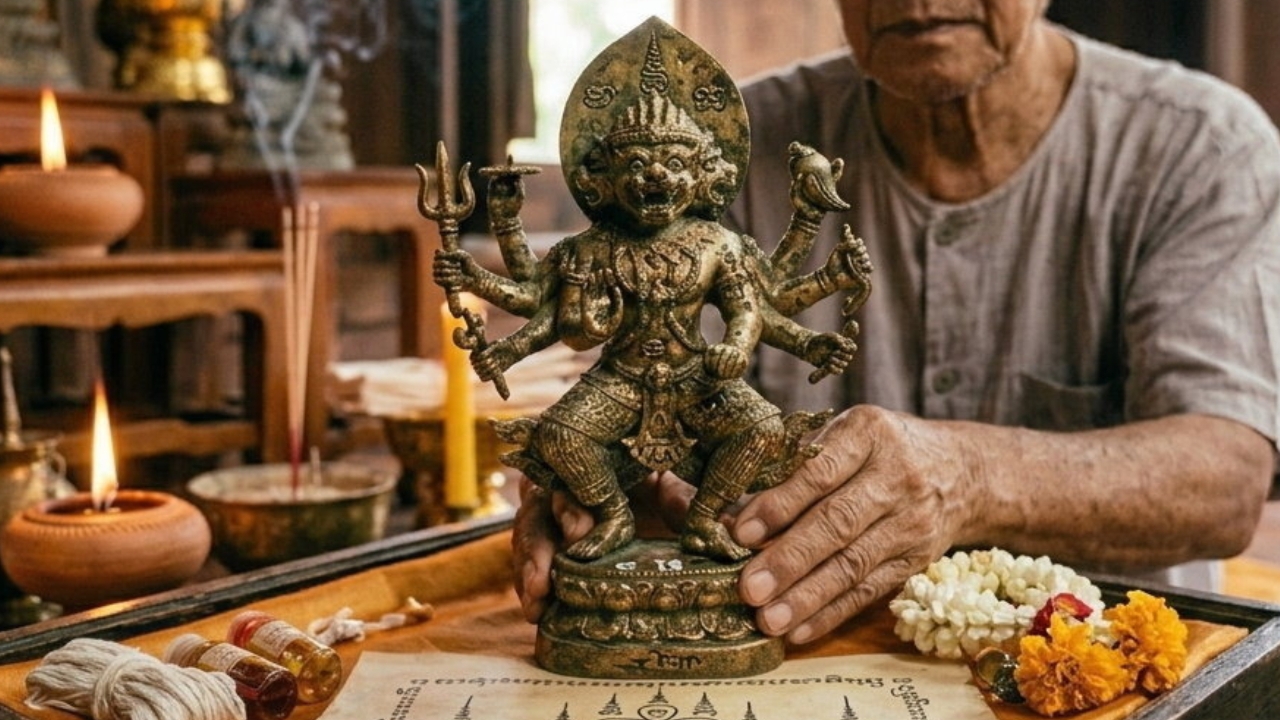
"Hanuman" Hanuman is not just a character in the Ramakien epic but a symbol of loyalty, strength, and success. For those facing obstacles or seeking to enhance their prestige, these tips on effective Hanuman worship are indispensable.
When you mention "Hanuman" everyone likely thinks of the powerful white monkey. However, Hanuman's origins have interesting historical and literary roots, divided mainly into two versions: the Indian Ramayana and the Thai Ramakien.
1. Thai version (Ramakien): Son of the Wind God and Suvannamaccha
In Thai literature, Hanuman originates from Suvannamaccha, who was cursed by her mother to stand on one foot, suspended by the wind at the edge of the cosmic mountain. Lord Shiva then commanded the Wind God (the deity of wind) to send a divine weapon into her mouth to conceive a child destined to be Rama's chief warrior. Upon birth, Hanuman leapt from his mother’s mouth, radiated a brilliant aura, possessed four faces and eight arms, adorned with earrings, diamond fur, and crystal fangs, and most notably, "the sky, stars, and moon bow to him." He was granted this power.

2. Indian version (Ramayana): Avatar of Lord Shiva
In Indian scriptures, Hanuman or "Hanumanji" is revered as a deity and considered the 11th avatar of Lord Shiva, incarnated to assist Lord Vishnu (Rama) in defeating the demon king Ravana, with the Wind God acting as his godfather.
The difference is that the Indian Hanuman is more reserved, observes strict vows, and symbolizes utmost gratitude and faithful service.
In belief, "Hanuman" is the supreme monkey king, an avatar of Lord Shiva, immensely powerful, intelligent, and immortal. Worship of Hanuman is popular among those seeking career advancement, especially civil servants, military, police, and business owners managing people.
Proper Hanuman worship is believed to bring benefits in various aspects:

It is believed to channel energies of "swiftness, victory, and great charm." Selecting the Hanuman form that matches your birth day further boosts these energies, for example:
Sunday Hanuman with eight arms performing miracles, boosting power and prestige to inspire awe, and aiding spiritual strength.
Monday Hanuman swallowing the pavilion, enhancing compassion and protecting your destiny for smoothness.
Tuesday The most compatible day: Hanuman carrying the battle flag, enhancing victory, competition, and determination.
Wednesday Hanuman offering a ring, strengthening negotiation skills, wit, and favor from superiors.
Thursday Hanuman meditating or joining bodies, improving wisdom, invulnerability, and auspiciousness.
Friday Playful Hanuman (engaging in love), boosting charm, popularity, and harmonious relationships.
Saturday Hanuman conquering demons, empowering victory over severe obstacles and remedying misfortune.
Hanuman worship can be done daily, but most commonly on Tuesday or Saturday, with the following offerings prepared:
Clean water (never omitted).
Fruits such as ripe Namwa bananas or young coconuts.
Flowers, commonly marigolds or red roses.
Sweets such as Thong Yip and Thong Yod (no savory foods allowed).
Five incense sticks and one pair of candles.
Precautions. According to Brahmin-Hindu belief, Hanuman worship strictly forbids offering meat, and worshippers should conduct themselves truthfully.
(Begin by chanting Namo three times)
"Om Phong Phlai Phanor Mani Mama Nama Pata Kapa Pasa Valalako Phong Phlan Sattru"
(Chant 3, 5, or 9 times as preferred)
Hanuman's core mantra. Recite to invoke concentration, energy, and confidence before undertaking great tasks.
"Yatama A Hanumana Nasang Satang"
Ancient belief holds that worshippers should remain virtuous and grateful to their parents and teachers, which are core values Hanuman upholds. If these are followed, the mantra's power and worship will bring smoothness and swift success in life.
Thanks to the images from the column“Above the Sky, Beneath the Earth”by Rak-Yom