

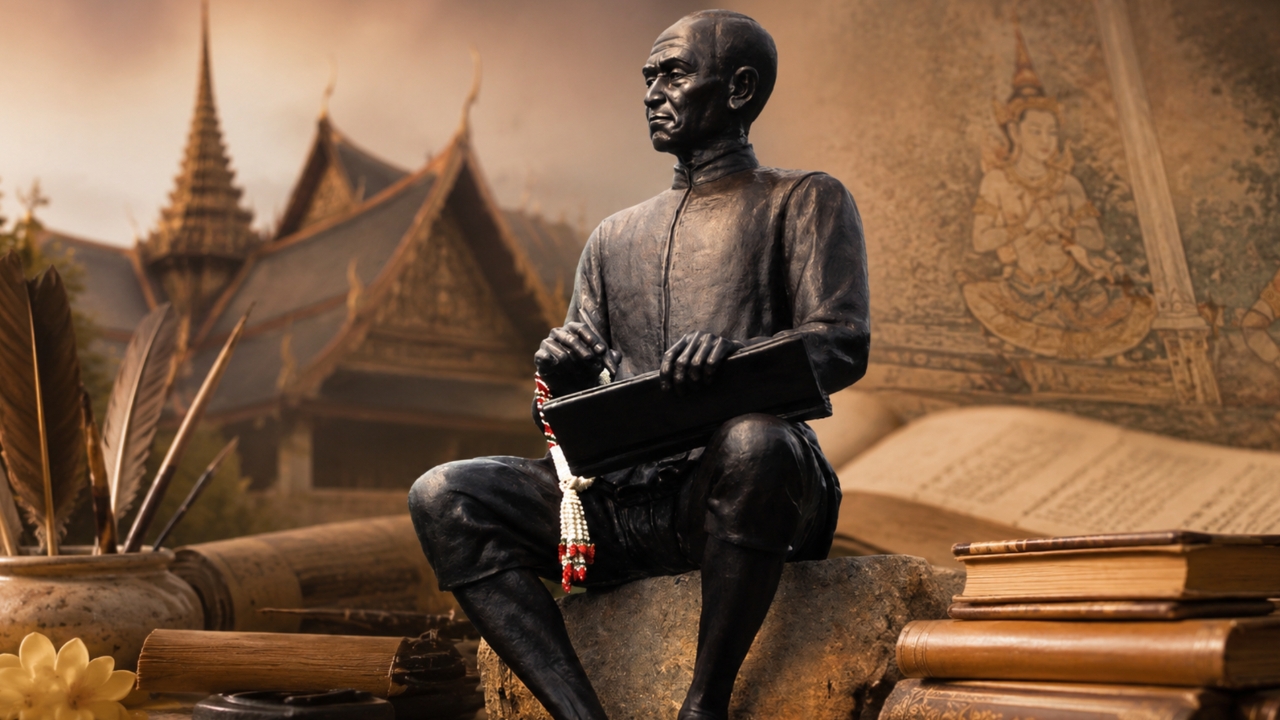
Sunthorn Phu Day 2026 GMT+7, falls on June 26 every year. Thai people collectively commemorate “ Sunthorn Phu ,” the great poet revered as one of Thailand’s most significant literary figures. His works are not only studied by students in classrooms but also deeply reflect the ideas, lifestyles, and values of past Thai society. UNESCO has honored him as a world important literary figure.
Sunthorn Phu —later bestowed the noble title “ Phra Sunthorn Voharn ” (Phu)—was born on June 26, 1786, in the early Rattanakosin period. His original name was “Phu.” His father was from Klaeng District, Rayong Province, while his mother served in the rear palace, allowing Sunthorn Phu to grow up and study within the royal court environment from a young age.
Sunthorn Phu’s notable talent was his language and poetic skills, which gave him opportunities to serve in the royal court and earn fame through his poetry. He gained the trust of several monarchs and created many Thai literary works, playing a key role in Thai poetry. He earned the nickname “Poet of Four Reigns” because he lived through the reigns of four kings:
As a young man, Sunthorn Phu began to demonstrate outstanding poetic talent. His early noted work was “ Nirat Phra Bat ,” which beautifully showcased his language and descriptive skills.
During King Rama II’s reign, he joined the royal scribes department and was promoted to the noble title “ Khun Sunthorn Voharn ” in recognition of his excellent literary abilities. His life included periods of both prosperity and hardship before he ordained as a monk for several years, during which he produced many important works.
In the reign of King Rama IV, he was again granted the noble title “ Phra Sunthorn Voharn ” and served until his death in 1855 at age 69.

Sunthorn Phu’s nine travel poems (Nirat):
- Nirat Mueang Klaeng (1806)
- Nirat Phra Bat (1807)
- Nirat Phu Khao Thong (circa 1828)
- Nirat Suphan (circa 1831)
- Nirat Wat Chao Fa (circa 1832)
- Nirat I Naeo (believed to be from King Rama III’s era)
- Ram Phan Pilap (1842)
- Nirat Phra Prathom (1842)
- Nirat Mueang Phet (1845)
Five poetic tales:
Sunthorn Phu’s five poetic tales:
- Khobut
- Phra Aphai Mani
- Phra Chai Suriyah
- Laksanawong
- Singha Kraiphop
Three collections of proverbs:
- Sawatdiraksa
- Phleng Yao Tawawot
- Proverbs Teaching Women
Three plays and long narrative poems:
- Play Aphai Nurat
- Long narrative poem Khun Chang Khun Phaen, Birth of Phlai Ngam episode
- Long narrative poem Royal Chronicles
Four lullabies:
- Lullaby from Phra Aphai Mani
- Lullaby from Khobut
- Lullaby from Chap Rabam
- Lullaby from Kaki
Though centuries have passed, Sunthorn Phu’s works are still continuously used in teaching Thai language because they help students practice
Moreover, many of his compositions convey lessons about gratitude, honesty, perseverance, and wise living, which remain applicable today.

Thailand has designated June 26 every year as “ Sunthorn Phu Day ” to honor the contributions of this great poet. Schools, universities, and various organizations often hold activities related to the Thai language and literature, such as poetry contests, recitations, and exhibitions about Sunthorn Phu’s life and works.
Therefore, studying the works of Sunthorn Phu is not just about literary study for exams but also about learning the value of the Thai language, creativity, and life lessons from a role model who exemplified dedication and a love of learning.