

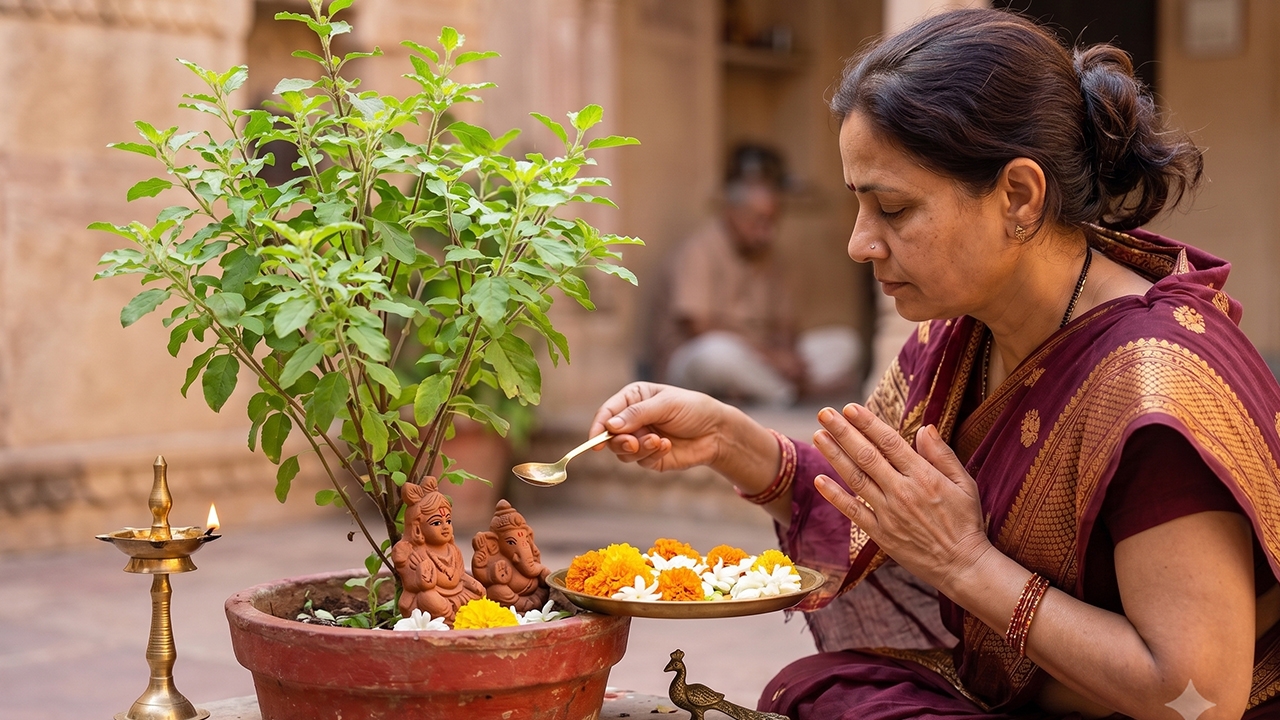
For Thai people "Holy basil" might be just a common popular dish ingredient found in typical street food stalls, but in the Indian subcontinent, the holy basil plant or what Hindus call "Tulsi" (Tulsi) is regarded as one of the highest sacred items and is a plant with great significance in daily life, honored as the "queen of herbs."
Many may have noticed in documentaries or Indian series that almost every Hindu home has a small altar with a tulsi plant placed in the center or at the front of the house. The question is, why has this plant become such a highly respected object of worship in Hindu-Brahmin religion?
According to the Hindu Purana scriptures, the tulsi plant, or Mother Tulsi, is not an ordinary plant but an avatar of Goddess Lakshmi (the consort of Lord Narayana, or Vishnu), the goddess of wealth, fortune, and virtue.
The legend says Mother Tulsi was deeply devoted to Lord Vishnu, who granted her the blessing to incarnate as a sacred plant on Earth, so humans could worship her. It is said that He will not accept any offerings from devotees if the ritual does not include "tulsi leaves" as part of the ceremony.
In worship ceremonies of Vishnu or Krishna, Hindus make garlands from tulsi leaves as it is believed to be His favorite. Planting tulsi at home symbolizes inviting Goddess Lakshmi to bless the household with peace and prosperity.

The belief in tulsi in India runs so deep there is a religious festival called "Tulsi Vivah" held annually in October or November. Hindus perform a symbolic wedding between the tulsi plant (representing Mother Tulsi) and a shaligram stone or idol of Lord Vishnu.
This ritual marks the beginning of the wedding season across India. It is believed that families without daughters who conduct this ritual by giving the tulsi plant at the symbolic wedding receive blessings as if they had actually given their own daughter in marriage—considered a great merit.
Beyond the religious aspect, ancient Indian ancestors used faith as a way to protect this highly valuable medicinal herb. The Indian Ayurveda texts describe Indian tulsi (Holy Basil) as having many medicinal properties, such as
in healing | medicinal benefits and uses |
for the respiratory system, | relieving cough, sore throat, reducing fever, and fighting colds. |
For the immune system, | it has strong antioxidant properties that help reduce cellular stress. |
For the environment, | tulsi leaves repel mosquitoes and insects and help purify the air around the home. |
The requirement for every home to have a tulsi altar and to water and care for it morning and evening was an ancient strategy to ensure every family had this versatile medicinal herb available for emergencies and to maintain a healthy living environment.
Thus, the Indian practice of worshiping the tulsi plant is not mere superstition but a harmonious blend of religious faith, respect for nature, and ancient medical wisdom passed down for thousands of years.