

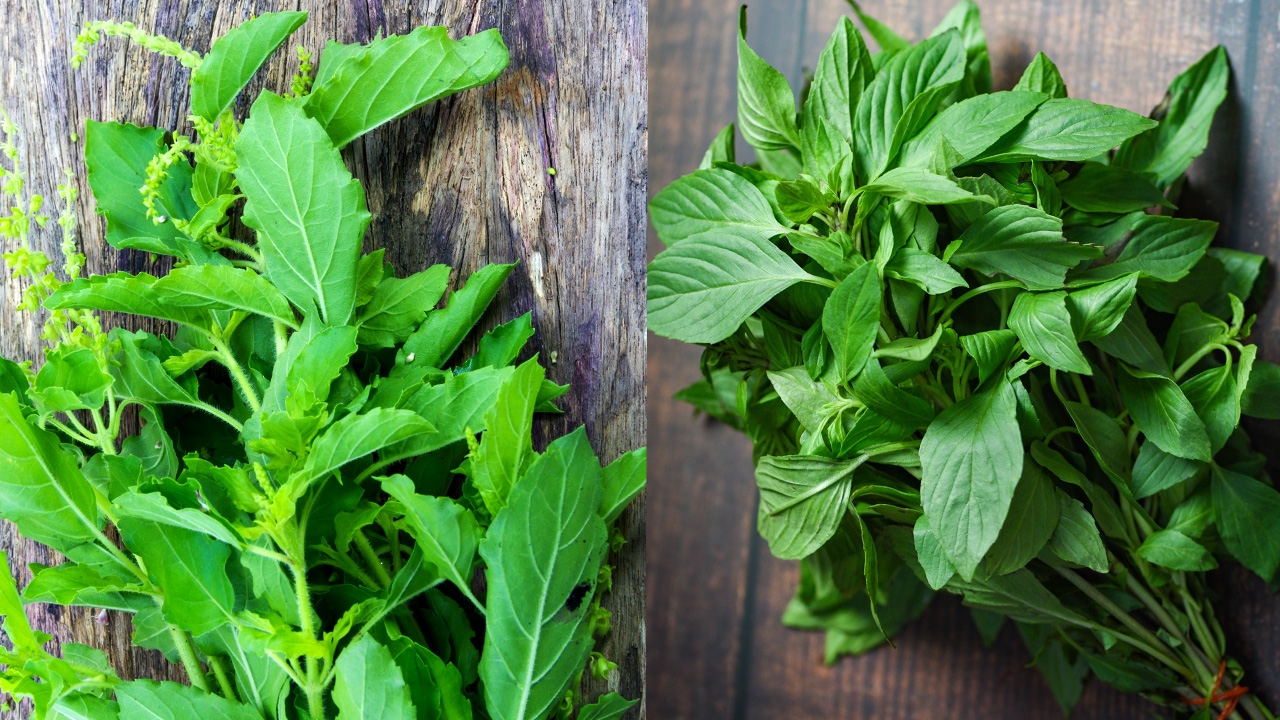
Holy basil and Thai basil are kitchen herbs with unique aromas and flavors that not only enhance taste but also serve as "common stomach remedies" Let's explore their differences and how to choose the best one for your dishes to maximize benefits.
The Thai kitchen staples "holy basil" and "Thai basil" are essential ingredients that bring distinctive flavors and aromas to a variety of Thai dishes. Although both belong to the same family (Lamiaceae) and have similar-looking leaves that often cause confusion, they differ clearly in taste, scent, and medicinal properties.
According to the Department of Thai Traditional and Alternative Medicine, Ministry of Public Health, both herbs contain beneficial essential oils but act differently. This article delves into their differences to help you choose appropriately and enhance your meals.
Beyond their indispensable role in Thai cuisine, from the perspective of traditional Thai medicine, these two herbs are regarded as "common stomach remedies" that you should grow at home, thanks to their outstanding effects on the digestive system.
Holy basil is a remedy for bloating. Its key compound, eugenol, stimulates bile secretion to aid digestion, especially of fatty foods. When eating spicy dishes or fatty meats, holy basil helps reduce bloating, indigestion, expel gas, and relieve abdominal discomfort effectively.
Thai basil helps relax muscles and relieve gas. Its essential oils reduce muscle spasms in the digestive tract, easing cramps and indigestion. Consuming coconut milk curries with Thai basil helps reduce greasiness and lightens the stomach's workload.

Holy basil has jagged leaf edges and comes in white and red varieties. Its distinctive pungent and spicy aroma effectively masks strong animal odors in cooking. Historically, holy basil has been used as a warming herb in Thai medicine to balance body elements.
Thai basil has smoother leaves with less jagged edges and usually has reddish-purple stems. Its scent is sweet and fragrant, similar to licorice or star anise, milder than holy basil, and its taste is cooler. Thus, it is commonly added to spicy curries and served fresh as a side vegetable.

Characteristic | Holy basil | Thai basil |
| Leaf and stem appearance | Leaves have clearly serrated edges with small hairs; stems can be green (white holy basil) or reddish-purple (red holy basil). | Leaves are smooth with slightly jagged edges and a glossy surface; stems are usually dark reddish-purple. |
| Aroma and taste | Strong, pungent, and spicy. | Sweet, mild fragrance similar to licorice or star anise; cooler taste. |
| Key medicinal properties | Relieves gas, bloating, indigestion; warming effect; alleviates cold symptoms. | High in beta-carotene; supports eye health; aroma helps relieve stress. |
| Ability to mask animal odors | Excellent; ideal for strong-smelling meats. | Moderate; enhances flavor and aroma. |
| Popular dishes | Stir-fried holy basil, spicy stir-fry, spicy soup. | Green curry, spicy curry, stir-fried clams, stir-fried eggplant, served fresh as a side vegetable. |
If you want dishes with bold flavors that mask strong odors and relieve gas, holy basil is the best choice. But if you prefer a mild, fragrant aroma to enhance coconut milk curries or enjoy fresh, Thai basil is better. Choosing the right herb not only improves taste but also ensures you receive their full medicinal benefits.